CPG Budgeting: A Framework for Growth and Cash Control
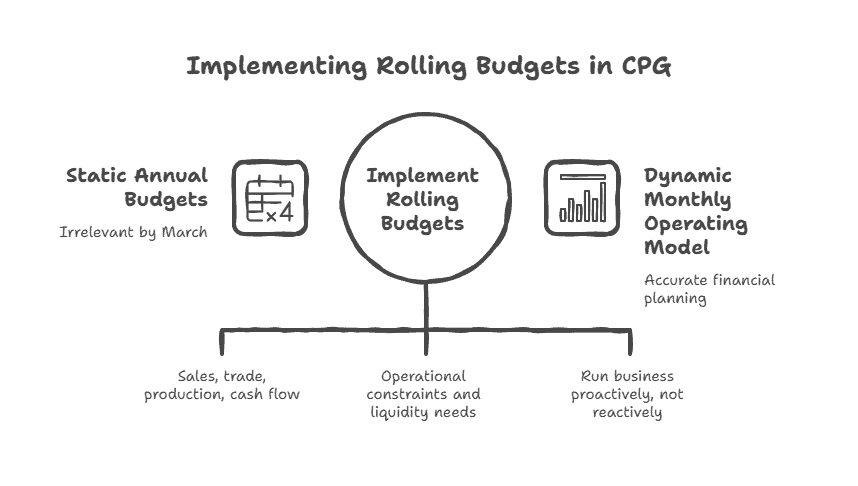
Most CPG companies treat budgeting as a once-per-year exercise that becomes irrelevant by March. These challenges are unique to the CPG industry, where a proper CPG budget is not a static spreadsheet — it is a rolling, month-by-month operating model that integrates sales velocity, retailer commitments, trade spend, production timing, freight, deductions, hiring plans, and cash flow.
A CFO-grade budgeting framework aligns revenue drivers with operational constraints and liquidity needs, enabling leadership to run the business proactively instead of reactively. This type of framework is essential for managing the complex operations typical in the CPG sector, where multiple variables and rapid changes require specialized tools for accurate financial planning, such as driver-based models.
Why Annual Budgets Fail in CPG: The Role of Revenue Growth Management
The traditional annual budgeting process — build in Q4, approve in December, lock for the year — fails spectacularly in CPG for reasons that seem obvious once stated but remain mysteriously persistent in practice.
We’ve consulted with a beverage company that spent 6 weeks building their 2024 budget in November 2023, achieved board approval in December, and watched it become obsolete by February when Whole Foods doubled their order volume while Kroger delayed a planned regional expansion. By April, when their co-packer announced a 12% price increase, the budget bore no resemblance to operational reality. Yet leadership kept measuring performance against these irrelevant numbers, creating organizational confusion and missed opportunities.
The fundamental problem: CPG businesses operate in environments where the three core drivers — retailer demand, input costs, and distribution capacity — change continuously. A static annual budget can’t accommodate this volatility. You need a dynamic operating model that updates monthly and projects forward 12–18 months. Structured planning cycles, involving cross-functional collaboration and regular review, are essential for adapting to ongoing changes. Equally important is ensuring strategic alignment between budgeting and operational execution, so that trade plans and business objectives remain consistent with overall corporate strategy.
The Six-Layer CPG Budgeting Framework
A robust CPG budget consists of six integrated layers that flow sequentially. Each layer depends on the preceding layers, creating a cascading financial model that reveals how operational decisions translate to financial outcomes. The six-layer framework is designed to address key features and key areas essential for effective cpg annual planning and budget allocation tools, ensuring comprehensive coverage from distribution to cash flow.
Layer 1: Distribution & Velocity Assumptions
Start with the foundation: which retailers will you be in, when will you launch, how many stores, and what velocity do you expect. This isn’t your sales forecast — it’s your distribution buildout roadmap. Incorporate bottom up planning by building detailed, retailer-specific distribution and velocity assumptions that align with broader strategic objectives and financial targets.
Example framework: – Q1: Maintain existing 1,850 stores across current retail partners – Q2: Add 275 Kroger stores (Southeast region launch, April 15 reset) – Q3: Add 180 Albertsons stores (West region, June 1 reset) – Q4: Add 320 Target stores (national launch, September 1)
For each retailer, forecast monthly velocity per store per SKU based on historical data, market basket analysis, promotional lift, and seasonal patterns. Your Whole Foods velocity might look like:
| Month | Base Velocity / Store / Week | Promotional Lift | Net Velocity |
|---|---|---|---|
| January | 8.2 units | 0% | 8.2 units |
| February | 8.5 units | 15% (Feb promo) | 9.8 units |
| March | 9.1 units | 0% | 9.1 units |
| April | 10.3 units | 0% | 10.3 units |
| May | 11.8 units | 25% (Memorial Day) | 14.8 units |
Multiply velocity per store by store count by weeks per month to get total unit volume. This becomes your revenue driver. Every other line item in the budget flows from this distribution and velocity model. Accurate sales forecasts at this stage inform the rest of the budget, supporting production, inventory, and financial planning.
Layer 2: Revenue Build by Channel and Deduction
Convert unit volume to gross revenue using retail pricing, wholesale multipliers, and distributor margins. But don’t stop at gross revenue — immediately model trade deductions to arrive at net revenue.
Gross Revenue Calculation: – Retail price: $6.99 – Retailer margin: 35% – Wholesale price to retailer: $4.54 – Distributor margin: 18% – Your net price to distributor: $3.73
Trade Deduction Model: – Off-invoice discounts: 5% of gross – Billback promotional allowances: 3% of gross – Slotting and marketing co-op: 8% of gross – Compliance deductions: 2% of gross – Total trade spend: 18% of gross
Trade promotion and promotional activities are key components here, as they directly impact trade spend and deductions, influencing net revenue and overall profitability.
For $100,000 in gross monthly revenue: – Gross revenue: $100,000 – Less off-invoice discount (5%): -$5,000 – Net invoiced revenue: $95,000 – Less deductions (13% of gross): -$13,000 – True net revenue: $82,000
Most CPG brands model gross revenue and wonder why their cash never matches projections. The 18–25% deduction rate means your true net revenue is 75–82% of what appears on invoices. Budget on net revenue to avoid systematic overstatement.
Layer 3: Production Timing and COGS
Revenue timing and production timing are disconnected in CPG. You must produce 6–10 weeks before retailer delivery, meaning production costs hit 6–10 weeks before revenue. Your budget must model this timing explicitly. Production plans and inventory levels are critical elements in this layer, ensuring manufacturing schedules align with sales forecasts and supporting efficient inventory management.
If April revenue is $850,000, your production budget looks backward: – April revenue requires production in February (8-week lead time) – February production volume: 850,000 ÷ $6.99 per unit = 121,602 units – February production cost at $1.95 COGS: $237,124
But you must also produce for May and June simultaneously: – May revenue forecast: $920,000 = 131,617 units – June revenue forecast: $1,100,000 = 157,367 units (promotional month) – April production run: 131,617 units (for May delivery) – Total Q2 production: 410,586 units = $800,643 COGS deployed
This production timing model reveals your working capital requirement. In April, you’re deploying $800K in production costs while collecting revenue from February production. The timing mismatch creates the working capital need that most founders dramatically underestimate. Beyond production timing, out-of-stock events can dramatically compound this working capital strain — learn how to quantify and prevent OOS-related revenue loss.
Layer 4: Freight and Fulfillment by Channel
Freight costs vary dramatically by customer and order pattern. Budget freight separately by channel using actual cost per case or cost per pound based on historical data.
Freight Budget Example:
| Channel | Cases / Month | Cost / Case | Monthly Freight |
|---|---|---|---|
| UNFI (West) | 2,400 | $3.20 | $7,680 |
| KEHE (East) | 1,800 | $3.85 | $6,930 |
| DTC / Small | 350 | $8.50 | $2,975 |
| Total | 4,550 | — | $17,585 |
Freight as percentage of net revenue varies by channel: – Large distributor deliveries: 3–5% of net revenue – Direct-to-retailer small orders: 7–10% of net revenue – DTC individual shipments: 15–25% of net revenue
Budget freight explicitly by channel. A 10% DTC revenue mix vs. 3% creates a 150 basis point gross margin difference that compounds into six-figure annual impact.
Layer 5: Operating Expenses with Growth-Driven Scaling
Operating expenses aren’t fixed — they scale with growth, but not linearly. Build your operating expense budget with clear scaling triggers based on revenue thresholds.
Headcount Scaling Model: – $0–3M revenue: Founder + 2 operations staff – $3M–7M revenue: Add 1 sales lead + 1 operations coordinator – $7M–12M revenue: Add 1 marketing manager + 1 customer service lead – $12M+ revenue: Add 1 finance/accounting manager (For more on effective headcount planning, see the Fractional CFO Framework on CFO Pro Analytics.)
Each threshold represents a 40–60 day ramp period where the new hire isn’t fully productive but costs are fully deployed. Budget the hire date 90 days before you hit the revenue threshold to ensure the person is productive when demand arrives.
Software and Systems Scaling: – $0–2M: Basic QBO + spreadsheets ($150/month) – $2M–5M: Inventory management system ($800/month) – $5M–10M: NetSuite or similar ERP ($2,400/month) – $10M+: Advanced retail analytics tools ($1,200/month)
Modern software and systems help drive efficiency and enable users to manage complex budgets, automate data flows, and reduce manual workload as the business scales.
Marketing Budget as Percent of Revenue: – Pre-revenue (launch phase): 15–20% of projected first-year revenue – $0–2M revenue: 20–25% of net revenue – $2M–5M revenue: 18–22% of net revenue – $5M–10M revenue: 15–18% of net revenue – $10M+ revenue: 12–15% of net revenue
Budget operating expenses with conditional logic tied to revenue milestones. This prevents the common mistake of scaling costs too early (burning cash) or too late (constraining growth).
Layer 6: Cash Flow with Working Capital Requirements
The cash flow layer integrates timing disconnects across all previous layers. Revenue, COGS, and operating expenses all have different timing patterns that create cash flow volatility independent of profitability.
Monthly Cash Flow Build:
Cash Inflows:– Retailer payments (revenue from 60–90 days prior) – Distributor payments (revenue from 30–45 days prior) – DTC revenue (immediate)
Cash Outflows:– Production costs (for revenue 60–90 days forward) – Ingredient/packaging suppliers (Net 30) – Freight (Net 15–30) – Payroll (monthly) – Rent and utilities (monthly) – Marketing and advertising (varies) – Trade spend settlements (quarterly)
Example: March Cash Flow
Inflows: – January retailer payments arriving: $580,000 – February distributor payments arriving: $240,000 – March DTC sales: $45,000 – Total cash in: $865,000
Outflows: – May production (8-week lead): $420,000 – Ingredient suppliers (March Net 30): $180,000 – Freight (February/March): $32,000 – Payroll: $85,000 – Rent, utilities, insurance: $18,000 – Marketing: $75,000 – Q1 trade spend settlement: $165,000 – Total cash out: $975,000
Net cash flow: -$110,000
Even though March P&L shows profitability, cash flow is negative due to working capital deployment for May revenue and Q1 trade spend settlement. This is why profitable CPG companies run out of cash — the budget must model cash timing, not just P&L.
Building Rolling 12-Month Forecasts for Improved Forecast Accuracy
Static annual budgets become obsolete quickly. Replace them with rolling 12-month forecasts that update monthly with actual performance and revised assumptions, enabling smarter decisions by incorporating the latest information.
Month 1–3 (Months Already Completed):Replace budget assumptions with actual results. January budget assumed 8,200 units sold — actual was 9,100 units. Lock actual performance.
Month 4 (Current Month):Blend actual month-to-date performance with remaining days forecast. If you’re 15 days into April with 5,400 units sold and 15 days remaining, forecast month-end at ~7,800 units based on current velocity.
Month 5–7 (Near-Term Future):Update assumptions based on confirmed retailer orders, scheduled promotions, and seasonal adjustments. April retailer orders indicate May delivery volume. Confirmed June promotional calendar drives June forecast.
Month 8–12 (Extended Forecast):Maintain strategic assumptions but update for known changes. If Target launch moved from September to November, shift the associated revenue and costs accordingly.
Month 13–18 (Strategic Planning Horizon):Maintain directional forecast for strategic initiatives, capacity planning, and financing needs. This extended view reveals long-term working capital requirements and guides major investment decisions.
The power of rolling forecasts: they incorporate learning continuously, supporting smarter decisions as you adapt to new data. When February comes in 12% above forecast, you immediately understand whether that’s sustainable velocity improvement (adjust March–December forecast up) or one-time promotional lift (don’t adjust future months). Rolling forecasts also help ensure all teams are working toward the same goals by aligning updated assumptions and targets across departments. Static budgets can’t accommodate this learning.
Data Integration for CPG Companies
For consumer packaged goods (CPG) companies, automated data integration is no longer a luxury—it’s a necessity for driving revenue growth and staying competitive. By seamlessly connecting sales data, financial planning, and supply chain planning, CPG organizations gain real-time visibility into their operations and can make smarter, data-driven decisions. Integrated data enables finance teams to monitor key metrics such as trade spend, forecast accuracy, and market trends, providing a holistic view that supports strategic priorities and resource allocation.
With robust data integration, CPG companies can break down silos between departments, ensuring that everyone—from sales to supply chain to finance—is working from the same set of numbers. This unified approach not only improves forecast accuracy and supply chain efficiency but also enhances the customer experience by enabling faster response to market shifts. Ultimately, leveraging automated data integration empowers CPG companies to optimize financial performance, identify growth opportunities, and maintain a competitive edge in a rapidly evolving market.
Variance Analysis That Actually Matters
Budget variance reports are useless if they compare actuals to stale assumptions from six months ago. Structure variance analysis around the three questions that drive decisions:
Question 1: What Changed vs. Last Month’s Forecast?
Compare April actuals to the April forecast you built in March, not the April budget you built last October. This reveals forecast accuracy and highlights where assumptions failed.
Example variance: – Forecasted April revenue (built March 15): $920,000 – Actual April revenue: $875,000 – Variance: -$45,000 (-4.9%)
Root cause analysis: – Kroger order delayed 2 weeks due to DC capacity: -$30,000 – Whole Foods velocity down 8% (Easter timing shift): -$22,000 – Sprouts order increased 15% (promotional success): +$7,000
This analysis reveals that two-thirds of the variance was timing-related (Kroger delay) while one-third was velocity-related (Whole Foods softness offset by Sprouts strength). Implication: May forecast should shift up $30,000 for delayed Kroger volume, but maintain conservative Whole Foods assumptions.
Question 2: How Does This Change Our Full-Year Outlook?
Each month’s variance informs your full-year forecast. If April’s variance was timing-based, the revenue shifts to May but full-year guidance doesn’t change. If April’s variance was velocity-based, full-year guidance adjusts.
Calculate full-year impact: – April timing variance (Kroger delay): $0 full-year impact – April velocity variance (Whole Foods softness): -$22,000 × 8 months remaining = -$176,000 full-year impact
Updated full-year forecast: – Original budget: $11.2M – Adjust for April learning: -$176,000 – Revised forecast: $11.02M
This continuous recalibration keeps your full-year outlook accurate and prevents the “surprise” year-end misses that destroy credibility.
Question 3: What Actions Do We Take Based on This Variance?
Variance analysis without action is just scorekeeping. Structure your variance review around required decisions.
April variance implications: – Whole Foods velocity down 8% → Schedule joint business planning meeting to review shelving, pricing, and promotional strategy – Kroger delay of 2 weeks → Adjust May production schedule to match delayed delivery (save working capital) – Sprouts promotional success → Evaluate expanding promotional frequency with Sprouts buyer
Variance analysis should trigger specific actions within 48 hours of month-end close. Otherwise, you’re documenting past performance without influencing future results.
Scenario Planning for Volatility
CPG budgets must accommodate volatility through explicit scenario planning. Build three versions of your budget simultaneously:
Conservative Case (70% Probability):
– New retail launches delayed 60 days – Existing velocity flat to down 5% – Trade spend increases 2 percentage points – Input costs increase 5% – Achieves profitability but requires working capital management
Base Case (50% Probability):
– New retail launches on planned timeline – Existing velocity up 8–12% – Trade spend stable – Input costs increase 3% – Achieves healthy profitability and generates positive cash flow
Aggressive Case (20% Probability):
– New retail launches accelerate 30 days – Existing velocity up 18–25% – Trade spend leverage improves – Input costs stable – Achieves strong profitability but requires working capital to fund growth
These scenarios aren’t just modeling exercises — they’re decision frameworks. The conservative case determines your minimum staffing levels and fixed cost commitments. The base case guides operational planning and hiring. The aggressive case identifies the capacity constraints that could limit growth if opportunity exceeds expectations.
Performance Metrics and Benchmarking
Tracking the right key metrics and benchmarking against industry standards are essential practices for CPG companies aiming to maximize performance and market share. Core metrics such as revenue growth, cash flow, category management effectiveness, and trade investments provide a clear picture of financial health and operational efficiency. By regularly analyzing these data points, CPG companies can spot trends, evaluate the impact of their strategies, and make informed, data-driven decisions.
Benchmarking these metrics against industry standards and market trends allows CPG companies to identify gaps and opportunities for improvement. This process not only highlights best practices but also ensures that resource allocation aligns with strategic goals. By understanding how their performance stacks up against peers, CPG companies can refine their approach to category management, optimize trade investments, and drive sustainable revenue growth.
Aligning Budgets with Strategic Priorities
Your budget translates strategy into resource allocation. If your strategic priority is expanding retail distribution, the budget must reflect:
Strategic Investment Required:
– Increased broker commissions (2% of gross sales in new regions) – Trade show and buyer meeting travel ($35K annually) – Slotting fees for new retailers ($15K–$45K per retailer) – Promotional launch support (10–15% of first 90 days sales) – Additional working capital for pipeline fill ($80K–$180K per major retailer)
Expected Return Timeline:
– Month 1–3: Pure investment, negative cash flow – Month 4–6: Revenue begins, still negative cash flow – Month 7–9: Revenue accelerates, approaching breakeven – Month 10+: Positive contribution margin and cash flow
Budget these investments explicitly with monthly granularity. Leadership needs to understand that a Q2 retail expansion decision creates Q2 and Q3 cash consumption that doesn’t generate positive cash flow until Q4. Many CPG brands launch new distribution without budgeting the 6–9 month cash consumption period, leading to preventable cash crises.
Best Practices
To achieve operational excellence and drive revenue growth, CPG companies should adopt a set of proven best practices. First, implementing a robust data integration system is critical—automated data collection and analysis streamline reporting and provide actionable insights across the organization. Regular variance analysis is another best practice, enabling teams to quickly identify deviations from plans and adjust strategies to improve financial performance.
Cross-functional alignment is also essential. Finance teams, sales, and supply chain must collaborate closely to ensure that demand planning, production scheduling, and sales forecasting are all working toward the same strategic objectives. Investing in advanced software solutions for supply chain management, demand planning, and production scheduling further enhances agility and responsiveness to changing market conditions. By embedding these best practices into their operations, CPG companies can make more informed decisions, optimize resource allocation, and position themselves for sustained growth.
Common Mistakes
Despite their best intentions, CPG companies often fall into common traps that undermine growth and profitability. One frequent mistake is failing to regularly update assumptions and plans, which can result in outdated forecasts and missed opportunities to respond to shifting market conditions. Another pitfall is overlooking the financial impact of operational decisions on cash flow and the balance sheet, leading to liquidity challenges even when the P&L looks healthy.
Relying too heavily on historical data without considering current market dynamics can also hinder responsiveness and innovation. Additionally, neglecting HR strategies—such as timely hiring plans and employee development—can limit a company’s ability to scale and adapt. By recognizing these common mistakes and proactively addressing them, CPG companies can safeguard their financial health, improve decision-making, and support sustainable growth.
Continuous Improvement
Continuous improvement is the cornerstone of long-term success for CPG companies. This means regularly reviewing and refining plans, strategies, and processes to ensure they remain aligned with evolving market conditions and business objectives. Embracing digital transformation—through predictive models, what-if analysis, and advanced analytics—enables CPG companies to enhance forecasting accuracy and quickly adapt to new challenges.
Tracking progress against key metrics and industry benchmarks helps identify areas for improvement and measure the effectiveness of changes. By fostering a culture of continuous improvement, CPG companies can drive revenue growth, stay ahead of competitors, and ensure their strategies and operations are always optimized for the current environment. This proactive approach not only supports better financial performance but also positions CPG companies to capitalize on new opportunities as they arise.
FAQ: CPG Budgeting Framework
How detailed should our SKU-level budgeting be?
Budget revenue by SKU for any product representing >10% of revenue or >15% of volume. Aggregate smaller SKUs into categories. Complete SKU-level detail creates complexity without improving decisions. Focus granularity where it matters: hero products, new launches, and high-volume items.
Should we budget by retailer or aggregate?
Budget separately for any retailer representing >15% of revenue. Aggregate smaller retailers by channel type (natural retailers, conventional grocery, club, etc.). Retailer-level budgeting reveals concentration risk and enables account-specific variance analysis.
How do we budget trade spend accurately?
Budget trade spend as a percentage of gross revenue by retailer based on historical rates and planned promotional calendar. Most retailers require 18–30% total trade spend. To effectively measure marketing spend ROI for medspas and clinics, track off-invoice discounts (immediate impact) separately from deduction-based trade (45–90 day lag).
What if we’re pre-revenue or launching new products?
Use industry benchmarks and comparable product velocity data. A new yogurt SKU in Whole Foods will likely achieve 60–80% of the velocity of your existing yogurt SKUs after a 12-week ramp period. Build conservative, base, and aggressive scenarios to bound possibilities.
How often should we update our budget?
Update rolling 12-month forecast monthly within 5 business days of month-end close. Update full-year strategic outlook quarterly. Update 3-year strategic model annually. Monthly updates keep forecasts relevant while avoiding constant chaos.
What budget variance triggers reforecasting?
Reforecast when: (1) any month varies >15% from forecast, (2) consecutive months vary >8% in the same direction, (3) full-year outlook shifts >10%, or (4) major business event occurs (new major retailer, lost customer, input cost shock). Small variances don’t require full reforecasting.
Should marketing be fixed or variable?
Budget marketing as percentage of revenue (15–22% for growth-stage CPG) but set monthly minimums. If revenue underperforms, marketing might stay fixed to defend market position. If revenue overperforms, marketing can scale up. Purely variable marketing creates pro-cyclical death spirals.
How do we budget for seasonality?
Apply seasonal indices by month based on historical POS data. If July represents 115% of average monthly sales, budget July at 115% of annual average. Production must lead revenue by 8–12 weeks, so budget June production at 115% to support July sales.
What key metrics should we track against budget?
Track: (1) revenue vs. budget by channel, (2) gross margin vs. budget (net of trade spend), (3) cash flow vs. budget, (4) velocity per store vs. forecast, (5) working capital deployed vs. budget. These five metrics reveal whether you’re on track operationally, financially, and strategically.
How do we present budget variance to the board?
Create one-page dashboard showing: (1) current month actual vs. forecast, (2) YTD actual vs. budget, (3) updated full-year forecast vs. original budget, (4) key variance drivers, (5) forward-looking risks and opportunities. Focus on decisions required, not historical explanations.
Further Reading
Browse more articles in the CFO Pro+Analytics Knowledge Base for in-depth financial frameworks, models, and strategies tailored to your business.
Ready to take action? Explore our FP&A Services → to see how we partner with founders and operators to build financial clarity.
