Building a Financial System for Omnichannel CPG Growth
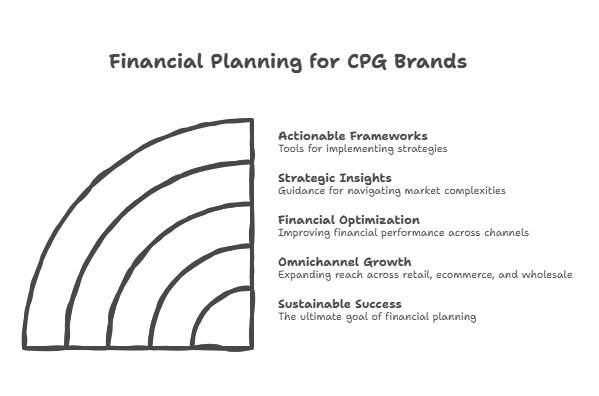
Omnichannel CPG brands fail not because their products aren’t good, but because their financial infrastructure can’t keep up with multi-channel complexity. The consumer packaged goods industry is economically significant and highly complex, with brands facing unique challenges in managing diverse channels, shifting market dynamics, and intense competition. Contribution margin varies dramatically by channel, trade spend behaves differently online vs. offline, cash cycles diverge, forecasting breaks, and operational costs escalate when channels are not aligned. A CFO playbook must establish channel-level P&Ls, shared cost allocation rules, unified demand planning, consistent contribution margin targets, and a financial architecture that connects retail, ecommerce, Amazon, distributor, and wholesale operations into one coherent system.
Robust financial systems are essential for CPG brands to thrive in this environment. Advanced FP&A solutions are enabling companies to proactively adapt to industry changes, improve forecasting, and optimize operations across departments. For emerging CPG brands, financial mastery and operational efficiency are especially critical to achieve profitability and sustainable growth.
Introduction to Consumer Packaged Goods
The consumer packaged goods (CPG) industry is a cornerstone of the global economy, encompassing everything from food and beverages to household products and personal care essentials. CPG brands are tasked with meeting the ever-changing needs of consumers, who are influenced by shifting trends, evolving preferences, and rising expectations for quality, convenience, and value. In this dynamic environment, effective financial management is not just a back-office function—it’s a strategic imperative.
CPG companies must navigate a landscape marked by frequent supply chain disruptions, volatile raw material costs, and intense competition. Pricing strategies must be agile, responding to both market pressures and consumer demand, and grounded in a rigorous CPG pricing strategy focused on margin and elasticity. Inventory management becomes a balancing act: too little inventory risks stockouts and lost sales, while too much ties up working capital and increases storage costs, underscoring the need for a robust CPG inventory replenishment model. The ability to anticipate consumer trends and adapt quickly is what separates industry leaders from the rest.
To remain competitive, CPG brands need robust financial systems that provide real-time visibility into business operations, enable informed decisions, and support growth across multiple channels. By implementing a disciplined month-by-month CPG budgeting framework and understanding the unique challenges and opportunities within the CPG industry, finance leaders can develop strategies that drive operational efficiency, optimize cash flow, and position their brands for long-term success.
The Omnichannel Illusion: One Brand, Multiple Businesses
The modern CPG brand is expected to be everywhere: on the shelf at Target, in the search results on Amazon, in the social media ad leading to a direct website purchase, and in the curated box of a specialty subscription service. This “omnichannel” presence is celebrated as the path to maximum growth and brand resilience. However, from a financial and operational standpoint, each of these channels operates as a fundamentally different business with its own economics, rules, and rhythms.
The illusion is that these are just different storefronts for the same product. The reality is that selling a unit on your own website (direct to consumer), through Amazon FBA, and to a national grocery chain are three distinct commercial transactions. They have different: Revenue Realization: Direct to consumer keeps ~85% of retail price; Amazon keeps ~70%; Grocery keeps ~45%. Variable Cost Structure: Direct to consumer has high CAC and requires careful tracking of direct costs beyond just COGS, including marketing, logistics, and customer service; Amazon has referral fees and FBA costs; Grocery has trade spend and slotting, each with their own direct costs that must be understood for accurate financial planning. Cash Conversion Cycles: Direct to consumer is immediate; Amazon is ~2 weeks; Grocery is 60-90+ days. Operational Requirements: Direct to consumer requires pick/pack/ship; Amazon requires compliance and prep; Grocery requires palletization and EDI.
When a brand attempts to manage these channels with a single, blended P&L and a generic operations plan, it becomes financially blind. Profits from one channel subsidize losses in another. Cash generated online is sucked into financing offline inventory growth. Decisions are made based on blended averages that mask severe inefficiencies in specific channels. The result is a brand that grows top-line revenue while eroding bottom-line profitability and burning through cash. The CFO’s first job in an omnichannel world is to break the illusion and build a financial system that sees, measures, and manages each business unit within the brand.
The Five-Pillar Omnichannel Financial Architecture
To scale profitably, you need an integrated financial model built on these five pillars. For CPG brands, accurate forecasting and more accurate forecasting are essential for strategic decision-making and maintaining competitiveness in a fast-moving market.
- Unified demand planning and inventory model: This model should incorporate demand forecasting to predict sales, seasonal trends, and retailer demand, which helps optimize inventory and improve cash flow. By integrating these insights, you can better align production and purchasing with actual market needs.
- Inventory as both asset and liability: Inventory levels must be carefully managed, as holding too much or too little can impact cash flow and profitability. Optimizing inventory ensures you meet consumer demand while minimizing excess stock and reducing the risk of stockouts.
- Inventory planning: Minimum order quantities play a significant role in determining inventory levels and cash flow, especially given the supply chain complexities and long production cycles common in CPG. Balancing order size is crucial to avoid tying up too much capital or running out of product during peak demand.
- Channel-level forecasting: When splitting the total brand forecast by channel, it’s important to forecast demand accurately to avoid overstocking or understocking, which can lead to lost sales or unnecessary markdowns.
- Real-time analytics and scenario planning: Leveraging data-driven tools and predictive analytics supports more accurate forecasting, enabling proactive adjustments to your financial plan as market conditions change.
Pillar 1: The Channel-Level P&L (The “Truth Machine”)
You must be able to see profitability for each major channel independently. A blended “Gross Margin” is meaningless.
Structure for Each Channel (DTC, Amazon 1P, Amazon 3P, Retail Grocery, Retail Mass, Wholesale/Distributor):
Gross RevenueLess: Channel-Specific Discounts & Allowances (Coupons, Promo Codes, Trade Terms) = Net RevenueLess: COGS (Fully loaded, including any channel-specific packaging and accurate tracking of product costs, which is essential for informed financial decision-making and overall profitability) = Gross ProfitLess: Fulfillment & Logistics Cost (Shipping to customer, FBA fees, Freight to DC) = Contribution Margin 1Less: Channel-Specific Variable Marketing (DTC CAC, Amazon Ads, Retailer-Specific Promo Allowances) = Contribution Margin 2 (The Key Metric)
This tells you the true profit of each channel before allocating shared overhead (salaries, rent, software). CM2 is what you use to compare channel health and make investment decisions.
Pillar 2: The Unified Demand Planning & Inventory Management System Model
Inventory is your largest asset and liability. It must be managed as a single, pooled resource across all channels.
Centralized Inventory Master: One system (or integrated spreadsheet) that shows total units on hand, in production, and in transit, allocated tentatively to each channel’s forecast. An inventory management system can help track and update inventory levels and costs, but it’s important to supplement software data with manual review for accuracy. When calculating landed costs and planning inventory, regularly review raw materials costs, as fluctuations in raw materials prices can significantly impact your overall cost calculations.
Channel-Agnostic Forecasting: Start with a total brand forecast, then split it by channel based on historical mix and growth plans. The sum of channel forecasts drives your total production plan.
Dynamic Re-Allocation Rules: Establish rules for shifting inventory between channels. If DTC demand spikes, you can pull from allocated retail inventory (and understand the margin trade-off). If an Amazon promotion is underperforming, you can redirect to DTC.
Pooled Safety Stock: Calculate safety stock at the total brand level, not per channel. This reduces total inventory by 20-40% compared to siloed planning.
Pillar 3: The Integrated Cash Flow Management Engine
Cash cycles vary wildly. You need a forecast that models the timing of inflows and outflows across the entire business.
Weekly Cash In by Channel: Model DTC (daily deposits), Amazon (bi-weekly settlements), Retail (based on DSO terms). Unified Cash Out: Model production payments, marketing spend, and overhead against the blended inflows. Understanding and managing your cash flow needs is essential to balance inventory, secure financing, and avoid common pitfalls like stockouts or overstocking. The Core Insight: DTC and Amazon can become the working capital engine for the slower-paying, capital-intensive retail channel. The model shows how much cash the “fast” channels need to generate to fund the growth of the “slow” channels.
Pillar 4: The Shared Cost Allocation Framework
How do you allocate the CEO’s salary, the R&D cost, or the branding photoshoot? Arbitrary allocation distorts channel P&Ls.
Rule: Allocate based on driver of the cost. Not all costs need to be allocated. Keep them as unallocated “Corporate Overhead” until you have a principled reason. Examples:
Brand Marketing (Awareness): Allocate based on total channel revenue (benefits all). Sales Team Salaries: 100% to the specific channel they support (Retail, Amazon). Product Development: Do not allocate. This is a corporate investment in the future total brand. Warehouse Rent: Allocate based on the cubic footage or pick/pack units consumed by each channel. Goal: Get to a clean “Channel Contribution Margin,” then subtract a fair share of overhead to see true “Channel Operating Profit.”
Pillar 5: The Cross-Channel Investment & ROI Calculator
Every dollar spent should be evaluated on its marginal return across the entire system, not just within a channel.
Example – A DTC Facebook Ad: It drives a sale on your site (direct ROI). It also increases brand awareness, which may drive incremental search volume on Amazon and in-store purchases at retail (indirect lift). A balanced cpg marketing strategy is essential for CPG brands, ensuring effective budget allocation across digital and traditional channels to maximize reach and ROI.
Example – A Retail Endcap Promotion: It drives in-store sales. It also exposes new customers to the brand, who may later subscribe on your website. Building customer loyalty through consistent brand experiences and strong retail relationships is crucial for ensuring repeat purchases and maintaining market competitiveness.
The Model: Develop estimates for “cross-channel lift.” Allocate a portion of marketing spend to “Brand” (unallocated) and a portion to “Performance” (channel-specific). Use promo codes and trackback URLs to measure cross-channel impact where possible.
Cash Conversion Cycle: Accelerating Working Capital in Omnichannel
For CPG companies operating across retail, ecommerce, and wholesale, the cash conversion cycle (CCC) is a vital metric that directly impacts financial health and growth potential. The CCC measures how quickly a company can turn its inventory investments into cash, factoring in the time it takes to sell products and collect payments. In an omnichannel environment, where inventory is spread across multiple sales channels and consumer demand can shift rapidly, managing the cash conversion cycle becomes even more complex.
Effective cash flow management starts with accurate cash flow forecasting and scenario planning. CPG finance teams must anticipate fluctuations in consumer behaviors, seasonal demand, and market trends to avoid excess inventory and minimize storage costs. By leveraging deep industry knowledge and real-time data, companies can optimize inventory turnover, streamline operations, and reduce the time between inventory purchases and cash receipts.
Scenario planning allows CPG brands to model the impact of different business decisions—such as launching a new product line or entering a new market—on their working capital needs, especially when supported by a dynamic CPG budgeting framework for predictable growth. By proactively managing the cash conversion cycle and avoiding common CPG errors that kill cash flow, companies can free up cash for reinvestment, reduce reliance on external financing, and build a more resilient business capable of weathering supply chain disruptions and market volatility.
Accounts Payable and Accounts Receivable: Building a Resilient Backbone
Accounts payable (AP) and accounts receivable (AR) are the financial arteries of any CPG business, directly influencing cash flow, working capital, and overall financial stability. Efficient management of supplier payments and customer collections is essential for maintaining strong relationships and ensuring uninterrupted supply chain operations.
Many CPG companies face challenges with delayed supplier payments, missed early payment discounts, and slow customer collections, all of which can strain cash flow and increase the risk of supply chain disruptions. Implementing best practices—such as automating AP processes, setting clear payment terms, and offering flexible options to customers—can help streamline these critical business processes.
By optimizing accounts payable and accounts receivable, CPG brands can improve their working capital position, reduce the risk of financial bottlenecks, and enhance their ability to respond to market changes. A resilient AP/AR backbone not only supports day-to-day operations but also provides the financial stability needed to pursue growth opportunities and navigate periods of uncertainty.
Market Analysis and Consumer Behavior: Informing Financial Strategy
In the fast-paced CPG industry, understanding market trends and consumer behavior is essential for crafting a winning financial strategy. Consumer preferences are constantly evolving, shaped by factors such as health consciousness, sustainability, and the desire for convenience. CPG companies must stay ahead of these shifts to remain relevant and competitive.
Thorough market analysis enables brands to identify emerging opportunities, refine their product lines, and adjust pricing strategies to align with consumer expectations, while a disciplined trade spend ROI model ensures that promotional investments convert those insights into profitable growth. Leveraging real-time data, social media listening, and direct customer feedback allows finance teams to make informed decisions about promotional strategies, inventory management, and resource allocation.
By integrating insights from market analysis into financial planning, CPG companies can optimize their operations, reduce the risk of excess inventory, and ensure that investments are directed toward high-potential growth areas. This data-driven approach empowers brands to respond quickly to changing consumer behaviors and market dynamics, driving sustained business success.
Financial Statement Analysis for CPG Companies: Turning Data into Insight
Financial statement analysis and multi-layered financial reporting for CPG brands are powerful tools for companies seeking to transform raw data into actionable business insights. By closely monitoring key metrics such as gross margins, inventory turnover, and cash flow, finance teams can pinpoint areas for improvement and implement strategies to enhance financial management.
The CPG industry is subject to external pressures—including rising tariffs, supply chain volatility, and fluctuating input costs—that can significantly impact financial performance. Best practices in financial statement analysis involve not only tracking historical performance but also forecasting future trends and stress-testing assumptions under different scenarios.
A deep understanding of the CPG industry, combined with expertise in financial planning and analysis, enables companies to make informed decisions that drive profitability and long-term growth. By continuously refining their approach to financial reporting and analysis, CPG brands can stay ahead of market changes, optimize their business operations, and deliver value to both customers and stakeholders.
The Operating Rhythm: Managing the Omnichannel System Weekly
This architecture requires a new meeting cadence and set of reports.
Weekly Omnichannel Performance Meeting (CFO, Head of Ops, Channel Leads):
- Review Channel P&L Snapshots: Focus on Contribution Margin 2 % for each channel vs. target. What changed? 2. Inventory Health Dashboard: Weeks of supply per channel, sell-through rates, cross-channel transfer alerts. 3. Cash Flow Forecast Update: Confirm the fast channels are generating enough cash to fund the slow channels’ growth plans. 4. Cross-Channel Initiative Review: How did last week’s Amazon deal impact DTC traffic? How is the retail launch affecting overall brand search volume?
Monthly Deep Dive & Planning:
- Re-forecast by Channel: Update the 12-month rolling forecast for each channel and consolidate into the master production plan. 2. Review Shared Cost Allocations: Adjust as needed. 3. Calculate System-Wide Metrics:
Use these insights to guide negotiations on vendor terms from a financial lens so that payment terms, MOQs, and lead times support your cash and margin targets. Brand-Level Contribution Margin: Sum of all channels’ CM2. Weighted Average Cash Conversion Cycle: (DTC Days * DTC % Revenue) + (Amazon Days * Amazon % Revenue) + (Retail Days * Retail % Revenue). Return on Invested Capital (ROIC): Are we earning a good return on the total capital tied up in multi-channel inventory and assets?
The Strategic Levers: Using the System to Make Better Decisions
With this system in place, you can move from reactive chaos to strategic choice.
Lever 1: Channel Mix Optimization. If Retail CM2 is 15% and DTC CM2 is 25%, the model shows the financial impact of shifting $100,000 of marketing spend from retail promotions to DTC acquisition. Lever 2: Pricing & Promotion Strategy. You can model the impact of a DTC price increase knowing it might push some volume to Amazon or retail, and calculate the net effect on total brand profit. Lever 3: New Channel Entry Analysis. Entering a new retailer (e.g., Club) is no longer a guess. You model it as a new “channel P&L” with projected slotting, terms, volume, and CM2, and see its impact on total cash flow and inventory needs before signing the deal. Expanding into new markets through additional distribution channels is a critical part of a CPG brand’s growth strategy and requires careful inventory management to support increased sales reach. Lever 4: Supply Chain Financing. You can confidently use faster-turn DTC cash as collateral for a line of credit to pre-fund a large retail production run, because your model proves the cash will be replenished.
The omnichannel brand that wins is not the one with the most channels, but the one with the best financial nervous system connecting them. It is a brand that knows the cost and value of every customer interaction, regardless of where it occurs. It makes trade-offs with eyes wide open, funds growth from its own operations, and presents a coherent, profitable financial story to the market. This is the ultimate CFO mandate in the modern CPG era: to be the architect of the financial engine that turns omnichannel complexity from a threat into a decisive, scalable advantage.
FAQ
Q1: We’re early-stage and don’t have the resources for complex systems. What’s the minimum viable omnichannel finance model?
Start with three spreadsheets: 1) A Channel P&L Tracker with just three lines per channel: Net Revenue, COGS, and key variable cost (CAC for DTC, Amazon fees for Amazon, Trade % for Retail). Calculate a simple Contribution Margin. 2) A Consolidated Inventory Tracker that lists all inventory and manually allocates it to channels. 3) A Basic Cash Flow Forecast that separates cash in by channel (DTC=immediate, Retail=60 days). This simple trio forces the discipline of channel-level thinking and reveals major leaks without complex software.
Q2: How do we handle channel conflict, especially on pricing, when we see each channel’s P&L separately?
Transparency is key. Set a Minimum Advertised Price (MAP) policy to protect retail partners. Your DTC channel can offer value-added bundles (subscription, gift sets) or exclusive products at the same MAP to avoid undercutting. Use the financial model to show retail buyers that your DTC channel, with its higher margin, funds marketing that increases total brand demand, benefiting their shelves. Frame DTC as a brand-building and margin-rich “lab,” not a discount competitor.
Q3: Our team is siloed by channel (DTC team, Amazon team, Retail team). How do we get them to think and operate in an integrated way?
Implement two simple practices: 1) Share the Channel P&L Data: Show each team their own Contribution Margin and how it fits into the whole. Tie a portion of their bonus to total brand profit, not just their channel’s revenue. 2) Hold the Integrated Weekly Meeting: Force collaboration by having the DTC lead explain how the retail launch is affecting their website traffic, and the retail lead explain how DTC social campaigns are supporting in-store sales. Create shared goals, like “Increase total brand household penetration by X%,” which requires all channels to win.
Further Reading
Browse more articles in the CFO Pro+Analytics Knowledge Base for in-depth financial frameworks, models, and strategies tailored to your business.
Ready to take action? Explore our Fractional CFO Services → to see how we partner with founders and operators to build financial clarity.
Further Reading
- Understand how tariffs affect CPG financial strategy and e-commerce
- Our perspective on CPG and e-commerce finance covers the macroeconomic factors
