How to Model Provider Productivity for Maximum Profits
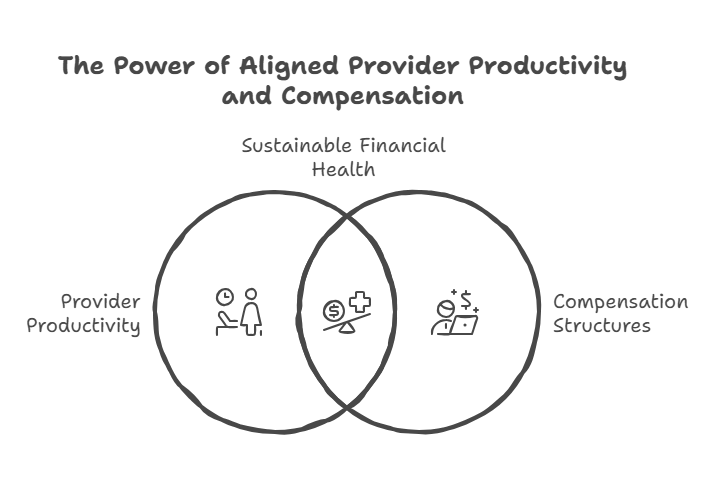
Most medspas and healthcare practices pay providers based on industry benchmarks, gut feeling, or “what it takes to hire them.” This creates misaligned incentives, margin compression, and unpredictable profitability. A true compensation model ties provider pay directly to contribution margin, utilization, and economic value—turning providers from cost centers into scalable profit centers. Compensation alignment ensures provider incentives support the organization’s goals and improves recruitment and retention by offering tailored, transparent compensation packages.
Why Most Provider Compensation Models Are Broken
When we review compensation structures, we find:
1. Flat Salary with No Performance Link– Providers paid the same whether they generate $400 or $800/hour – No incentive to optimize schedule or service mix – High fixed cost regardless of productivity
2. Pure Commission That Encourages Bad Behavior– High % commissions drive over-treatment – Providers chase volume over margin – Patient satisfaction and retention suffer
3. Inconsistent Structures Across Locations– Same role, different pay in different sites – Internal equity issues and turnover risk – Impossible to scale predictably
4. No Link to True Economic Contribution– Compensation disconnected from actual profitability of services – Providers rewarded for revenue, not margin
The result? Providers whose financial interests aren’t aligned with the practice’s profitability. A fragmented compensation structure can undermine provider engagement and satisfaction, making it harder to retain top talent and achieve organizational goals.
The 5 Components of a CFO-Grade Compensation Model
- Base Salary: The Foundation of Stability2. Productivity Component: Aligning Effort with Output3. Profitability Component: Rewarding Margin, Not Just Revenue4. Quality & Retention Metrics: Protecting the Long Term5. Scalability Structure: Designing for Growth
Let’s build this from the ground up.
1. Base Salary: How Much Guarantee Is Appropriate?
Base salary should cover: – Market competitiveness – Provider’s experience and credentials – Minimum expected clinical hours
Formula:$$text{Base Salary} = text{Market Rate} times text{Experience Factor} times text{Location Factor}$$
Example: Experienced NP Injector– Market rate: $120,000 – Experience factor: 1.15 (15% premium for 5+ years) – Location factor: 1.10 (high-cost market)
Base salary = $120,000 × 1.15 × 1.10 = $151,800
Rule of thumb: Base should be 50–70% of total target compensation for most providers.
Contracts should clearly define base salary and bonus eligibility to ensure transparency and alignment with organizational goals.
2. Productivity Component: Paying for Output
Productivity pay should reward: – Clinical hours worked – Revenue generation – Efficient use of time
Best Practice: Tiered Revenue per Hour Bonus
| Revenue/Hour | Bonus per Productive Hour | |——————-|——————————-| | $400–$500 | $10 | | $501–$600 | $20 | | $601–$700 | $30 | | $701+ | $40 |
Why this works:– Encourages providers to maximize each hour – Self-correcting—low utilization = low bonus – Easy to calculate and communicate
Data on clinical hours and revenue per hour is used to determine productivity bonuses and ensure providers are compensated fairly for their output, and a structured provider productivity modeling framework helps standardize how these metrics are tracked and applied. Straight salary models may not incentivize physicians to increase productivity or engage in organizational initiatives.
3. Profitability Component: The Most Important (and Missing) Piece
This is where compensation aligns with actual economic contribution
Method: Contribution Margin Bonus
Calculate: 1. Provider’s total contribution margin (Revenue – Direct Costs) 2. Set a target margin % (e.g., 60% for injectors) 3. Bonus a percentage of margin above target
Example:– Provider generates $800,000 annual revenue – Direct costs: $320,000 (40% COGS) – Contribution margin: $480,000 (60%) – Target margin: 55% – Margin above target: 5 percentage points – Bonus rate: 10% of margin dollars above target
Bonus = ($800,000 × 5%) × 10% = $4,000
Work relative value units (wRVUs) or relative value units (RVUs) can also be used to measure provider productivity and align compensation with contribution margin, supporting both transparency and fairness, but many medspa and healthcare practices get more leverage by focusing on revenue per provider productivity as a central metric.
This makes providers care about:– Consumables usage – Service mix optimization – Pricing integrity, which are the same operational levers highlighted in playbooks on improving provider profitability without adding headcount.
4. Quality & Retention Metrics: Protecting Your Asset
Compensation should reward what matters long-term, and pairing payouts with clear, behavior-based staff accountability KPIs turns the plan into a management system instead of just a paycheck:
A. Rebooking Rate Bonus– Target: 70–85% depending on service type – Bonus: $X per percentage point above target
B. Patient Satisfaction Score Bonus– Based on NPS or satisfaction surveys – Paid quarterly
C. Retention Bonus– Paid annually based on tenure – Encourages long-term commitment
Provider satisfaction and engagement are supported by transparent quality metrics and clear communication, which help providers feel confident in the fairness of their compensation.
5. Putting It All Together: The Total Compensation Formula
Example: NP Injector Compensation Model
Base Salary: $140,000
Productivity Bonus:– 1,400 clinical hours/year – Average revenue/hour: $650 – Bonus rate: $25/hour (tier 3) – Annual productivity bonus: 1,400 × $25 = $35,000
Profitability Bonus:– Annual revenue: $910,000 (1,400 × $650) – Contribution margin: 58% (vs. 55% target) – Bonus: ($910,000 × 3%) × 10% = $2,730
Quality Bonus:– Rebooking rate: 78% (vs. 75% target) – Bonus: 3 points × $500 = $1,500– Patient satisfaction: 4.8/5.0 – Bonus: $2,000
Total Target Compensation:$140,000 + $35,000 + $2,730 + $1,500 + $2,000 = $181,230
Physicians receive a combination of base salary and bonuses tied to productivity, profitability, and quality metrics, ensuring compensation alignment with organizational goals.
On-Target Earnings (OTE): $181,230 Variable at Risk: 23% ($41,230)
Why This Model Scales
- Predictable Cost Structure: Base salary is fixed, bonuses variable with performance 2. Alignment: Providers incentivized on margin, not just revenue 3. Fairness: Clear metrics, transparent calculation 4. Scalability: Same structure works across locations, with market adjustments
A unified compensation structure can be tailored to individual physicians and specialties, supporting workforce stability and the organization’s goals. A flexible compensation structure can be adapted for different specialties and individual physicians, ensuring alignment with workforce needs.
High provider utilization metrics were a critical input in redesigning incentives.
Case Study: Multi-Location Medspa Compensation Overhaul
Before:– Flat salaries across all injectors – No performance differentiation – Top performers leaving for commission-based roles – EBITDA margin stagnant at 18%
After Implementing CFO Model:– Base + variable structure – Clear metrics tied to margin and retention – Top performers earned 25–40% more – Lower performers either improved or left
The process of overhauling compensation involved reviewing contracts, collecting data, and engaging providers to create a model that supports value based models and improves recruitment, similar to building a driver-based financial model where each operational lever is explicitly tied to results.
Results (12 months):– Provider retention: 68% → 92% – Average revenue/provider: +31% – EBITDA margin: 18% → 24% – Voluntary turnover: 32% → 8%
Strategic CFO Insights
1. Compensation should be more variable as revenue per hour increases.
2. The best providers care about margin when it affects their paycheck.
3. Quality metrics prevent short-term gaming of the system.
4. A scalable model works for both new hires and seasoned veterans.
5. Total compensation should correlate directly with economic contribution.
Using a single source of data for compensation decisions helps providers feel confident in the fairness and transparency of the model, supporting provider engagement and satisfaction, and mirrors the disciplined data practices discussed in CFO blogs on financial insights and strategies.
FAQ
1. How much variable pay is appropriate?– Entry-level: 10–20% – Mid-career: 20–35% – Senior/High-revenue: 35–50%
**2. Should all providers have the same model?**No. Different models for: – Injectors (high revenue/hour) – Aestheticians (moderate revenue/hour) – Laser techs (device-dependent) – Hybrid medical providers
3. How often should we review compensation?– Quarterly for bonus calculations – Annually for base salary adjustments – Every 2–3 years for full model review
**4. How do private practice compensation models differ?**Private practice models often rely on revenue sharing after expenses, with compensation determined by collections minus costs. Stark Law prohibits paying physicians a percentage of collections for certain ancillary services, impacting what can be included in compensation.
Introduction to Provider Compensation
Provider compensation is at the heart of every successful healthcare system, shaping not only the financial health of medical groups and health systems but also the quality of patient care delivered. As the industry shifts from traditional fee-for-service payment models to value-based care, the way organizations reward physicians has become a strategic lever for driving patient satisfaction, improving patient outcomes, and achieving organizational goals.
Modern physician compensation models are designed to do more than simply pay for services rendered—they are structured to attract and retain top talent, support high performance, and align provider incentives with the broader mission of the organization. Effective compensation plans help ensure that physicians are motivated to deliver high-quality, patient-centered care, which in turn enhances retention and supports the long-term success of the healthcare organization.
The evolution of compensation models reflects a growing recognition that rewarding physicians solely based on volume can undermine quality and sustainability. Today, many organizations are adopting value-based compensation structures that balance productivity with quality metrics, patient satisfaction, and outcomes. This shift not only benefits patients but also positions healthcare organizations to thrive in a rapidly changing environment, where value and performance are paramount.
Operationalizing Provider Compensation
Turning a well-designed compensation model into reality requires more than just a spreadsheet—it demands a disciplined, transparent approach that aligns provider compensation with the organization’s strategic objectives. Operationalizing provider compensation starts with establishing clear, measurable performance metrics that reflect both productivity and quality, setting realistic targets, and ensuring that physicians understand exactly how their compensation is determined.
Transparency is key: when physicians see how their performance translates into compensation, trust and engagement increase. Regular feedback and open communication help providers track their progress and understand how their efforts contribute to organizational goals. Ongoing monitoring and evaluation are essential to ensure the compensation plan remains effective, allowing for timely adjustments as the healthcare landscape evolves.
By operationalizing provider compensation, healthcare organizations can foster a culture of accountability and continuous improvement. This approach not only boosts physician satisfaction and reduces turnover but also supports the transition from fee-for-service to value-based care models. Ultimately, a well-executed compensation model rewards physicians for delivering high-quality, patient-centered care—driving better patient outcomes and supporting the long-term success of the organization. It also gives finance leaders a cleaner story when aligning clinical incentives with strategic metrics like contribution margin, utilization, and revenue per hour—an approach that parallels how SaaS companies structure revenue KPI alignment from a fractional CFO perspective and is frequently explored in top CFO blogs for financial insights and strategies that cover forecasting, operational efficiency, and modern revenue models supported by fractional CFO-driven financial modeling.
Further Reading
Browse more articles in the CFO Pro+Analytics Knowledge Base for in-depth financial frameworks, models, and strategies tailored to your business.
Ready to take action? Explore our Fractional CFO Services → to see how we partner with founders and operators to build financial clarity.
