How to Use KPIs to Improve Healthcare Staff Performance
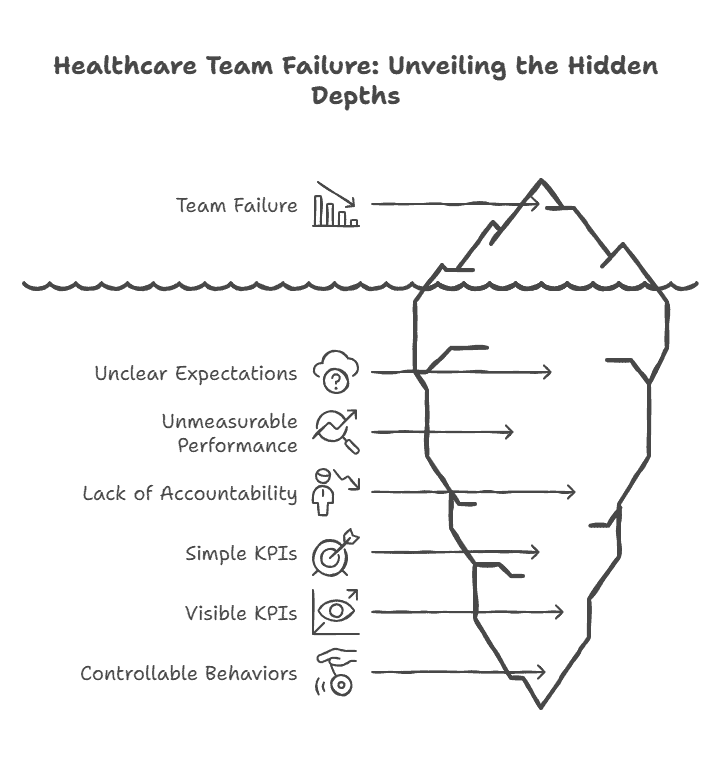
TL;DR: Most healthcare and medspa teams don’t fail for lack of effort — they fail because expectations are unclear, performance isn’t measurable, and accountability isn’t built into the daily workflow. KPIs solve this when they’re simple, visible, and tied directly to behaviors the frontline can control. We’ve seen practices raise provider productivity 15–30%, improve retention, stabilize staffing, and add 5–12 EBITDA points simply by implementing a clean KPI accountability system. Accountability is not punishment — it’s clarity, coaching, and alignment.
Why Most Practices Struggle With Accountability
We’ve worked with hundreds of healthcare and medspa operators, and the root cause of accountability problems is nearly always the same:
– Staff aren’t sure what “good” looks like.
– Providers think they’re busy, but utilization says otherwise.
– Front desk believes they’re converting well, but the data shows 40–50%.
– Managers “coach,” but the team doesn’t have metrics to anchor improvements.
– Ownership wants consistency but can’t measure consistency.
What looks like a people problem is almost always a visibility problem.
Accountability requires three conditions:
1. Clear expectations
2. Measurable performance
3. Consistent follow-through
KPIs are the operating system that makes this possible without micromanagement.
—
KPIs Are Not the Goal — Behavior Change Is
Too many businesses implement KPIs like a report card:
– Scores go up → praise
– Scores go down → frustration
This doesn’t improve performance. It just creates anxiety and gaming.
The real purpose of KPIs is:
> To make the right behaviors obvious, repeatable, and coachable.
When done right, staff stop guessing and start owning their results.
—
The 5 Rules of Accountability KPIs
Rule 1: Every KPI Must Be Behavior-Controllable
If the staff member cannot directly influence it, it’s not an accountability KPI.
Examples of bad accountability KPIs:
– Total revenue
– New patient volume
– Google reviews
Examples of good accountability KPIs:
– Provider rebooking rate
– Provider utilization
– Revenue per clinical hour
– Lead response time
– Membership enrollment rate
—
Rule 2: KPIs Must Be Simple Enough for Daily Use
We target 1–3 KPIs per role, no more.
—
Rule 3: KPIs Must Be Reported Consistently
Cadence that works:
– Daily: operational KPIs
– Weekly: scorecards + coaching
– Monthly: performance review
– Quarterly: strategic adjustments
—
Rule 4: KPIs Require Coaching, Not Policing
Weekly rhythm:
1. Review the KPI trend
2. Identify root causes
3. Coach to next steps
4. Reinforce wins
—
Rule 5: KPIs Must Connect to Compensation
Tie only the highest-value behaviors to pay.
—
Role-Based KPI Framework
Provider KPIs (Injectors, Aestheticians, MD/NP/PA)
1. Utilization
Target: Injectors 75–85%, Aestheticians 65–80%.
2. Revenue per Hour
Injectors: $600–$1,200/hr
Aestheticians: $150–$350/hr
3. Rebooking Rate
Target: 65–85%
—
Front Desk KPIs
1. Lead Response Time
Target: <5 minutes digital, immediate phone.
2. Conversion Rate
Target: 65–85%
3. Membership Conversion Rate
Target: 10–20%
—
Support Staff KPIs
1. Room Readiness Rate
Target: 95%+
2. Room Turnover Time
Target: <3–5 minutes
3. Chart Prep Compliance
Target: 100%
—
Manager KPIs
1. Location-Level EBITDA Margin
Medspa: 18–28%
Derm: 14–22%
2. Staffing Ratio Productivity
3. Operational Compliance Score
Target: 90%+
—
Case Study (Abbreviated)
After implementing KPI accountability:
– Utilization: 58% → 82%
– Revenue/hr: $480 → $715
– Response time: 22 min → 3 min
– Conversion: 48% → 76%
– EBITDA: 11% → 18%
Same staff. Same rooms. Different accountability.
—
FAQ
1. Should providers see each other’s KPIs?
Yes—transparency improves performance.
2. How do we avoid KPIs feeling punitive?
Coach, don’t punish.
3. How long does adoption take?
30–45 days for stability, 60–90 days for lift.
Further Reading
Browse more articles in the CFO Pro+Analytics Knowledge Base for in-depth financial frameworks, models, and strategies tailored to your business.
Ready to take action? Explore our BI & Analytics Services → to see how we partner with founders and operators to build financial clarity.
