Cash Flow Mistakes SaaS Startups Commonly Make
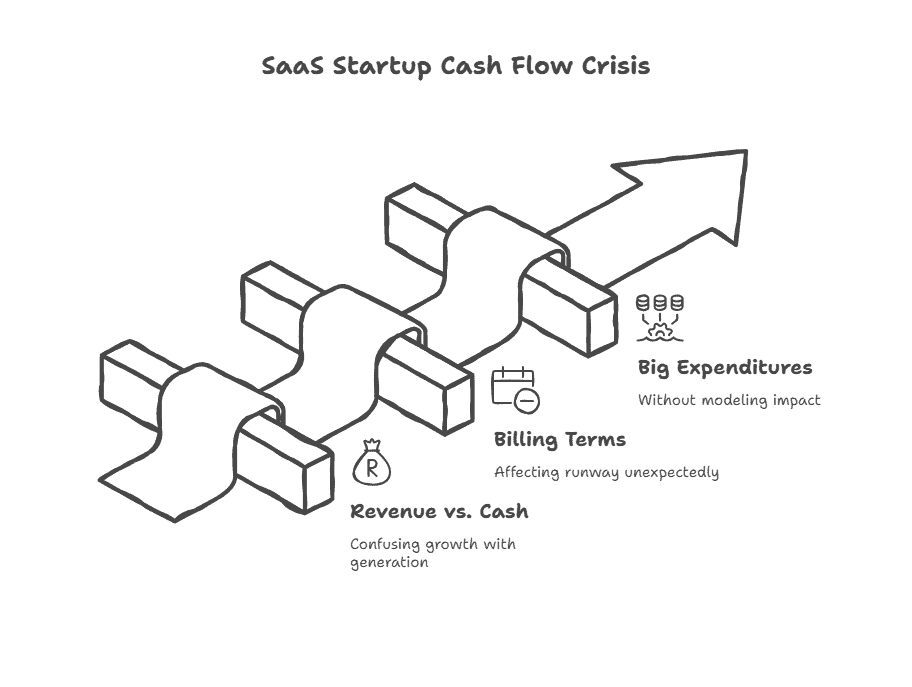
TL;DR: SaaS startups fail from cash flow problems more than anything else. They confuse revenue growth with cash generation, they don’t understand how billing terms affect runway, and they burn through months of cash on big expenditures without modeling the impact. The companies that survive track cash weekly, understand the lag between bookings and collections, and plan spending around actual cash timing rather than revenue recognition rules. Master cash flow management and you’ll survive the market conditions that kill your competitors. Poor collections is one of the most common cash flow mistakes SaaS startups make — and one of the most fixable with the right systems.
The Fatal Confusion: Revenue vs Cash
Every month, I talk with founders celebrating their growing revenue while they’re eight weeks from running out of money. The disconnect is brutal and it happens because SaaS accounting creates an optical illusion.
Here’s the problem: you close a $50K annual contract on January 15th. Your revenue grows by $4,167 monthly starting in January. Your bookings number for the month shows $50K. Your sales team gets credited with a win. The board deck shows accelerating growth.
But you don’t have $50K in cash. If the contract has net-30 payment terms, you might not get paid until March. If the customer negotiates quarterly payments, you get $12,500 in January, another $12,500 in April. If there’s a lengthy implementation process before invoicing, cash might not arrive until May.
Meanwhile, your expenses hit in real time. Payroll comes out January 15th. AWS bills on February 1st. The sales commission gets paid on February 5th. You’re spending real cash based on projected revenue that hasn’t arrived yet.
This is how companies with “strong growth” suddenly announce emergency layoffs. They optimized for revenue metrics while ignoring cash flow timing.
Mistake #1: Not Building a Cash Flow Forecast
Most SaaS startups have a P&L forecast. Fewer have a balance sheet forecast. Almost none have a proper cash flow forecast until they’re forced to build one during an emergency.
A cash flow forecast shows when money actually moves. It starts with your current cash balance, adds cash inflows by week (when will customers actually pay?), subtracts cash outflows by week (when do your bills come due?), and projects your ending cash balance.
Build this forecast weekly. Monthly is too coarse for an early-stage company burning $200K-400K monthly. By the time you realize there’s a problem in your monthly forecast, you’re two weeks from payroll with no money.
A proper 13-week cash flow forecast is usually part of a broader SaaS financial model that ties revenue, collections, headcount, and runway together, not just a standalone spreadsheet. Founders who want a deeper framework can explore a full SaaS financial modeling guide built from a fractional CFO perspective.
Here’s what a weekly cash flow forecast looks like in practice:
Week of Dec 1: Starting cash $450K, collections $85K, expenses $110K, ending cash $425K
Week of Dec 8: Starting cash $425K, collections $95K, expenses $105K, ending cash $415K
Week of Dec 15: Starting cash $415K, collections $75K, expenses $180K (payroll week), ending cash $310K
Week of Dec 22: Starting cash $310K, collections $60K, expenses $95K, ending cash $275K
Projected out 13 weeks, this forecast shows you exactly when you hit cash constraints. If week 10 shows ending cash of $125K and week 11 has $180K in expenses, you know you have a problem in 10 weeks, not when you’re 3 days from missing payroll.
Mistake #2: Ignoring Billing Terms and Collection Timing
Early-stage SaaS companies often give generous payment terms to close deals. Annual contracts with quarterly payments. Net-60 terms for enterprise customers. Deferred invoicing until implementation completes.
Each of these decisions affects cash runway, but most founders only think about booking the deal.
Let’s model this. You have $800K in the bank and $300K monthly burn. Your runway is 2.67 months, which is terrifying. You close three deals totaling $300K ARR, which is $25K in monthly revenue. Problem solved, right?
Wrong. If those deals are:
– Deal A: $100K annual paid upfront (cash arrives in 30 days)
– Deal B: $120K annual paid quarterly (cash arrives $30K per quarter)
– Deal C: $80K annual paid monthly with net-60 terms (cash arrives 90 days after booking)
Your actual cash inflow over the next 90 days is $130K (Deal A upfront plus one quarterly payment from Deal B). You needed $900K to cover three months of burn but you’re getting $130K in cash. Revenue looks great, cash flow is still a disaster.
Track your days sales outstanding (DSO): how long on average it takes to collect payment after you recognize revenue. If DSO is 60 days and rising, you’ve got a collections problem that will eventually become a cash crisis.
Negotiate payment terms that match your cash needs. Early-stage companies should push for annual upfront payments with discounts if needed. Taking 10% less in ARR but getting cash upfront extends your runway by months compared to monthly or quarterly payments.
Mistake #3: Making Big Spend Decisions Without Cash Flow Analysis
I see this constantly. A startup with 6 months of runway decides to hire three engineers, expand the office, and prepay for a year of software tools because they got a discount. These decisions happen independently without anyone modeling the combined cash impact.
Let’s say each engineer costs $180K loaded ($15K/month), office expansion adds $8K monthly, and the prepaid tools cost $60K upfront. That’s $105K in immediate cash outflow (first month payroll plus prepaid tools) plus $23K in additional monthly burn.
Your $300K monthly burn just became $323K. Your 6-month runway just became 4.8 months. And you committed to payroll expenses that are very hard to reverse once people are hired.
Before making any material spending decision, model the cash flow impact. “If we do this, what happens to our runway?” Should be a mandatory question for any expenditure over $10K.
Build a simple decision framework:
– Any spending that reduces runway by more than 2 weeks requires CEO approval
– Any spending that reduces runway below 6 months requires board approval
– Any spending that reduces runway below 4 months should be rejected unless it directly generates cash
Mistake #4: Treating Fundraising as the Cash Flow Solution
Many SaaS startups operate under the assumption that when they get low on cash, they’ll raise more money. This works until it doesn’t, and when it doesn’t work, the company dies.
Market conditions change. Investors who were interested in your Series A might disappear if the market turns. Due diligence takes longer than expected. Term sheets fall apart during negotiation. The round that you thought would take 8 weeks takes 16 weeks, and you run out of money during diligence.
The correct approach is operating as if fundraising might fail and you need to reach profitability or at least default alive (capable of breaking even) on your current cash. This forces disciplined spending and gives you negotiating leverage with investors.
Companies that manage cash tightly can raise on their terms. Companies that are weeks from running out of money accept terrible terms from the only investor willing to save them.
Build your financial model to show multiple scenarios:
– Base case: moderate growth, reach break-even in 18 months
– Growth case: raise Series A in 6 months, accelerate spending
– Survival case: fundraising fails, cut to profitability in 9 months
Know how to execute each scenario before you need to. If you wait until you have 8 weeks of cash to figure out how to cut to profitability, you’ll make panicked decisions that destroy the business.
Mistake #5: Not Managing Accounts Receivable
For SaaS companies with enterprise customers or non-automated billing, AR management is critical and often neglected. You closed the deal, you sent the invoice, now you assume the money will show up.
Except the invoice went to the wrong person. Or the customer’s AP process takes 45 days. Or they’re disputing some aspect of the implementation. Or they lost the paperwork and need you to resend it.
Meanwhile, that $50K invoice you sent 60 days ago still hasn’t been paid and it’s not in your bank account.
Implement systematic AR follow-up:
– Day 1: Invoice sent with payment instructions
– Day 10: Friendly reminder email
– Day 20: Phone call from account manager
– Day 35: Escalation to customer executive sponsor
– Day 50: CEO reaches out to customer CEO
Track AR aging weekly. Any invoice over 45 days past due should have active intervention happening daily. Your customer success team should know which customers have overdue invoices and be actively working to collect. To explore how financing unpaid invoices can free up cash faster than waiting on collection terms, founders can use a receivables financing calculator.
For companies with automated billing (credit card charges), the equivalent issue is failed payment recovery. If 15% of your monthly charges fail and you don’t have a systematic retry and recovery process, you’re losing 15% of your monthly revenue to avoidable payment failures.
Mistake #6: Confusing Growth Initiatives With Cash Generation
Founders often believe that “investing in growth” will solve cash flow problems. They’re burning $400K monthly with 8 months of runway, so they hire more sales people and increase marketing spend to grow faster.
This works if the new spending generates cash faster than it consumes cash. Usually it doesn’t.
If your CAC payback period is 14 months, increasing sales and marketing spend makes your cash position worse for 14 months before it makes it better. You’re financing customer acquisition with your cash runway, betting that you can raise money or reach profitability before you run out.
Sometimes this bet pays off. Often it doesn’t.
Know your cash return on sales and marketing investment. If you spend $100K on marketing in January, how much cash will you collect in February, March, April? If the answer is “less than $100K for the next 12 months,” then increasing marketing spend accelerates your cash burn.
The counterintuitive truth is that sometimes slowing growth extends runway and increases your chances of survival. A company that cuts sales and marketing spend by 40%, extends runway from 7 months to 12 months, and uses that time to improve product-market fit and reduce CAC payback might be making the right decision even though growth slows.
Cash preservation is more important than growth velocity when runway is short.
Mistake #7: No Cash Buffer for Surprises
Early-stage companies operate with zero margin for error. They model runway down to the month, plan to raise their next round when they hit 4 months remaining, and assume everything will go according to plan.
Things never go according to plan. Your biggest customer churns unexpectedly. A key product initiative takes three months longer than estimated. A major vendor increases prices. The market shifts and your expected Q4 growth doesn’t materialize.
Any of these individually could reduce your runway by 1-2 months. Combined, they can be fatal if you’re operating with no buffer.
Maintain a 3-month cash buffer if possible, 6 months if you’re pre-product-market fit or operating in an uncertain market. This means if your monthly burn is $300K, you should have at least $900K in cash at all times beyond what you need for planned operations.
This buffer gives you time to react to problems rather than forcing immediate crisis management. If a major customer churns, you have 3 months to replace that revenue rather than 3 weeks. If fundraising takes longer than expected, you have flexibility to wait for better terms rather than accepting the first offer.
What Good Cash Management Actually Looks Like
The SaaS companies that survive market downturns and unexpected challenges have a few things in common:
They track cash weekly, not monthly. The CFO or founder knows exactly how much cash is in the bank and can project the next 13 weeks with reasonable accuracy.
They negotiate payment terms that favor cash generation. Annual prepaid with a discount rather than monthly or quarterly billing. Shorter payment terms (net-15 instead of net-30). Automated billing with backup payment methods.
They manage accounts receivable and collections aggressively. Nothing sits unpaid for 60+ days without escalation. Failed payments are recovered within 7 days through automated dunning.
They model material spending decisions against cash runway before committing. “How does this affect our runway?” is a standard question in budget discussions.
They maintain a cash buffer and they start fundraising or cutting expenses when they hit 9-12 months of runway, not when they hit 4 months.
They know the difference between revenue growth and cash generation, and they optimize for cash when runway is constrained.
Most importantly, they treat cash management as a strategic priority, not just an accounting function. The CEO understands cash flow timing. Board meetings include cash runway discussions. Spending decisions factor in cash impact, not just P&L impact.
The Path Forward
If you’re running a SaaS startup and you don’t have a 13-week cash flow forecast, build one this week. It’s more important than your revenue forecast because running out of cash kills companies, not running out of revenue.
Audit your billing terms and collection processes. Are you making it easy for customers to pay? Are you following up on overdue invoices? Are you recovering failed payments?
Model your cash runway under different scenarios. What happens if growth slows 30%? What if your biggest customer churns? What if fundraising takes 6 months longer than planned?
Then build buffers and processes that protect you against these scenarios. The market will test your cash management eventually. The companies that survive are the ones that were ready.
—
FAQ
Q: Should we raise prices to improve cash flow?
Price increases can help but they’re usually not the primary solution. A 20% price increase on new customers takes months to flow through to cash because it only affects new sales. It doesn’t help your current burn rate unless you’re growing fast enough that new customers are a material part of monthly revenue. Better near-term solutions are billing terms changes (annual prepaid instead of monthly), improving collections on existing AR, and cutting unnecessary spending. Use price increases for long-term unit economics improvement, not short-term cash crisis management.
Q: How do we balance growth investment with cash preservation?
Track CAC payback period by channel. Invest aggressively in channels with sub-12-month payback because they generate cash relatively quickly. Cut or limit channels with 18+ month payback when runway is constrained. The right balance depends on your runway: with 18+ months of cash, you can invest for growth. With 6 months of cash, you should preserve runway. The mistake is treating this as an all-or-nothing decision rather than a continuous optimization based on current cash position.
Q: What’s the right cash buffer for a SaaS startup?
Depends on your stage and market conditions. Pre-product-market fit or in uncertain markets, maintain 12+ months of runway and start cutting burn or raising money at 9 months. Post-PMF with predictable growth, 6-9 months is workable if you’re confident in your ability to raise. But remember that fundraising typically takes 3-6 months from first conversation to money in bank, so you need to start the process while you still have 6+ months of cash. Better to have too much runway than too little.
