The Ultimate Guide to SaaS Financial Modeling: Wiki Fractional CFO
Overview
SaaS financial modeling is the backbone of planning, forecasting, and decision-making for subscription-based businesses. Unlike traditional business models, SaaS relies on recurring revenue, customer retention, and the timing of churn behavior — all of which must be represented accurately in a financial model. In contrast to traditional financial management, which focuses on routine accounting and basic oversight, SaaS financial modeling demands a more strategic, data-driven approach to capture the complexities of subscription metrics and growth dynamics. A well-built model helps leaders forecast MRR, annual recurring revenue (ARR), churn, CAC payback, hiring needs, runway, and the capital required to scale sustainably. Financial expertise is essential for building and interpreting SaaS financial models, ensuring that companies are prepared for growth inflection points and investor readiness.
Why SaaS Models Are Different
Traditional models focus on one-time revenue and predictable cost structures. For a SaaS company, key differences include:
- Highly recurring revenue streams
- Upfront acquisition costs
- Long-tail payback periods
- Retention and churn dynamics
- High gross margins
- Often negative cash flow despite growth
- Cash flow challenges due to the timing of subscription revenue and rapid growth
The growth stage of a SaaS company introduces unique financial challenges that require specialized projections and strategic planning.
These financial challenges make SaaS modeling more complex and more critical.
Key Components of a SaaS Financial Model
1. Subscription Revenue Engine
A strong model includes:
- New MRR
- Expansion MRR
- Contraction MRR
- Churned MRR
- Net New MRR
- Monthly Recurring Revenue (MRR): tracks predictable monthly income from existing customers and new subscriptions
- ARR bridge
Cohort-level modeling is ideal for accuracy.
Recurring revenue models are central to SaaS financial modeling, providing predictable cash flow and supporting strategic growth. Understanding Customer Lifetime Value (CLV) is essential for long-term revenue forecasting and maximizing value from existing customers. Tracking SaaS metrics such as MRR, churn, and CLV is critical for accurate revenue forecasting and informed decision-making.
2. Customer Acquisition Analysis
This section must include:
- CAC by channel
- Sales cycle length
- Organic vs paid contribution
- Funnel conversion assumptions
- CAC payback period
- Customer Acquisition Cost (CAC) as a key metric, critical for monitoring and managing the efficiency of marketing and sales efforts in acquisition projections
CAC miscalculations are the #1 cause of SaaS forecasting failure.
Different pricing models and pricing strategies directly impact Customer Acquisition Cost and overall revenue. Aligning pricing strategies with current market demand is essential for optimizing acquisition efficiency and driving sustainable growth.
3. Expense Structure
Model your expenses using:
- Headcount with exact start dates
- Departmental allocation (R&D, S&M, G&A)
- Hosting and COGS
- Software tools
- Professional services
Managing expenses effectively is crucial for maintaining healthy profit margins, especially as your SaaS business grows. Accurate expense analysis also supports the preparation of reliable financial statements, which are essential for informed decision-making and investor confidence. As your company scales, implementing sophisticated financial systems becomes vital for tracking and managing increasingly complex expense structures.
4. Churn Mechanics
Include:
- Logo and revenue churn
- Cohort decay
- Gross retention
- Net retention
Analyzing customer behavior helps predict churn and improve retention by identifying patterns that signal when customers are likely to leave. Understanding customer lifetime is essential for examining the long-term impact of churn on revenue and business growth. Interpreting complex financial data is necessary for accurate churn analysis and forecasting, ensuring that strategic decisions are based on reliable insights.
Small churn changes dramatically impact valuation and runway.
5. Cash Flow & Runway
Managing cash flow is critical to ensure your business survives challenging periods and supports future growth. Runway is the most important survival metric. Model:
- Operating burn
- Working capital
- Deferred revenue
- Capital raises
- Minimum cash levels
- Cash reserves
Tracking financial metrics and creating accurate financial projections are essential for effective runway management, helping you anticipate challenges and make informed decisions. Optimize your working capital using the Receivables Financing Calculator.
Financial Reporting and Analysis
The reality is that most SaaS CFOs I encounter are drowning in spreadsheets that promise financial clarity but deliver operational chaos instead. Consider this: I worked with a Series B SaaS company last quarter that was reporting $2.8 million in monthly recurring revenue, yet their leadership team couldn’t explain a $340,000 variance in customer acquisition costs between forecast and actuals. Their financial reporting existed, sure—dozens of Excel files with pivot tables and formulas that broke every time someone added a new data point. Here’s what I’ve learned from my CFO travels: without a robust financial reporting foundation that actually connects to your recurring revenue complexity, you’re not managing growth—you’re reacting to it.
Strategic financial planning in SaaS becomes transformational when you have access to granular, real-time data that tells the complete story. In my experience working with scaling SaaS companies, the sophisticated ones track monthly recurring revenue down to cohort-level churn rates, measure customer acquisition costs against 18-month payback periods (not just the marketing department’s optimistic 6-month projections), and tie every growth initiative to specific financial outcomes. One of my manufacturing software clients increased their forecast accuracy from 73% to 94% within eight months by implementing disciplined reporting protocols that connected their subscription metrics to cash flow projections. The sophistication extends to understanding how a 2.3% improvement in net revenue retention translates to $1.2 million in additional runway—numbers that transform board conversations and investor confidence.
Here’s how this operational excellence creates sustainable competitive advantage: SaaS companies with disciplined financial reporting and analysis don’t just optimize cash flow management—they engineer predictable growth engines. When your financial operations can identify that customers acquired through channel partnerships have 23% higher lifetime value but require 14% more onboarding investment, you’re not just tracking metrics—you’re architecting strategy. The compound effect is remarkable: companies that master this financial sophistication consistently outperform their peers in valuation multiples, investor confidence, and market response agility. Strong financial leadership becomes your strategic differentiator in an industry where precise execution determines who scales successfully and who burns through runway chasing vanity metrics.
How SaaS Models Are Used
Leaders use these models for strategic guidance and strategic financial guidance, helping them make informed decisions in SaaS environments.
- Investor reporting
- Board updates
- Budgeting and planning
- Hiring roadmaps
- Pricing strategy
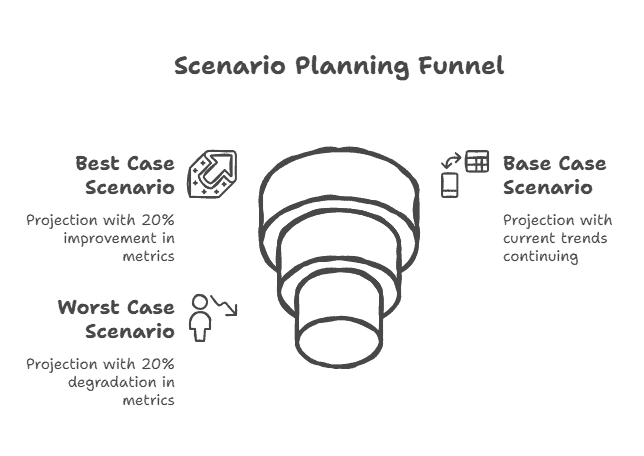
- Scenario analysis
- Investor relations
- Assessing the company’s financial performance
- Meet our team of finance experts
SaaS models also help clearly communicate the business model, support the development of accurate financial projections, and guide the company’s growth trajectory.
Best Practices
- Keep assumptions separate from formulas
- Use data-driven churn and funnel inputs
- Build scenario toggles
- Stress test revenue and expense drivers
Transforming raw financial data into actionable insights is a best practice for SaaS founders and leaders, enabling more accurate forecasting, real-time business analytics, and better decision-making. Comprehensive financial leadership—delivered by a fractional CFO or a team of fractional CFOs—provides SaaS businesses with a strategic financial partner who can guide growth, support fundraising, and help navigate complex financial landscapes. Engaging fractional CFO services extends beyond cost savings to include operational improvements, risk mitigation, and support for market expansion. SaaS founders benefit from these services when scaling their SaaS business model, ensuring they have the financial expertise needed to address industry-specific challenges and drive sustainable growth.
A SaaS model is not just a forecast — it’s the CEO’s navigation system. Calculate your business valuation here.
For more on this topic, read our fractional CFO onboarding what the first 90 days look like and building a driver-based model with a fractional CFO.