Cash Forecasting: Methods and Relevance to a Small or Mid-Sized Business
in Cash Flow Management, CFO, Finance, Fractional CFO, Strategy, analytics and finances, Cash Flow Improvement, CFO Services, Small or Mid-Sized Business, All Posts
Retail-heavy CPG businesses face the widest cash-flow variability of any consumer category. Distributor payment timing, retailer deduction cycles, long production lead times, seasonal swings, and inventory buildups create cash shocks that traditional forecasting simply can’t catch.
Understanding CPG demand and leveraging demand foforecastingre critical for anticipating cash needs and managing liquidity in retail-heavy CPG businesses.
A robust cash-flow forecasting framework must integrate sell-in volatility, POS-driven replenishment, deduction lag, inventory flows, trade-spend timing, and manufacturing schedules. When done correctly, retail-heavy CPG companies can predict cash needs 8–26 weeks in advance — and avoid the liquidity crises that destroy growth.
The Unique Cash Flow Challenge in Retail CPG
Retail-heavy CPG brands operate in a fundamentally different financial reality than DTC or foodservice businesses. While DTC companies collect payment within days and foodservice operators work on relatively predictable order cycles, retail CPG brands navigate a labyrinth of delayed cash conversion that can stretch 90–120 days from production to payment.
We’ve seen CPG companies with $3M in monthly revenue burn through their entire credit line within 60 days, not because of poor sales, but because they fundamentally misunderstood the timing gaps in their cash conversion cycle. The founder watched revenue climb 40% year-over-year while simultaneously facing payroll shortfalls — a paradox that’s heartbreakingly common in retail CPG. These timing disconnects, if not properly managed, can ultimately result in lost revenue as delayed cash inflows hinder the ability to meet demand or invest in growth.
The root cause isn’t revenue performance. It’s the compounding effect of multiple timing disconnects that traditional cash conversion cycle analysis often misses and that traditional cash flow forecasting fails to capture.
The Seven Cash Flow Disconnects in Retail CPG
Disconnect #1: Production Lead Time vs. Order Timing
When Target places a purchase order for $250,000 in April for June delivery, most founders see “June revenue.” But the cash implications started in February when you ordered raw materials, in March when you paid your co-packer’s deposit, and in April when you paid the balance. You’ve deployed $175,000 in cash three months before Target’s payment arrivearrn August.
Disconnect #2: Sell-In vs. Sell-Through
You invoice the retailer when the product ships to their distribution center — these distribution centers are critical nodes in the supply chain, responsible for inventory management, product availability, and logistics efficiency. But the retailer’s payment terms often don’t start until the product clears their DC and ships to stores — this is sell-through. For slow-moving products or new SKUs, this DC holding period can add 2–4 weeks to your cash conversion cycle. A SKU sitting in a Kroger DC for three weeks means your 60-day payment terms just became 81 days. Delays at distribution centers can directly impact product availability and stock levels at retail locations, leading to potential out-of-stocks and significant financial impact from retail out-of-stocks, including lost sales.
Disconnect #3: Deduction Processing Lag
Retailers take deductions for spoilage, promotional allowances, shipping damage, and compliance failures. These deductions don’t appear on the original invoice — they show up 30–90 days later as chargebacks against future payments. Your accounts receivable aging looks clean, but then $40,000 in deductions hit simultaneously, creating an unexpected cash gap that wasn’t in your forecast.
Disconnect #4: Promotional Timing Mismatch
Promotional periods require inventory builds 6–8 weeks in advance. If Whole Foods runs a Memorial Day promotion requiring 3x normal inventory, you’re paying for that production in March while the promotional sell-through happens in May and payment arrives in July. Four months of cash deployed for a one-week promotion.
Disconnect #5: Seasonal Production vs. Seasonal Sales
CPG brands with seasonal sales patterns often must produce year-round to meet peak demand. A pumpkin spice product that sells 80% of annual volume in Q4 requires production starting in Q2. You’re funding six months of inventory carrying costs before the first retailer payment arrives. The cash outflow is spread across 24 weeks while cash inflow concentrates in 8 weeks.
Disconnect #6: New Distribution Buildup
When you secure a new retailer, you must fund the entire pipeline fill before receiving any payment. A national Albertsons rollout requiring $180,000 in initial inventory won’t generate cash inflow for 75–90 days, but the production costs hit immediately. This “growth penalty” has killed more CPG brands than failed products ever did.
Disconnect #7: Trade Spend Accrual vs. Payment
Trade spend — slotting fees, promotional allowances, marketing co-op — often gets paid quarterly or tied to specific promotional periods. But the associated sales happen continuously. Your P&L accrues trade spend monthly to match revenue, but your cash forecast must reflect that $120,000 in accrued Q1 trade spend gets paid in a single April wire transfer.
Building a Robust 13-Week Cash Flow Model
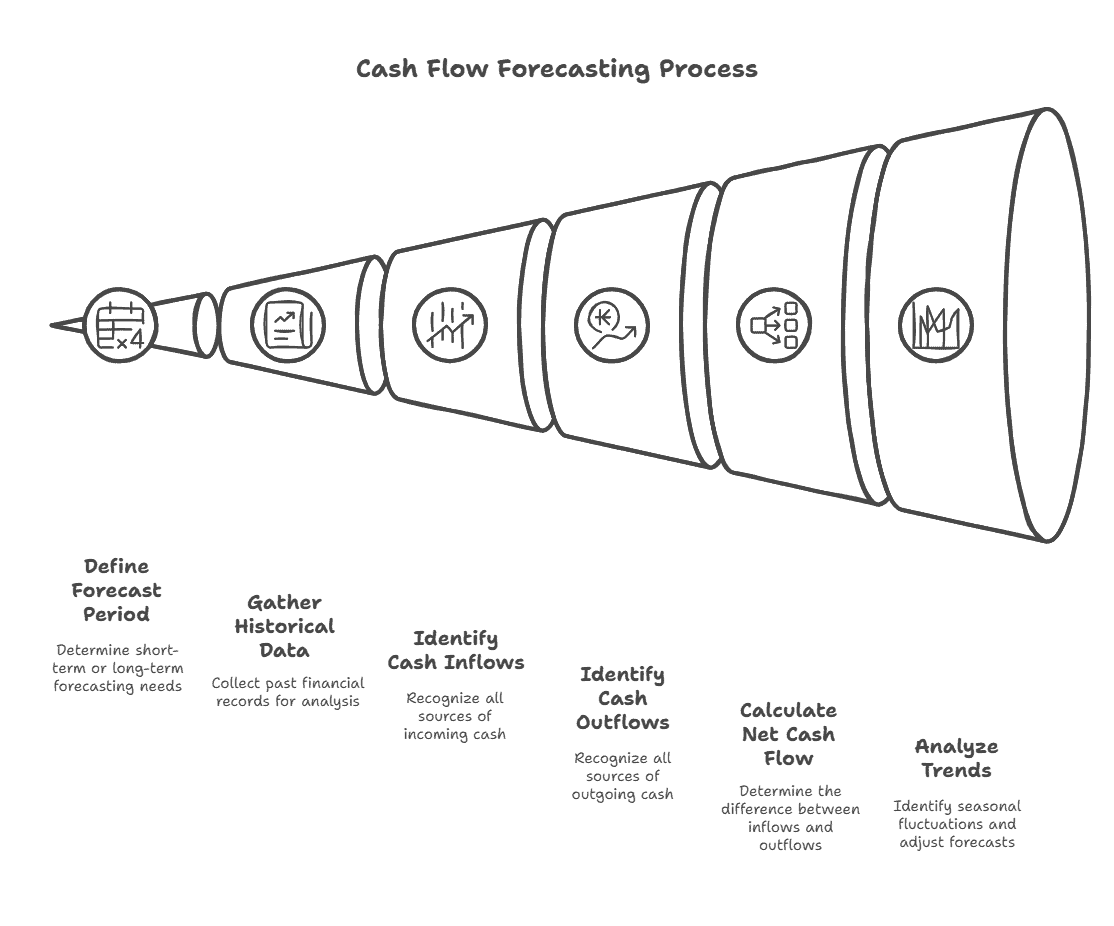
The standard monthly cash flow forecast is worse than useless for retail CPG — it creates false confidence while missing the weekly volatility that triggers crises. We build 13-week rolling cash forecasts that update weekly and extend 90 days forward. This 13-week rolling cash forecast serves as a forecasting model designed to improve cash flow visibility and support more informed decision-making. Here’s the framework:
Week 1-4: Known Commitments
This period should be 95%+ accurate because it reflects committed inventory builds, scheduled payments, and confirmed retailer remittances. Your accounts payable aging, production schedules, and distributor payment terms provide hard data. The only variables are minor timing shifts. Accurate demand forecasting at this stage ensures the reliability of short-term cash flow projections, supporting efficient inventory management and supply chain operations.
Week 5-9: High-Probability Events
This period incorporates expected purchase orders based on retailer velocity data, planned promotional builds, and normal replenishment cycles. Accuracy drops to 80–85% because retailer ordering can shift by 1–2 weeks based on DC inventory levels, but the general cash flow shape is predictable.
Week 10-13: Directional Planning
The outer weeks provide directional cash flow trends rather than precise predictions. This horizon captures seasonal builds, major promotional events, and new distribution launches. Accuracy drops to 65–70%, but these weeks reveal whether you’re heading toward a cash surplus or deficit that requires advance planning.
Integrating POS Data and Consumer Demand for Replenishment Forecasting
Retailer purchase orders don’t follow your revenue forecast — they follow shelf depletion driven by consumer purchases. POS data transforms cash forecasting from reactive to predictive. Understanding customer demand is essential for accurate replenishment forecasting, as it enables CPG brands to align inventory with real-world consumption patterns and optimize supply chain efficiency.
When we implement POS-driven forecasting, we typically see a 40–60% improvement in order timing accuracy within 90 days. Here’s the methodology:
Step 1: Establish Velocity Baselines by Account and SKU
Weekly POS data reveals your true sales velocity, not your shipment velocity. A SKU selling 1,200 units per week at Kroger with 3 weeks of inventory coverage will trigger a reorder when inventory drops to 1,800 units. This is predictable mathematics, not guesswork.
Step 2: Calculate Days of Supply at Store and DC Levels
Retailers manage inventory at both store and DC levels. When store inventory depletes, stores pull from the DC. When DC inventory drops below threshold, the DC orders from you. Understanding both layers is critical. A retailer might have 45 days of supply in total, but only 8 days at store level. The replenishment order comes when DC inventory hits 15 days of supply, which happens in 30 days based on current velocity.
Step 3: Model Promotional Lift Impact
Promotions create 2x–5x velocity spikes that trigger accelerated replenishment. But promotional timing is known months in advance from retailer calendars. When Safeway plans a 20% off promotion for Week 12, and historical data shows 3.2x lift, you can forecast the pre-promotional build order arriving in Week 8 and the post-promotional replenishment order in Week 14. Planning for high demand items during these promotional periods ensures you have sufficient stock to meet increased customer demand and avoid lost sales.
Step 4: Identify Seasonal Velocity Shifts
POS data reveals when seasonal velocity changes begin — often 2–4 weeks before retailers adjust orders. When your sparkling water sales start climbing in Week 15 as weather warms, you know the retailer’s order increase will hit in Week 17. This advance notice lets you schedule production and forecast the associated cash outflows precisely. Analyzing sales history and identifying recurring trends and seasonal trends helps anticipate seasonal demand and seasonal fluctuations, allowing for more accurate demand planning and inventory optimization.
Modeling Deduction Timing and Impact
Deductions are the silent killer of CPG cash flow. Your aged accounts receivable looks strong, then $75,000 in deductions hit simultaneously, creating an immediate crisis. Proper deduction forecasting prevents these surprises.
Establish Deduction Rate Baselines by Retailer
Historical data reveals each retailer’s typical deduction rate. Walmart might average 3.2% of gross invoiced amounts in deductions, while Whole Foods averages 1.8%. These rates are remarkably consistent once you have 12 months of data. Apply these rates to your forward revenue forecast to project deduction timing. Historical analysis of deduction patterns is essential for building accurate deduction forecasts, as it helps identify trends and seasonal fluctuations unique to each retailer.
Model Deduction Lag by Category
Different deduction types have different lag patterns: – Shortage claims: 15–30 days – Damaged goods: 30–45 days – Promotional allowances: 45–75 days – Compliance chargebacks: 60–90 days
When you ship $200,000 to Target in Week 1, forecast $6,400 in deductions hitting Week 6 (shortage claims), $3,200 in Week 8 (damaged goods), and $2,800 in Week 12 (promotional allowances). These aren’t surprises — they’re predictable patterns.
Create Deduction Reserve Schedules
Your P&L should accrue deductions monthly, but your cash forecast must reflect actual payment timing. Build a deduction reserve schedule that tracks accrued but not-yet-claimed deductions by retailer and aging period. This reserve converts P&L accuracy into cash forecast precision.
Inventory Management Timing and Working Capital Requirements
Inventory is simultaneously your largest asset and your biggest cash drain. Understanding the true cost of inventory for CPG brands makes it clear why proper inventory timing forecasts prevent the growth-induced cash crunches that plague scaling CPG brands. Aligning inventory timing with an efficient supply chain helps minimize cash drain by reducing excess stock, lowering logistics costs, and improving operational performance.
Calculate Inventory Carrying Costs by Stage
Inventory costs don’t stop at production. You’re paying for storage, insurance, quality control, and opportunity cost. A pallet of product sitting in your 3PL for 60 days costs $47 beyond the original production cost. When your inventory turns slow down from 8x to 6x annually, you’ve just increased your working capital requirement by 33%.
Model Production Batch Economics
Co-packers have minimum order quantities that often exceed immediate demand. A 10,000-unit MOQ when you need 6,000 units means 4,000 units sit in inventory for 6–10 weeks. This batch economics reality must flow through your cash forecast. If production costs $2.40 per unit, that’s $9,600 in cash deployed 8 weeks early.
Forecast Seasonal Inventory Builds
Seasonal brands must build inventory months ahead of demand. Your cash forecast must reflect these builds explicitly: – Week 12–20: Build inventory for Q3 seasonal peak – Week 20–28: Peak inventory levels — maximum cash deployment – Week 28–36: Inventory depletion — cash recovery – Week 36–44: Post-season clearance — final cash recovery at reduced margins
Account for New Distribution Pipeline Fill
When securing new retail distribution, forecast the complete pipeline fill requirement. A new retailer wanting 2 months of safety stock across 200 stores requires: – DC initial fill: 45 days of supply – Store initial stocking: 21 days of supply – In-transit buffer: 7 days of supply Total: 73 days of inventory at launch
Integrating data pipelines between inventory systems and supply chain partners ensures that inventory planning reflects operational realities, such as real-time inventory levels and promotional activity, leading to more accurate forecasts and a more efficient supply chain.
For a SKU with $1.85 COGS selling 50 units per store weekly, that’s 73,000 units at $1.85 = $135,050 in cash deployed before the first payment.
Managing Trade Spend Cash Timing
Trade spend represents 15–35% of gross revenue for most CPG brands, but its cash timing rarely matches P&L accrual. This mismatch creates significant forecast errors. To address this, it is essential to effectively implement trade spend ROI modeling and management processes that align with marketing and promotional strategies, ensuring accurate demand planning and improved cash flow visibility.
Distinguish Between Scan-Based and Invoice-Based Trade
Scan-based trade (off-invoice discounts, billbacks) reduces your invoice amount immediately — the cash impact is instantaneous and predictable. Invoice-based trade (slotting fees, marketing co-op, promotional allowances) gets invoiced separately or deducted from future payments — the cash timing is disconnected from the revenue.
Model Quarterly Trade Spend Payment Cycles
Most retailers settle trade spend quarterly. Q1 promotional allowances get reconciled and paid in April. Q2 marketing co-op settles in July. Your P&L accrues these expenses monthly, but your cash forecast must show: – April: $180,000 trade spend settlement for Q1 – July: $220,000 trade spend settlement for Q2 – October: $195,000 trade spend settlement for Q3 – January: $240,000 trade spend settlement for Q4. Integrating CPG pricing strategy, including margin, elasticity, and retail math, with trade spend planning can further optimize cash flow by aligning product pricing with anticipated trade spend cycles and market demand.
Forecast Promotional Trade Spend Advance Payments
Major promotional events often require advance payment of promotional allowances. A September promotional program might require 50% payment in July. These advance payments create cash outflows 8–10 weeks before the promotional sales and 16–18 weeks before the promotional sales generate cash inflow. Promotional strategies must be coordinated with cash flow planning to avoid liquidity issues and ensure that marketing initiatives do not strain working capital.
Technology and Automation in Forecasting
The rapid evolution of technology is reshaping how consumer packaged goods (CPG) companies approach forecasting. By harnessing machine learning and advanced analytics, finance teams can move beyond static spreadsheets to dynamic, data-driven models that account for historical sales data, market trends, and external factors such as economic shifts or weather events. Automated forecasting tools not only streamline the forecasting process but also dramatically improve forecast accuracy by reducing manual errors and surfacing actionable insights in real time.
Data integration platforms play a pivotal role by consolidating information from across the entire supply chain—linking sales, invpivoty management, production, and logistics data into a single source of truth. This unified view empowers sales and marketing teams to collaborate more effectively, respond quickly to changes in consumer demand, and optimize inventory management strategies. With automation, CPG companies can anticipate market shifts, adjust to fluctuations in consumer packaged goods demand, and maintain a significant advantage over competitors still relying on manual processes.
Ultimately, investing in technology and automation enables CPG companies to generate more accurate forecasts, improve operational efficiency, and make smarter, faster decisions that drive growth and resilience in a rapidly changing market.
Integrated Cash Flow Forecasting and Forecast Accuracy: Bringing It Together
The power emerges when you integrate these seven elements into a unified 13-week rolling forecast. Clearly defining the stakeholders involved—such as sales, marketing, supply chain, finance, and external partners like suppliers and retailers—is essential to ensure alignment, collaboration, and accuracy throughout the cash flow forecasting process.
Week 1 Example:– Production cash out: $145,000 (committed production run) – A/P payments: $87,000 (net 30 supplier invoices) – Retailer payments in: $210,000 (Kroger, Sprouts, Whole Foods remittances) – Trade spend out: $0 – Net cash flow: -$22,000 – Running cash balance: $387,000
Week 8 Example:– Production cash out: $195,000 (seasonal build for Q4) – A/P payments: $112,000 – Retailer payments in: $340,000 (includes Target promotional sell-through) – Trade spend out: $0 – Net cash flow: +$33,000 – Running cash balance: $445,000
Week 12 Example:– Production cash out: $85,000 (regular production) – A/P payments: $93,000 – Retailer payments in: $280,000 – Trade spend out: $165,000 (Q2 settlement) – Net cash flow: -$63,000 – Running cash balance: $334,000
This granular visibility reveals the Week 12 trade spend settlement creates a cash trough that requires planning. Without this forecast, that $165,000 payment could trigger a banking covenant violation or force you to delay supplier payments.
Measuring Forecasting Success
For CPG companies, measuring the effectiveness of forecasting is not just about hitting a number—it’s about driving operational efficiency and supporting strategic decision-making. Key performance indicators (KPIs) such as forecast accuracy, inventory levels, and fill rates provide a clear picture of how well demand planning aligns with actual consumer demand. Monitoring these metrics helps finance teams identify gaps in the forecasting process and adjust inventory management strategies to minimize excess inventory and lost sales.
Other critical metrics include the frequency and impact of supply chain disruptions, the volume of excess inventory, and the rate of lost sales due to stockouts. By regularly tracking and analyzing these indicators, CPG companies can pinpoint the root causes of inefficiencies, respond proactively to emerging trends, and adapt to market shifts before they impact the bottom line. Continuous review of forecasting performance ensures that demand planning remains agile and responsive, supporting both short-term operational goals and long-term business growth.
Common Mistakes to Avoid
Even the most sophisticated forecasting models can fall short if common pitfalls are not addressed. One frequent mistake is relying exclusively on historical data, which may not reflect current market trends or shifts in consumer behavior. Ignoring external factors—such as economic changes, competitor actions, or unexpected events—can also lead to inaccurate forecasts and costly missteps.
Another major error is poor data integration, where siloed information prevents a holistic view of the supply chain and undermines collaboration between sales and marketing teams. Without leveraging advanced analytics and machine learning, CPG companies risk missing subtle patterns and emerging risks that could impact demand. These mistakes often result in excess inventory, lost sales, and supply chain disruptions that erode profitability.
To avoid these pitfalls, CPG companies should adopt a comprehensive approach to forecasting—incorporating multiple data sources, fostering cross-functional collaboration, and utilizing advanced analytics to generate accurate forecasts. This proactive strategy not only reduces risk but also positions businesses to capitalize on new opportunities as market conditions evolve.
Future Trends in the CPG Industry
The CPG industry is on the cusp of transformative change, driven by evolving consumer preferences, technological innovation, and shifting market dynamics. The rise of e-commerce and direct-to-consumer channels is reshaping how companies forecast demand and manage inventory, requiring more agile and responsive supply chain strategies. At the same time, growing consumer demand for sustainable and environmentally friendly products is prompting CPG companies to rethink their supply chain and production planning to align with these values.
Artificial intelligence, machine learning, and predictive analytics are becoming essential tools for generating accurate forecasts and anticipating future demand. As these technologies become more accessible, CPG companies that invest in advanced analytics, scenario planning for CPG and retail, and robust data integration will be better equipped to navigate market shifts and emerging trends. Building a more resilient supply chain—capable of withstanding disruptions and adaptiscenario planninges—will be a strategic imperative for long-term success.
To stay competitive, CPG companies must embrace digital transformation, strengthen partnerships across the supply chain, implement disciplined month-by-month CPG budgeting practices, and remain attuned to key trends shaping the industry. By doing so, they can anticipate changes in consumer demand, optimize inventory management, and drive sustainable growth in an increasingly complex marketplace.
FAQ: Cash Flow Forecasting for Retail CPG
How far out should CPG cash forecasts extend?
Maintain three forecast horizons simultaneously: 13-week rolling forecast (weekly granularity), 6-month directional forecast (monthly granularity), and 18-month strategic forecast (quarterly granularity). The 13-week forecast drives daily operations, the 6-month forecast guides inventory and staffing decisions, and the 18-month forecast supports financing and capacity planning.
What accuracy targets should we expect?
Week 1-4 should achieve 95%+ accuracy, weeks 5-9 should hit 80–85% accuracy, and weeks 10-13 will land at 65–75% accuracy. If you’re missing these targets, you need better data integration, a more integrated CPG budgeting framework for predictable growth, or revised assumptions. Accuracy below these thresholds renders forecasting unreliable for decision-making. Accurate forecasting in CPG demand not only improves operational efficiency but also leads to increased sales by ensuring product availability and timely inventory replenishment.
How do we handle retailer payment timing variability?
Create retailer payment profiles based on 12 months of historical data. Walmart might pay on day 58 of 60-day terms with 3-day standard deviation. Whole Foods might pay on day 33 of 30-day terms. Model each retailer’s actual payment behavior, not their stated terms. This historical pattern forecasting typically improves accuracy by 25–40%.
Should we forecast cash or accrual-based?
Your operational forecast must be pure cash basis — only actual cash in/out dates matter. However, maintain parallel accrual-basis financial statements for investor reporting and P&L management. The two views serve different purposes and shouldn’t be merged.
How do we forecast deductions we can’t predict?
Apply historical deduction rates by retailer and category with 30–90 day lag periods. Even though you don’t know which specific invoices will face deductions, you know Target will deduct approximately 3.2% of invoiced amounts with most deductions hitting 45–75 days post-invoice. Forecast the pattern, not the individual events.
What if POS data isn’t available?
Request POS data through your distributor or broker — most retailers will share weekly velocity data once you’re an established supplier. If unavailable, use invoice timing patterns and distributor inventory data to build replenishment forecasts. The accuracy will be lower (65% vs. 85%), but pattern-based forecasting still outperforms guess-based forecasting.
How do we model new product launches with no historical data?
Use comparable product benchmarks from your existing portfolio or industry data. A new SKU launching in the same category as an existing product will likely follow similar velocity patterns with a 12–16 week ramp period. Build conservative, moderate, and aggressive scenarios to bound the range of possible outcomes.
When should we raise debt or equity based on cash forecasts?
When your 13-week forecast shows you’ll drop below minimum operating cash (typically 30 days of operating expenses) within 90 days under moderate assumptions, begin financing discussions immediately. Raising capital under time pressure yields worse terms than proactive fundraising with 6–9 months of runway remaining.
How often should we update the forecast?
Update the 13-week forecast weekly, incorporating actual results and rolling forward one week. Update the 6-month forecast monthly with revised retailer velocity data. Update the 18-month forecast quarterly with strategic changes in distribution or product launches. This cadence balances accuracy with effort.
What tools do we need for effective cash forecasting?
At minimum: connected accounting system, distributor sales data, production scheduling system, and trade spend tracking. Most CPG brands benefit from dedicated cash flow forecasting software that integrates these data sources and automates weekly updates. Manual Excel-based forecasting works until $5–7M in annual revenue, beyond which automation becomes necessary.