blog-ftr-img

Why Tariff Increases Haven’t Shown Up in Inflation—Yet: A CFO’s Real-World Perspective on E-Commerce and Consumer Packaged Goods

January 8, 2026

in Fractional CFO, #FractionalCFO, CFO Services, Finance, Inflation, Tariff Impact, All Posts

Last year, when tariffs were introduced, I wrote a blog article about how they represented a critical kitchen table issue for many small American businesses that have built their business models around contract manufacturing in China and selling through U.S. retail channels—often their own web properties or Amazon—directly to American consumers. This represents a significant portion of the consumer packaged goods (CPG) market and e-commerce landscape. The e-commerce industry has flourished over the last three decades, with many consumers now using e-commerce as their primary product acquisition channel for discretionary spending on consumer goods. E-commerce businesses have been enabled by massive upgrades in technology capabilities to stand up and manage online stores with remarkable efficiency.

Today, on January 6th, The Wall Street Journal published an article examining why the increases in tariffs are not showing up in inflation data. In my article from last year, I pointed to a couple of the reasons implied in this WSJ piece. But from working directly with CPG brands and e-commerce clients navigating these challenges, I’ve observed additional factors at play that provide important real-world context. I’d like to share those insights in this blog post.

TL;DR

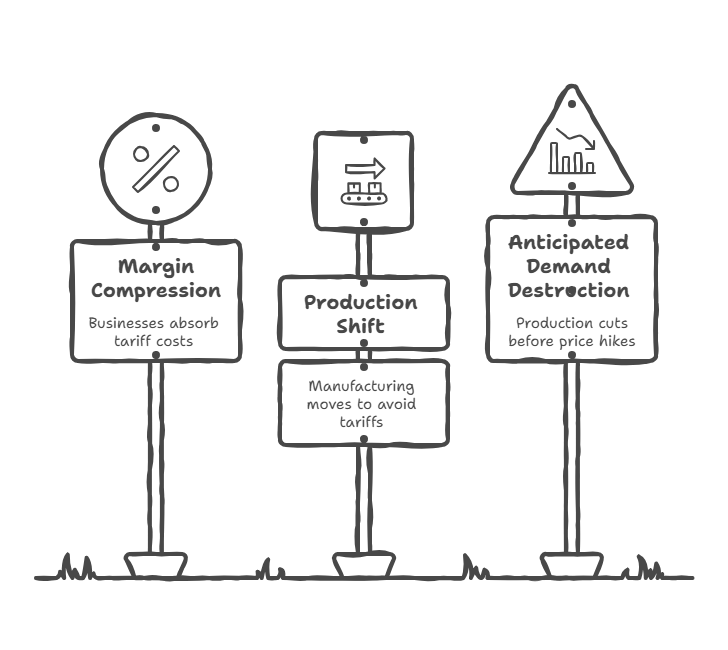
Tariff increases haven’t appeared in inflation data yet for reasons the WSJ article discusses: (1) e-commerce businesses and CPG brands are absorbing costs through margin compression rather than passing them to consumers—though this is starting to change in recent months, suggesting delayed rather than absent inflation; (2) consumer goods manufacturers have shifted production to lower-tariff countries like Vietnam and Indonesia, reducing the average tariff rate below headline expectations. We have seen both of these factors at play in businesses we work with.

One last factor that has merit: Consumer packaged goods manufacturers facing rising input costs from tariffs are proactively contracting production and cutting labor in anticipation of the demand softening they expect when they eventually raise prices. This means manufacturing production has declined below the ISM 50 expansion threshold while unemployment rises—representing inflation suppression through anticipated demand destruction rather than through actual price increases.

1. Cost Absorption in E-Commerce and CPG: Margin Compression Now, Price Increases Later

The WSJ article correctly identifies that inflation from tariffs may take time to trickle through to consumer prices. What it doesn’t fully address is how e-commerce businesses and consumer packaged goods brands have been managing these increased costs in the interim—and what that means for future inflation.

From our work with e-commerce clients and CPG brands, we’ve seen a clear pattern: initially, both manufacturers and online retailers absorbed tariff costs through profitability cuts rather than pushing through price increases. This protected consumers from immediate inflation but came at the expense of business margins. The e-commerce company might absorb some of the tariff impact, and the contract manufacturer of consumer goods might absorb another portion. This is straight margin compression—businesses eating the cost to maintain market share and customer relationships in competitive online marketplaces.

However, this strategy has limits for CPG brands and e-commerce sellers. In recent months, once tariff rates settled and businesses could accurately calculate their true cost structure, we’ve seen clients begin passing these costs to consumers through price increases on consumer products. This suggests that we may not be seeing all the inflation yet—it’s delayed, not absent. The margin compression approach buys time, but it’s not sustainable long-term for consumer goods sellers.

This delay mechanism isn’t mentioned prominently in the WSJ piece, but it’s critical for understanding the inflation timeline in e-commerce and CPG sectors. E-commerce businesses don’t immediately raise prices when costs increase. They analyze the competitive landscape on platforms like Amazon, test price elasticity with their consumer base, and often wait until they have clear evidence that competitors are also adjusting prices on similar consumer products. This creates a lag effect where tariff-driven inflation arrives months after the tariff implementation. With that said, the inflation may never be a material issue. The bigger issue we might see is increasing unemployment in consumer goods manufacturing.

2. Geographic Manufacturing Shifts in Consumer Goods: Lower Average Tariff Rates

The second factor that’s keeping aggregate inflation lower than headline tariff rates would suggest is the significant movement of consumer packaged goods manufacturing capability away from China to Southeast Asian countries where tariffs are lower.

We’re seeing e-commerce clients and CPG brands actively diversifying their manufacturing relationships to countries like Vietnam and Indonesia, where tariff structures are more favorable for consumer goods production. This geographic arbitrage means that while China-specific tariffs may be high, the average tariff rate that consumer goods manufacturers are actually paying across their entire production portfolio is lower than what headlines would suggest.

This shift doesn’t happen overnight for consumer packaged goods—establishing new manufacturing relationships, conducting quality audits, and building supply chain logistics takes months or even years. But e-commerce businesses and CPG brands have been working on this diversification since the first round of tariffs, and by now, many have successfully reduced their China exposure significantly.

The result is that aggregate inflation from tariffs is muted because consumer goods businesses are effectively routing around the highest-tariff pathways. This is basic economic response to policy changes: when the cost of one channel increases, e-commerce businesses and CPG manufacturers find alternative channels. The WSJ article doesn’t explore this geographic dimension, but it’s a major reason why tariff-driven inflation hasn’t materialized as dramatically as some predicted in the consumer goods sector.

3. Manufacturing Contraction in Consumer Goods and Labor Market Adjustments: Anticipating Demand Destruction

The third factor—and perhaps the most concerning from a macroeconomic perspective—is that manufacturing production has declined below the ISM 50 index threshold, which indicates contraction rather than expansion. This affects consumer packaged goods manufacturing significantly.

While I don’t have definitive proof of causation, I believe this contraction is being driven by a forward-looking strategic calculation: consumer goods manufacturers facing increasing input costs from materials sourced through higher-tariff channels can see what’s coming. They understand that when they eventually pass these costs through as price increases on consumer products, demand will decline. Rather than maintaining production capacity and then scrambling to adjust when that demand softening materializes, they’re proactively contracting operations now.

This is consumer packaged goods manufacturers reading the writing on the wall. Their imported input costs are rising due to tariffs, which means their marginal profits on consumer products are being squeezed. They have long-term demand forecasts and understand customer price sensitivity in e-commerce channels. They know that future price increases on consumer goods—which are inevitable given the cost pressures—will reduce demand. So they’re cutting production capacity, reducing overhead, and trimming workforce in anticipation of that demand softening, not in response to it.

One telltale sign of this dynamic: businesses in the consumer packaged goods sector appear to be absorbing cost pressure by reducing overhead and labor rather than immediately raising prices on consumer products. The current unemployment statistics demonstrate that something significant is happening in the labor market. Unemployment has risen to 4.60% as of November 2025—up from lower levels earlier in the year.

This suggests a third pathway for tariff impact that doesn’t show up in consumer price inflation: instead of raising prices first on consumer goods and then adjusting capacity when demand falls, manufacturers are cutting costs through workforce reductions and operational efficiency measures preemptively. This protects margins in the short term but has obvious negative implications for employment and economic growth in the consumer goods sector.

The manufacturing sector’s contraction, combined with rising unemployment, paints a picture of an economy absorbing tariff costs through reduced economic activity rather than through price increases on consumer products. Consumer packaged goods manufacturers are essentially saying: “Our input costs are up, we’ll have to raise prices eventually, demand will soften when we do, so let’s right-size our operations now.” This is inflation suppression through anticipated demand destruction—not exactly a positive outcome, even if it keeps CPI numbers stable in the near term.

What You Might Notice in Everyday E-Commerce Shopping

If you’re a regular online shopper or frequent buyer of consumer packaged goods through e-commerce channels, you might already be noticing subtle shifts that reflect these larger economic forces at play.

The slow creep of higher prices on consumer products. That electronics gadget, home goods item, or personal care product you’ve been watching on Amazon or other e-commerce sites? You might notice the price has edged up 8-12% over the past few months, even though there hasn’t been any dramatic announcement or obvious reason. This is the margin compression strategy finally reaching its limit for CPG brands and e-commerce sellers. Online retailers held prices steady for as long as they could, but now they’re quietly adjusting upward. If you’ve been comparison shopping for consumer goods and thinking “I swear this used to be cheaper,” you’re not imagining it—you’re witnessing the delayed inflation effect in action across e-commerce platforms.

Fewer options from familiar CPG brands. Browse consumer product categories you know well on Amazon or other e-commerce sites, and you might notice that certain brands or specific consumer packaged goods have simply disappeared from the marketplace. This isn’t always about products being discontinued—sometimes it’s about manufacturers deciding that certain consumer goods are no longer profitable at price points consumers will accept. When tariffs squeeze margins on lower-priced consumer products, CPG companies often consolidate their product lines, keeping only the higher-margin items. That budget-friendly consumer goods option you relied on? It might be a casualty of this economic reshuffling in the e-commerce landscape.

The “Made in Vietnam” or “Made in Indonesia” trend in consumer goods. Pay attention to product labels and descriptions when shopping for consumer packaged goods, and you’ll see a geographic shift happening in real-time. Consumer products that were manufactured in China just a year or two ago are now coming from Vietnam, Indonesia, Thailand, or Bangladesh. This is that geographic arbitrage playing out at scale in the consumer goods sector. For consumers buying through e-commerce channels, the quality might be slightly different—sometimes better, sometimes requiring more refinement—as CPG manufacturers work out the kinks with new factory relationships. This transition is why your favorite consumer product might have subtle quality variations from one e-commerce purchase to the next.

Sales that seem less frequent or less generous on e-commerce platforms. Remember when that e-commerce site ran 25% off sales on consumer packaged goods every other month? Notice how those have become 15% off and less frequent? Or how “free shipping” thresholds have crept from $35 to $50 or higher for consumer products? These are e-commerce businesses trying to protect margins without overtly raising base prices on consumer goods. The sticker price might look stable, but the effective price you pay—accounting for fewer discounts and higher shipping minimums—has increased. This is margin pressure revealing itself through promotional strategy rather than list prices on consumer products.

The employment angle you might be seeing locally in consumer goods manufacturing. If you live in a region with consumer packaged goods manufacturing presence, you might be noticing “Now Hiring” signs coming down or hearing about layoffs at local factories—even though the economy otherwise seems reasonably healthy. This is that anticipatory contraction playing out in communities. Consumer goods manufacturers aren’t waiting for orders to decline; they’re cutting capacity now because they can see higher prices on consumer products will reduce demand later. For workers, this means job losses are arriving before the inflation that’s causing them even shows up in headlines.

The fascinating—and somewhat unsettling—aspect of this moment is that these changes are happening gradually enough that they don’t feel like a crisis in e-commerce or consumer packaged goods sectors, but consistently enough that they’re reshaping the consumer landscape. The tariff impact is real and tangible for CPG brands and e-commerce businesses, just distributed across price adjustments on consumer products, product availability, promotional strategies, and employment rather than showing up as one dramatic inflation spike that makes headlines.

Conclusion

The WSJ article asks an important question: why haven’t tariff increases shown up in inflation? The answer is more complex than simple time lags, particularly for e-commerce businesses and consumer packaged goods brands. Businesses are absorbing costs through margin compression, diversifying consumer goods manufacturing geographically to reduce average tariff exposure, and in some cases, cutting production and labor in anticipation of demand softening from inevitable price increases on consumer products—rather than waiting for that demand destruction to arrive.

These mechanisms are keeping consumer inflation muted for now, but they come with costs: reduced business profitability for CPG brands and e-commerce sellers, consumer goods manufacturing contraction, and rising unemployment. The tariff impact is real—it’s just being distributed across multiple channels rather than showing up cleanly in consumer price indices.

For e-commerce businesses and consumer packaged goods brands built on cross-border supply chains, the strategic imperative is clear: adapt through geographic diversification of consumer goods manufacturing, prepare for eventual price increases, and manage margin pressure actively rather than hoping tariff policies reverse. The economic environment has fundamentally shifted, and successful navigation requires understanding the real-world mechanisms that traditional inflation metrics don’t fully capture.


FAQ

Q: If tariffs haven’t caused inflation yet for consumer packaged goods and e-commerce, does that mean they won’t cause inflation in the future?

A: Not necessarily. What we’re seeing is delayed inflation rather than absent inflation in the consumer goods sector. E-commerce businesses and CPG brands initially absorbed tariff costs through margin compression, but many are now beginning to pass costs to consumers as those margin pressures become unsustainable. Additionally, geographic diversification to lower-tariff countries has reduced average tariff rates below headline numbers for consumer packaged goods manufacturing, but this doesn’t eliminate the cost increase—it just moderates it. Expect gradual price increases on consumer products over the next 6-12 months as e-commerce businesses adjust pricing strategies. However, the bigger concern may not be inflation itself but rather rising unemployment as consumer goods manufacturers proactively contract operations in anticipation of softer demand.

Q: How long does it take to shift consumer packaged goods manufacturing from China to countries like Vietnam or Indonesia?

A: Establishing new manufacturing relationships for consumer goods typically takes 6-18 months depending on product complexity, quality requirements, and supply chain logistics. This includes factory vetting, sample production, quality audits, and logistics setup for CPG products. Many e-commerce businesses and consumer packaged goods brands began this diversification process during the first round of tariffs and are now seeing the benefits in terms of lower average tariff exposure. However, it’s not a complete solution—Southeast Asian manufacturing capacity for consumer goods has limits, and not all consumer products can be easily relocated.

Q: What does the declining ISM Purchasing Managers Index and rising unemployment tell us about tariff impacts on consumer goods and e-commerce?

A: The ISM index falling below 50 indicates manufacturing contraction, while unemployment rising to 4.60% suggests labor market softening in the consumer goods sector. Together, these indicators suggest that consumer packaged goods manufacturers are responding to rising input costs from tariffs by proactively cutting production capacity and workforce in anticipation of demand softening when they eventually raise prices on consumer products. This represents a form of economic adjustment that doesn’t show up in consumer inflation metrics but has significant implications for economic growth and employment in the consumer goods and e-commerce sectors. It’s essentially anticipated demand destruction rather than price inflation—manufacturers are right-sizing their operations now rather than waiting for reduced demand to force their hand later.

At CFO Pro+Analytics, we partner with founders and owners to deliver clarity, confidence, and control. Together, we can design a roadmap that connects your ambition with a sound financial strategy.

CLICK HERE to schedule a free 20-minute consultation call