in Finance, Analytics, Cash Flow Management, CFO, Finance, financial planning, Fractional CFO Services, Strategic Planning, All Posts
In part one of this series of articles, I discussed “Strategic Financial Forecasting: How Time Tracking Data Transforms Multi-Year Financial Models.” In part two, I focused on “Building a Calendar System that Anchors Multi-Year Models.”
In this article, I will explain how to create staffing and resource allocation models using actual productivity curves for more accurate and actionable forecasts.
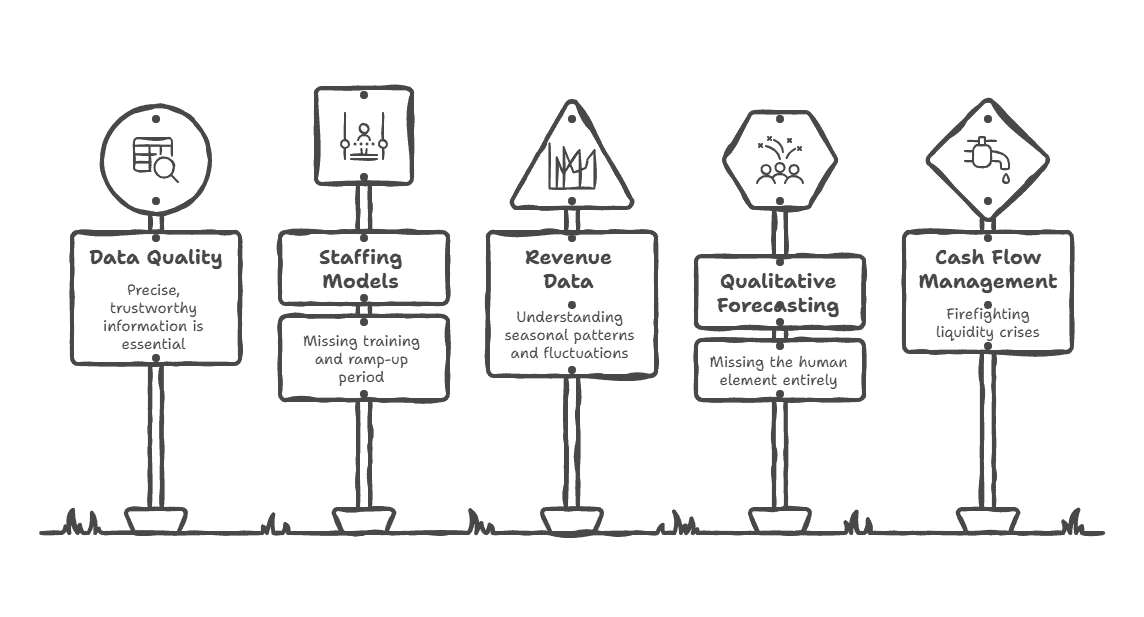
Accurate financial forecasting allows organizations to anticipate outcomes, manage risk, and make informed decisions about investment and resource allocation. But the challenge lies in the uncertainty of the future and the quality of historic data used to inform estimates. Having access to reliable financial data is essential for building accurate forecasts and making sound decisions. Forecasts are only as reliable as the accurate data used to build them; precise, trustworthy information is the foundation of any reliable forecasting model. This series focuses on how accurate time tracking data, sometimes viewed as only a necessary evil, actually enables accurate forecasts. This improves outcomes and boosts stakeholder confidence.
Intro:
Most CFOs treat time tracking as operational overhead—a way to monitor productivity and manage resources. Smart financial leaders see it differently: time data reveals your business’s seasonal patterns, capacity limits, and growth potential.
When integrated into financial models, time tracking transforms forecasting from guesswork into precision planning. Whether you’re a seasoned CFO or building your first forecasts, this approach delivers more accurate predictions and better strategic decisions.
Here’s how to turn time data into financial models that actually work.
The reality is, financial forecasting isn’t just spreadsheet exercise—it’s the strategic backbone that separates thriving companies from those constantly playing catch-up. In my CFO travels, I’ve watched organizations transform their decision-making by analyzing historical data with precision. Consider one of my manufacturing clients who shifted from gut-feel planning to data-driven forecasting: they moved from 15% budget variance down to 3.2% within eighteen months, translating to $1.8 million in improved resource allocation accuracy. Here’s what I’ve learned: businesses that examine past performance patterns with granular detail—not just high-level trends—can anticipate market fluctuations with remarkable precision. Strategic planning becomes exponentially more effective when you’re working with forecasts grounded in 24-month rolling averages rather than quarterly snapshots. The sophistication extends to resource allocation: companies leveraging robust trend analysis consistently hit their growth targets within 5% variance, compared to the industry average of 18% miss rates. What’s particularly fascinating is how this data-driven approach creates compound advantages—better forecasting leads to proactive market responses, which generates more predictable cash flows, which enables more confident strategic investments. The result: every financial decision becomes grounded in quantifiable historical patterns and emerging market signals, giving leadership the confidence to chart aggressive growth trajectories while maintaining operational stability.
The reality is that revenue data forms the operational foundation of any serious forecasting effort—and in my CFO travels, I’ve seen companies achieve remarkable precision when they treat this data with the sophistication it deserves. Consider one of my manufacturing clients who discovered that their Q4 revenue consistently spiked 23% above baseline (driven by year-end capital equipment purchases), while Q1 dropped 18% below average due to budget reset cycles. By analyzing 36 months of granular sales data, we uncovered these seasonal patterns alongside market fluctuations that created predictable variance windows of ±4.2% quarterly. This deep operational understanding allowed the organization to generate revenue forecasts within 2.1% accuracy—a dramatic improvement from their previous 12% variance range that had been wreaking havoc on cash flow planning. Here’s what’s particularly fascinating: with this clear view of revenue patterns, they identified $1.7 million in optimization opportunities (primarily inventory timing adjustments and strategic pricing moves during peak cycles), addressed performance gaps that were costing them roughly $340,000 annually in missed upsells, and implemented automated forecasting strategies that reduced planning time by 67% while supporting 15% year-over-year growth. The sophistication extends beyond simple trend analysis—when you leverage historical revenue data with this level of precision, your financial forecasts become both operationally realistic and strategically actionable, providing the solid analytical foundation that transforms routine planning into competitive advantage.
In my CFO travels across manufacturing and services companies, I’ve seen the transformational power of historical data in financial forecasting—and the reality is, most organizations are sitting on goldmines of predictive intelligence they’re barely tapping. Consider one of my recent consulting clients: by diving deep into 36 months of their sales patterns, expense cycles, and market performance data, we identified recurring seasonal drivers that were creating 15-18% variance in their quarterly forecasts (variance that was costing them credibility with investors and millions in misallocated working capital). This granular analysis doesn’t just improve forecast accuracy—it fundamentally changes how leadership teams make strategic decisions by quantifying risks and spotlighting opportunities that pure gut-feel approaches miss entirely. What’s particularly powerful is how this historical intelligence enables proactive strategy adjustments: when you can see that Q2 inventory builds consistently outpace Q3 demand by 22% based on three years of data patterns, you’re not just forecasting anymore—you’re architecting resilient operations that anticipate market shifts rather than react to them. The sophistication here transforms historical reporting from a backward-looking compliance exercise into a forward-looking competitive advantage that builds stakeholder confidence through demonstrable precision.
The reality is that while spreadsheet models and quantitative analytics drive most financial forecasting, I’ve seen too many CFOs get blindsided because their numbers missed the human element entirely. Consider one of my manufacturing clients who hit their Q3 revenue target within 2% but completely missed a 40% spike in raw material costs that everyone in procurement “felt coming” for months. Here’s how smart finance teams actually work: they layer qualitative methods like expert panels, scenario modeling, and trend synthesis directly onto their quantitative frameworks. In my CFO travels, I’ve watched this hybrid approach catch market shifts that pure data models miss—like when a Delphi process with 12 industry veterans predicted a supply chain disruption three quarters before it hit the P&L. What’s particularly fascinating is how robust time-tracking platforms like ClickTime enable this integration by capturing the granular operational signals that inform qualitative judgment. Result: forecasts that aren’t just mathematically elegant but operationally grounded in market reality. This sophisticated approach transforms financial planning from reactive number-crunching into proactive strategic advantage, giving leadership teams the nuanced intelligence they need to navigate uncertainty and capitalize on emerging opportunities.
Most financial models treat new employees as either fully productive or unproductive, missing the critical training and ramp-up period that significantly impacts cash flow and project delivery. At CFO Pro+Analytics, we build driver-based projections that require nuances like productivity ramp to create accurate financial models. Labor forecasting is a key component in predicting staffing needs for accurate financial planning, ensuring that workforce requirements are anticipated and managed effectively. Workforce planning is a strategic process that aligns staffing models with organizational goals, optimizing the broader context of workforce management. These factors also influence the cost of goods sold and overall expenses and cash flow, which are essential for accurate financial forecasting and budgeting. The most robust solutions on the market today provide detailed time tracking, laying the data foundation for building sophisticated staffing models that account for realistic productivity curves and support effective resource planning for optimal staff allocation.
Achieving accurate and reliable financial forecasts requires a commitment to best practices throughout the forecasting process. One key strategy is to employ a blend of quantitative and qualitative forecasting methods, including the analysis of historical data, market research, and expert insights—often involving consulting experts, particularly through the Delphi Method, to contribute to consensus forecasts. It is important to determine the most appropriate forecasting approach based on the organization’s specific needs and objectives. Staying current with market trends, economic indicators, and regulatory developments is also essential for producing reliable financial forecasts.
Leveraging financial forecasting software and specialized tools like ClickTime can streamline the process and enhance accuracy. Seeking guidance from financial professionals ensures that forecasts are grounded in expertise. It’s also important to align financial forecasts with the organization’s strategic plans and goals, using them as a foundation for informed decision-making and business growth. By following these best practices, businesses can create financial forecasts that not only reflect reality but also drive better outcomes.
The reality is that cash flow management separates successful CFOs from those constantly firefighting liquidity crises. Consider one of my manufacturing clients who improved their 13-week rolling forecast accuracy from 73% to 94% simply by implementing systematic cash flow analysis—that’s the difference between $2.3 million in unnecessary credit line draws versus maintaining optimal cash positioning. In my CFO travels, I’ve seen businesses with strong revenue growth still fail because they couldn’t predict when $847,000 in receivables would actually hit their bank account versus when $1.2 million in vendor payments were due. Here’s how sophisticated cash flow forecasting transforms operations: by analyzing granular historical patterns and building forward-looking models that account for seasonal variations, payment terms, and collection cycles, you create the foundation for strategic decision-making. What’s particularly powerful is how accurate cash flow projections enable you to spot working capital optimization opportunities worth 15-25 basis points of margin improvement. The sophistication extends beyond basic survival—when you can forecast cash position within 3% accuracy across rolling 90-day periods, you unlock the ability to negotiate better vendor terms, optimize investment timing, and maintain stakeholder confidence even during market volatility. Result: sustainable growth backed by operational precision rather than hope and reactive management.
Many businesses struggle with traditional staffing models that fail to account for real-world variability, leading to inaccurate forecasts and resource misallocation. Establish productivity baselines from time tracking data. Analyze historical data to understand how new employees progress from 0% to 100% productivity. In service-based businesses, this might be a 3-month curve. For an engineer, it could be up to 6 months. The key is using actual data, not assumptions.
Create month-by-month productivity cliffs. A typical progression is: Month 1 (20% productive), Month 2 (40%), Month 3 (60%), Month 4 (75%), Month 5 (90%), Month 6 (100%). Project-level tracking time tracking enables you to validate these assumptions by comparing billable hours or task completion rates for employees across different tenure levels.
Model different productivity curves by role. Senior developers may reach 85% productivity in month 2, while junior developers may need 4 months to achieve the same level. Customer service representatives might plateau at 90% due to complex product knowledge requirements. To improve accuracy, build different scenarios to account for variability in employee ramp-up and productivity, such as faster or slower onboarding periods. Teams from finance, HR, and operations should collaborate to build and validate these staffing models, ensuring that assumptions reflect real organizational dynamics. Tracking to task-level data helps you identify these role-specific patterns.
Integrate training costs and non-billable time. During the ramp-up period, new employees consume senior staff time for training and mentoring. Time tracking on internal projects and training activities helps you quantify these hidden costs and build them into your staffing model.
Plan hiring timing around project delivery. If you know a new developer will be 60% productive in month 3, and you have a significant project delivery in month 4, you need to hire accordingly. Accurate historical project data helps you understand the lead time required for different roles and skill levels.
The financial impact of proper staffing models is enormous. Consider a consulting firm hiring five new consultants. With a traditional model assuming immediate 100% productivity, you might forecast $500K in additional quarterly revenue. With a realistic ramp-up model based on precise time tracking data, that same hiring might only generate $275K in quarter one but $650K in quarter two as productivity peaks. This difference affects cash flow planning, hiring budgets, and project capacity planning.
The real power emerges when you integrate these three elements I have discussed in this three-part series: labor demand cycles, calendar precision, and staffing curves into a single, comprehensive financial model. By developing a seasonality curve to reflect monthly fluctuations in business activity, you can more accurately capture the impact of seasonality on labor demand cycles. Integrating these elements ensures your financial models are closely aligned with the organization’s growth goals. This approach provides a clear view of the company’s economic future and supports the development of a comprehensive financial plan. Time entry data becomes the foundation for what I call “reality-based forecasting.”
Ultimately, this integrated modeling approach leads to improved financial results and enables better performance measurement.
Your Q4 forecast accounts for December having 19 working days (not 22), applies a 125% seasonality factor for service demand, and reflects that your two new hires will be 75% and 90% productive, respectively. Meanwhile, your cash flow model accurately reflects the precise impact on working capital, as it is based on modeling actual billing cycles and real capacity constraints. This integrated model enables accurate financial forecasting, ensuring that your projections are not only realistic but also actionable. The ability to generate an accurate forecast is crucial for strategic decision-making and long-term planning. It’s important to consider factors like supply chain issues, which can significantly impact forecasting accuracy and seasonal analysis.
This level of precision transforms financial planning from educated guessing into a strategic advantage. When you’re presenting to investors or board members, you can confidently explain not just what you expect to happen, but why—backed by actual operational data from your time tracking system. Combining quantitative data with qualitative insights from your team provides the whole story, capturing factors that numbers alone may miss. Robust forecasting processes and a well-defined financial forecasting process ensure that your projections are reliable and trustworthy. Significant deviations from forecasts can lead the organization in the wrong direction, so maintaining accuracy is essential for supporting confidence and effective decision-making.
The key insight for finance leaders is this: time tracking data isn’t just about payroll compliance or client billing. It’s strategic intelligence that should inform every aspect of your financial planning. Comprehensive tracking capabilities provide the data foundation that sophisticated financial models require, including the 3-statement model—composed of the income statement, balance sheet, and cash flow statement as the core components for comprehensive financial forecasting.
When you’re building forecasts that drive business decisions—whether for fundraising, strategic planning, or operational management, the quality of your underlying data determines the quality of your outcomes. Analytical techniques such as multiple linear regression, which utilize dependent and independent variables, are essential for building robust forecasting models. Time tracking data transforms financial modeling from a necessary evil into a competitive advantage that drives better business outcomes. This approach also supports maintaining fiscal discipline, streamlines the budget preparation process, and leads to improved financial reporting.
By leveraging time tracking and market data, you can gain a deeper understanding of consumer behavior and apply various financial forecasting methods to enhance the accuracy and relevance of your forecasts.
This article was originally published on Clicktime.com with the title “Strategic Forecasting Part 3: Modeling Staffing and Productivity Curves for Accurate Financial Planning“
Salvatore Tirabassi is a fractional CFO and financial forecasting expert who helps growing businesses build sophisticated financial models that drive strategic decisions. With expertise in integrating operational data into financial planning, he specializes in creating 3-statement forecasts that serve multiple business functions from budgeting to investor relations.
Connect with Salvatore on LinkedIn or learn more about his fractional CFO services at CFO Pro+Analytics.