When Every Dollar Has a Name on It: Mastering Third-Party Fund Accountability
in Accounting, Finance, CFO, Finance, financial planning, Strategic Planning, All Posts
Table of Contents
- The $31 Million Documentation Disaster
- Understanding the Federal Compliance Maze
- Due Diligence Readiness: The Foundation of Audit Success
- The Cascade Effect of Poor Documentation
- Overcoming Financial Challenges
- Expert Advice and Resources
- The ProcurementExpress Solution: Compliance by Design
- Real-Time Budget Enforcement
- The Audit-Ready Advantage
- Beyond Compliance: Strategic Grant Management
- The True Cost of Compliance Failure
- Frequently Asked Questions (FAQ)
- 1. Why is it important to give every dollar a name in managing third-party funds?
- 2. How can technology like ProcurementExpress help with fund accountability?
- 3. What are the risks of poor documentation in managing federal grants?
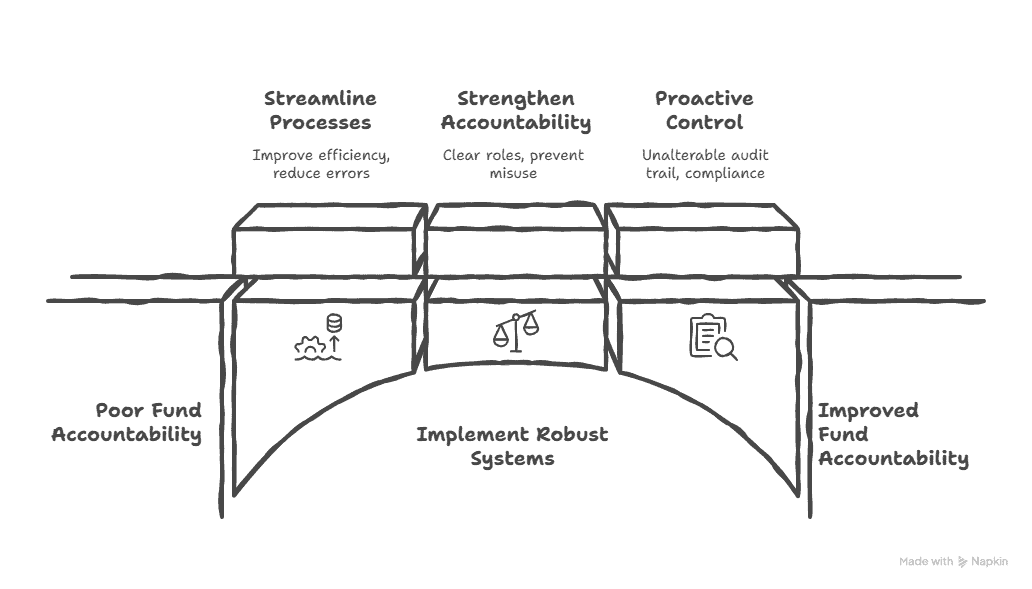
Throughout my CFO consulting work, I’ve helped numerous owners restructure their financial approval processes to close a dangerous gap: when dividing responsibilities across a team, it’s surprisingly easy to create workflows that accidentally circumvent the controls designed to prevent fraud and errors. Many founders and owner operators are single threaded through themselves for moving cash around, which creates inefficiency but provides great protection against mishandling and misuse of funds. As businesses scale, the owner operator often needs to spend time on more strategic and financially impactful tasks than mitigating risk in money movement. My work with clients has shown that implementing robust systems not only streamlines processes but also strengthens financial accountability for all clients involved. Easier said than done. Imagine a scenario where every dollar is tracked and accounted for, giving you complete control and peace of mind over your finances.
However, true financial control means not just relying on your bank account balance, but understanding the specific purpose of each dollar. Regularly reviewing your bank statements and monitoring bank account activity is essential for effective financial planning and ensuring every deposit and withdrawal aligns with your financial records.
About a year ago, James Kennedy, founfounder CEO of Procurement Express, chatted on his podcast and I was impressed with the thoroughness of Procurement Express in helping founders and owner operators relieve the responsibilities around cash movement while mitigating the risks of misuse or mishandling of funds. The company plays a key role in supporting financial accountability and compliance for organizations.
In this three-part blog series, I want to dive into some examples of risk management and how Procurement Express helps protect your business. We are going to look at three storylines: receiving public funding and auditing, protecting against mishandled operational spending with distributed controls and in the last article, mitigating the exploitation of your business through systematic fraudulent transactions.
Let’s start with perhaps the most complex challenge: managing third-party funds where accountability isn’t just good practice—it’s federal law.
TL;DR: When federal auditors questioned $31 million in COVID grant spending across Washington school districts, the problem wasn’t fraud—it was documentation. Organizations managing federal grants, research funding, or donor money face a paradox: the more funding you receive, the more complex proving compliance becomes. ProcurementExpress transforms grant compliance from reactive scrambling to proactive control, ensuring every federal dollar leaves an unalterable audit trail that satisfies the most stringent Single Audit requirements.
Every dollar must be properly tracked and accounted for to ensure compliance and avoid costly errors.
Financial accountability is the cornerstone of effective business management. Most people are left wondering where their money has gone at the end of the month, which highlights the importance of establishing clear accountability and tracking systems.
Taking charge of your finances means more than just paying bills—it’s about setting priorities and making intentional choices. To truly gain control, you must decide how every dollar is allocated so your spending aligns with your goals.
The $31 Million Documentation Disaster
In July 2023, state auditors delivered findings that sent shockwaves through Washington State’s education community. Seattle Public Schools faced $4.9 million in “questioned costs” from federal COVID relief grants. Everett, Edmonds, and Mukilteo districts found themselves in similar positions. The collective damage: $31 million in federal funds that might need to be repaid.
Here’s what makes this story particularly painful: These weren’t cases of fraud or misappropriation. The districts had actually purchased exactly what they said they would—laptops, internet hotspots, bills, and other recurring expenses that also require proper documentation—to enable remote learning during the pandemic. Students received the equipment. Learning continued through lockdowns. The mission was accomplished.
But when federal auditors arrived, they found a fatal flaw: inadequate documentation linking each purchase to its funding source. The districts couldn’t produce the paper trail proving that specific federal dollars went to specific allowable purchases for specific eligible students. In the world of federal grants, good intentions without documentation equals non-compliance. Funds must be properly paid and documented to meet federal requirements and avoid questioned costs. Without proper processes, organizations can easily fall into financial setbacks, even when their intentions are good.
Accurate tracking of all transactions is essential for compliance and financial health. Organizations must also track all income sources, such as grants or paychecks, to ensure compliance and align spending with incoming funds. Budgeting around each paycheck is crucial for covering expenses, paying off debt, and achieving financial goals, as it helps ensure that every dollar is allocated effectively.
Seattle’s spokesperson insisted the district was compliant, but federal grant requirements operate on a different plane of reality. They don’t care that you did the right thing. They care that you can prove you did the right thing, with documents, in triplicate, with proper signatures, following proper procedures, within proper timeframes.
Understanding the Federal Compliance Maze
To understand why documentation failures are so catastrophic, you need to understand the federal Single Audit framework. When any organization—school district, nonprofit, research institution—receives $750,000 or more in federal funds (recently raised to $1 million), they trigger Single Audit requirements. This isn’t just a financial audit; it’s a compliance examination covering 12 specific areas:
- Allowable Activities and Costs: Can you prove every dollar went to permitted uses?
- Cash Management: Did you draw federal funds appropriately?
- Matching Requirements: Did you provide required matching funds?
- Period of Performance: Did all activities occur within the grant period?
- Procurement Standards: Did you follow federal procurement regulations?
- Program Income: Did you properly track and report any income generated?
- Reporting: Were all required reports submitted accurately and timely?
- Subrecipient Monitoring: If you passed funds through, did you monitor properly?
- Special Tests: Did you comply with program-specific requirements?
- Equipment Management: Can you account for all equipment purchased?
- Real Property: Were any real property acquisitions properly documented?
- Budget Control: Did you stay within approved budget categories?
Adopting a simple way to document and track these requirements can make the audit process much more manageable.
Fail any one of these areas, and your entire grant comes under scrutiny. Fail badly enough, and you face the nightmare scenario: repayment of funds you’ve already spent on legitimate purposes. Accurate tracking of all transactions is essential, as unrecorded expenses can distort reported profits and hinder your organization’s financial health. Organizations must also track all income sources, such as grants or paychecks, to ensure compliance and align spending with incoming funds.
Due Diligence Readiness: The Foundation of Audit Success
At CFO ProAnalytics, one of our core service themes is due diligence readiness. This involves preparation, creation of procedures, and the efficient use of systems to establish a repeatable set of financial operating procedures that make due diligence fast and accurate. Whether you’re preparing for investor scrutiny, acquisition evaluation, or lender review, the discipline is the same: front-load the work so the process runs smoothly when it matters most. Creating space in organizational processes allows teams to focus on compliance and avoid last-minute scrambles.
This same discipline applies directly to federal grant management. The upfront work—establishing proper procurement controls, implementing systematic documentation processes, and building audit-ready systems—goes a long way to mitigate the burdensome aspects of a federal grant audit. Organizations that treat audit readiness as an ongoing operational discipline rather than a scramble when auditors arrive consistently outperform their peers. They spend less time reconstructing documentation, face fewer questioned costs, and maintain the credibility that opens doors to future funding opportunities. To master compliance processes, organizations must develop expertise in both documentation and system use.
The parallel is clear: Whether you’re facing institutional investors or federal auditors, the organizations that succeed are those that build compliance into their daily operations rather than treating it as an afterthought. Organizations that have invested in robust systems see better audit outcomes. Making compliance a habit and developing strong financial habits are key to sustaining long-term success.
The Cascade Effect of Poor Documentation
Washington State started with good intentions and reasonable plans. The districts received federal funds to address urgent needs—in this case, enabling remote learning during a global pandemic. They moved quickly to purchase necessary equipment and distribute it to students.
But in the urgency of the moment, documentation becomes secondary. The purchase order gets approved via email because the normal approval system is too slow. The vendor substitution happens through a phone call because the preferred vendor can’t deliver in time. The distribution to students occurs without signed receipt forms because contactless delivery is safer.
Each deviation seems reasonable in isolation. Collectively, they create an audit nightmare. Eighteen months later, when auditors arrive, the institutional memory has scattered. The IT director who approved the purchases has moved to another district. The email approvals are buried in archived accounts. The vendor who provided the equipment has changed ownership. The students who received the devices have graduated.
Now you’re trying to prove that $4.9 million in federal funds were properly spent, but your evidence is scattered across dozens of email accounts, hundreds of spreadsheets, and thousands of paper documents that may or may not still exist. Without a clear plan for documentation and compliance, organizations risk losing track of critical information and failing to align spending with organizational priorities. Every piece of documentation matters, no matter how small, in ensuring compliance and avoiding costly errors. Recognizing every expense, even the smallest, is essential for maintaining financial control and clarity.
Overcoming Financial Challenges
Overcoming financial challenges starts with a shift in mindset and a commitment to building better money habits. Most people find themselves struggling with their finances simply because they don’t fully understand where their money is going. By making it a habit to track every dollar spent, you gain valuable insight into your spending patterns and can identify small expenses that add up over time. Tracking your monthly expenses is crucial for creating a comprehensive spending plan that accounts for all recurring costs. This awareness allows you to stay focused on your priorities, cut unnecessary costs, and redirect those dollars toward building wealth, paying off debt, or investing in your future. Choosing to invest in yourself through coaching, community, or resources is a powerful step toward achieving financial confidence. Additionally, planning how you pay for expenses—whether by debit, credit, or other methods—helps you maintain control over your finances.
The journey to financial freedom is not about having more money overnight—it’s about making intentional financial decisions every day. As you progress on your financial journey, you’ll realize that every dollar matters. By managing your finances with purpose and control, you create the ability to make choices that align with your values and long-term goals. This process not only helps you reduce stress and increase your confidence, but also empowers you to create a better life for yourself and your loved ones.
Developing strong money habits and maintaining a focused mindset are essential for overcoming obstacles and achieving financial success. By tracking your expenses, managing your budget, and making conscious decisions about how you spend and save, you build the foundation for lasting wealth and financial peace. Teaching others practical financial skills, such as giving every dollar a name and creating a spending plan, empowers them to gain control and confidence. Remember, financial freedom is about having the control and ability to shape your future, one dollar at a time.
Expert Advice and Resources
Achieving financial success and true financial freedom starts with building strong money habits and gaining a clear understanding of your finances. Experts like Dave Ramsey emphasize that creating a monthly budget and tracking every dollar spent are foundational steps on your financial journey. When you give every single dollar a job—whether it’s paying bills, building savings, or investing for the future—you take control of your money, rather than letting it control you.
If you’re ready to master your finances, there are powerful resources available to help you stay focused and make confident financial decisions. Tools like Wealth Over Now and EveryDollar offer expert advice and easy-to-use budgeting platforms, making it simple to track your expenses, manage your monthly budget, and plan for both small expenses and big goals. By following a clear budgeting plan and monitoring where every dollar is spent, you can reduce debt, increase savings, and build wealth over time.
Many people struggle with managing their finances, but the right mindset and habits can transform your financial life. As leaders in the finance world, including the founder of Bland & Company and DigitalBlackWallStreet.us, often point out, tracking every dollar spent is a financial habit that leads to greater confidence, control, and financial peace. When you create a plan for your money and stick to it, you’ll see real progress toward your long-term goals and the lifestyle you desire.
The ProcurementExpress Solution: Compliance by Design
This is where ProcurementExpress fundamentally changes the game. Instead of treating documentation as something you do after the purchase, it makes documentation inseparable from the purchase itself. You literally cannot complete a transaction without creating the required audit trail. The system was created specifically to address the compliance challenges faced by organizations managing grants and third-party funds. Additionally, ProcurementExpress can be used by market vendors and small businesses to track cash sales, manage expenses, and ensure financial accountability during market days.
When a school district implements ProcurementExpress for federal grant management, the transformation begins at the moment of purchase request. Let’s walk through how the Washington situation would have played out differently:
Grant Code Requirements: When Edmonds School District’s IT coordinator initiates a purchase request for 500 student laptops, the first requirement isn’t the item description or quantity—it’s the funding source. The system presents a dropdown menu of available grants: ESSER I, ESSER II, ESSER III, Title I, IDEA, E-Rate. No selection, no progress. The purchase request cannot move forward without identifying exactly which federal program will fund it.
Automatic Compliance Checking: Once “ESSER III” is selected, ProcurementExpress knows the rules. ESSER III funds expire September 30, 2024. Technology purchases require competitive bidding over $10,000. Equipment must go to eligible students. The system enforces these rules automatically. Try to make a purchase on October 1, 2024? Blocked. Try to bypass competitive bidding on a $50,000 purchase? Blocked. Try to allocate equipment without identifying recipients? Blocked.
Multi-Level Approval Workflows: Federal grants require proper authorization at multiple levels. ProcurementExpress enforces this through configured approval chains. The $250,000 laptop purchase routes first to the IT director (technical approval), then to the grant coordinator (compliance approval), then to the business manager (budget approval), finally to the superintendent (executive approval). Each approval is timestamped, identified, and permanently logged.
Document Attachment Requirements: The system won’t process the purchase without required documentation. Competitive bid documents? Mandatory attachment. Sole-source justification? Required upload. Technical specifications? Must be included. These aren’t suggestions—they’re system-enforced requirements. The purchase order literally won’t generate without them.
Real-Time Budget Enforcement
Federal grants aren’t just restricted by rules—they’re restricted by amounts. ESSER III might allocate $2 million for technology, $500,000 for professional development, and $300,000 for mental health services. Even a thousand dollars allocated to a specific category can make a significant difference in overall financial planning. Mix these up, and you’re in violation.
ProcurementExpress maintains real-time budget tracking by grant and category. When Seattle’s technology coordinator checks the ESSER III technology budget, they see exactly what’s available: $743,000 remaining from the original $2 million. But that’s not just the uncommitted balance—it’s the true available balance after accounting for all approved but not-yet-invoiced purchases.
This prevents the all-too-common scenario where multiple departments draw from the same grant simultaneously, each thinking funds are available. The curriculum department orders $400,000 in digital learning platforms. The IT department orders $400,000 in devices. The facilities department orders $400,000 in air filtration systems. All approved independently by different administrators who saw $500,000 “available” in the budget. Result: $700,000 in overspending that the district must cover from general funds.
ProcurementExpress makes this impossible. The moment the first $400,000 purchase order is approved, the available balance drops to $100,000 for everyone, instantly, system-wide. The second purchase attempt triggers a warning. The third is automatically blocked. Having a clear financial plan for grant management ensures that funds are allocated appropriately and that spending aligns with both compliance requirements and organizational priorities. Tracking variable expenses like groceries is just as important as managing larger categories, as it helps ensure that all spending aligns with financial goals. When possible, organizations should also allocate funds to savings categories to prepare for future needs.
The Audit-Ready Advantage
When federal auditors arrive at a ProcurementExpress-enabled organization, the entire audit experience transforms. Instead of scrambling to compile documentation, finance teams generate comprehensive reports with a few clicks. Let’s say auditors want to examine all ESSER III technology purchases. The CFO logs into ProcurementExpress, selects the grant code, specifies the date range, and generates a complete audit package:
- Every purchase request with its complete approval chain
- All supporting documentation including bids, quotes, and specifications
- Delivery confirmations and asset assignments
- Budget impact reports showing running balances
- Vendor payment records with invoice matching
- Equipment distribution logs with recipient information
The auditors receive not just proof of purchase, but proof of compliance at every step. They can verify that competitive bidding occurred when required. They can confirm that approvals followed proper authority levels. They can trace equipment from purchase order to student laptop. Most importantly, they can see that these controls operated consistently throughout the grant period, not just when audit was approaching. To fully understand spending and compliance requirements, organizations must maintain thorough documentation and clear processes.
Beyond Compliance: Strategic Grant Management
While compliance is crucial, ProcurementExpress enables something greater: strategic optimization of grant funds. When you have real-time visibility into grant utilization, you can make better decisions about resource allocation. If ESSER III technology funds are underspent with six months until expiration, you can accelerate planned purchases. Planning for expenses over several weeks can help organizations stay ahead of compliance deadlines and budget constraints. If Title I funds are depleting faster than expected, you can shift strategies before hitting limits.
The platform’s reporting capabilities also strengthen future grant applications. When applying for competitive grants, organizations can demonstrate their management capabilities through historical performance data. “Over the past three years, we’ve managed $15 million in federal grants with zero audit findings” carries weight with grant reviewers.
The True Cost of Compliance Failure
The Washington districts’ predicament illustrates costs beyond potential repayment. Staff time consumed by audit response is enormous—hundreds of hours that should focus on education. Legal fees mount as districts contest findings. Insurance premiums increase. Bond ratings suffer. State oversight intensifies. Public trust erodes.
Most damaging is the “high-risk” designation that can follow audit failures. Once labeled high-risk, an organization faces additional reporting requirements, reduced payment flexibility, and increased scrutiny on all future grants. It’s a scarlet letter that can take years to remove.
ProcurementExpress prevents these cascading consequences by making compliance automatic rather than aspirational. The benefits of automated compliance include reduced risk, increased efficiency, and greater peace of mind for leadership. When every transaction inherently maintains proper documentation, when every approval follows required procedures, when every dollar is tracked from appropriation to expenditure, compliance becomes a byproduct of operations rather than a burden upon them.
For organizations managing federal grants, research funding, or any third-party money where accountability is paramount, the lesson from Washington State is clear: Good intentions don’t satisfy federal requirements. You need systems that make compliance systematic, documentation comprehensive, and audits routine. In an era of increasing federal investment in education, infrastructure, and social services, that’s not just convenient—it’s essential for survival.
Organizations that have decided to implement systematic controls and decided to prioritize compliance consistently see better outcomes and fewer audit issues. By making compliance a habit and developing strong financial habits, organizations enhance their ability to manage funds effectively and build wealth over time.
Every dollar you manage wisely brings you one step closer to your goals, and over time, those small decisions add up to significant progress.
Frequently Asked Questions (FAQ)
1. Why is it important to give every dollar a name in managing third-party funds?
Giving every dollar a name ensures that each dollar is assigned a specific purpose, which is crucial for maintaining accurate financial accountability and compliance, especially when managing third-party or federal funds. It helps prevent misuse, simplifies audit processes, and provides clear documentation that every dollar is spent according to regulations and organizational priorities.
2. How can technology like ProcurementExpress help with fund accountability?
ProcurementExpress automates compliance by integrating documentation requirements directly into the purchasing process. It enforces grant-specific rules, manages multi-level approvals, tracks budgets in real-time, and generates comprehensive audit reports. This reduces errors, streamlines workflows, and ensures that every transaction is properly documented and compliant with federal regulations.
3. What are the risks of poor documentation in managing federal grants?
Poor documentation can lead to questioned costs, repayment of funds, legal fees, increased oversight, and damage to an organization’s reputation. It can also result in a “high-risk” designation that imposes additional reporting requirements and limits future funding opportunities. Maintaining thorough, audit-ready records is essential to avoid these costly consequences and sustain financial health.

Salvatore Tirabassi is an accomplished leader and strategist with over 25 years of diverse industry experience. His expertise spans finance, accounting, analytics, credit risk, data science, and strategy.
Schedule a free consultation call