in Finance, Accounting and Finance, Cash Flow Improvement, Finance, Financial Leadership, financial planning, Fractional CFO Services, Strategic Planning, All Posts
Outright financial fraud in the form of stealing company funds is something that happens. In the news you can find a variety of examples of systemic cash fraud, and, all too often, this occurs in the accounting and finance areas of the business. Division of duties generically speaking is the root cause in almost all cases.
As mentioned in our previous blog posts on these topics, businesses that single-thread cash movement through the owner are usually insulated but that does not scale. The breakdown can happen when the business reaches a chasm where the financial operations have not expanded with the resources and sophistication to establish appropriate division of duties. In an effort to scale, mistakes are made in standard operating procedures and gaps in cash governance create major risks to the business. In this blog post, we are going to highlight the gaps in specific areas and discuss how we mitigate them.
Financial fraud exploits predictable gaps in procurement controls: inadequate separation of duties, unchecked vendor creation, single-person approval authority, and invisible spending patterns. ProcurementExpress systematically closes these vulnerabilities through enforced role separation, multi-level approvals, automated three-way matching, and real-time transparency—making fraud structurally impossible rather than merely detectable. The platform also helps organizations save time and money by automating processes and reducing manual errors.
Before we examine specific vulnerabilities, it’s important to understand the fraud triangle—a framework that explains the conditions necessary for fraud to occur. Three elements must align:
Opportunity: The technical ability to commit fraud without detection. This includes inadequate controls, poor separation of duties, or system weaknesses that allow unauthorized transactions.
Motivation: Personal or financial pressure that creates incentive to steal. This can range from medical emergencies and debt to lifestyle maintenance or substance abuse issues.
Rationalization: The mental justification that allows someone to view their actions as acceptable. Common rationalizations include “I’ll pay it back,” “The company owes me,” or “Everyone does it.”
While we cannot control motivation or rationalization—these are human elements that vary by individual—we can eliminate opportunity. When fraud becomes technically impossible, the other two elements of the triangle become irrelevant. This is where systematic procurement controls provide absolute protection, and where partnering with a fractional CFO to strengthen internal controls can translate these principles into a practical, enforceable framework across the entire finance function.
Most financial fraud exploits a predictable set of weaknesses. Understanding these vulnerabilities is the first step toward closing them. Here are the most common gaps that enable procurement fraud:
When any employee can add new vendors to the system without oversight, fictitious vendors become possible. An employee creates a vendor under their control, submits invoices from that vendor, and processes payments to themselves. The vendor might be a shell company, a personal account with a business-sounding name, or even an existing legitimate business name with altered payment details. The difference between a legitimate and a fraudulent vendor often comes down to proper validation and oversight.
The most dangerous control gap occurs when one individual can complete the entire procurement cycle: create a purchase request, approve it, receive the goods or services, process the invoice, and authorize payment. This concentration of power eliminates the checks and balances that prevent fraud. In many small businesses, purchase orders are often created in the office or at various job sites, making it even more important to separate duties.
When purchase approval limits are too high or non-existent, large fraudulent transactions can flow through without scrutiny. A single approver with authority to approve unlimited amounts creates a single point of failure in the control system.
Paper-based or manually-entered invoice processing makes it difficult to detect duplicates, altered amounts, or invoices without corresponding purchase orders. Manual systems also lack audit trails showing who entered data, when, and what changes were made. The process becomes especially challenging and cumbersome when handling dozens of purchase orders each month.
Without automated matching between purchase orders, receiving documents, and invoices, phantom purchases become possible. An employee can create an invoice for goods never ordered or received, and without systematic matching, the fraud goes undetected.
When budget holders cannot see real-time spending across their organization, unusual patterns go unnoticed. Large expenditures to questionable vendors, spending that exceeds departmental norms, or budget categories being depleted at abnormal rates—all of these signals get lost without visibility.
When one person controls bank reconciliations and financial reporting without oversight, they can hide fraudulent transactions indefinitely. Discrepancies get “adjusted,” questionable transactions get coded to obscure accounts, and financial reports get filtered before reaching management.
If financial reports flow through the same person who processes transactions, fraud remains hidden. Management receives filtered information, board members see summarized data, and the person committing fraud controls the narrative around any anomalies.
Without technology flagging unusual patterns—round-number invoices, excessive transactions to new vendors, budget overruns, or purchasing outside normal patterns—fraud can continue for years. Human review alone cannot consistently catch subtle anomalies across hundreds or thousands of transactions.
When vendor information isn’t independently verified—business addresses, tax identification numbers, bank account details—fictitious vendors easily enter the system. The absence of validation creates an open door for fraud.
Now let’s examine howProcurementExpress addresses each vulnerability through systematic controls that make fraud technically impossible rather than merely difficult.
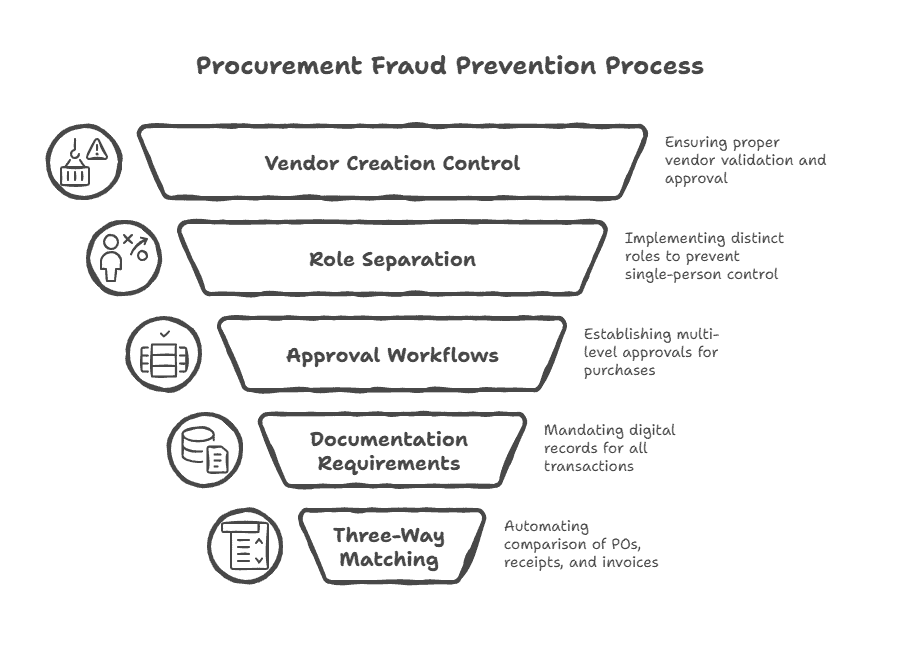
ProcurementExpress requires independent approval for all new vendors. The person requesting a vendor addition cannot be the person who approves it. The system maintains complete audit trails: who requested the vendor, who approved it, when approval occurred, and what validation was performed. Suspicious patterns—vendors sharing addresses with employees, vendors with individual names rather than business entities, or unusual banking information—trigger automatic review flags. An integrated tool allows users to quickly verify entity status on official registries, streamlining vendor validation.
The platform enforces four distinct roles that cannot overlap: Team Members create purchase requests but cannot approve. Approvers authorize purchases within defined limits but cannot create vendors or process payments. Finance processes invoices but cannot initiate purchases or approve their own submissions. Company Admins configure permissions but cannot circumvent the approval chain.
This structural separation makes single-person fraud impossible. Even if someone wanted to create a fraudulent transaction, the system requires other people to participate at multiple stages. The fraud would need to involve conspiracy across roles—dramatically increasing risk of detection and requiring multiple people to compromise their ethics simultaneously. The distinction between buyer and seller is clearly defined in the system, with each party’s responsibilities and actions tracked for transparency.
Purchase approvals route automatically based on dollar thresholds and organizational hierarchy. A $500 purchase might require one manager approval. A $5,000 purchase routes to department head. A $50,000 purchase requires CFO approval. A $500,000 purchase needs CEO authorization.
These workflows cannot be bypassed. Even administrators cannot approve their own purchases or skip approval levels. The audit trail shows every approval with timestamp and user identification, creating permanent records that auditors and management can review. Approval workflows can be tailored to suit the unique needs and structure of each organization, ensuring flexibility and control.
All purchases occur through the system with digital records. Paper invoices get scanned and attached. Supporting documentation—quotes, bids, specifications, delivery confirmations—link directly to purchase orders. The system won’t process transactions without required documentation, eliminating the manual data entry that enables fraud. Each purchase order must include a clear description and quantity of goods or services to ensure accurate fulfillment and validation.
ProcurementExpress automatically compares three documents: the purchase order (what was authorized), the receiving document (what was delivered), and the invoice (what’s being billed). Discrepancies halt payment and trigger review. An invoice for goods never ordered? Blocked. An invoice exceeding the purchase order amount? Flagged for approval. An invoice without corresponding receipt? Held for verification.
This matching happens automatically, instantly, and cannot be overridden by the person who created any of the three documents. It requires an independent reviewer to resolve discrepancies. When goods are received, a delivery note is attached and signed to confirm satisfactory condition, providing an additional layer of documentation.
Every stakeholder sees relevant budget information in real-time. Department heads see their departmental spending. Project managers see project budgets. Finance sees organizational totals. Board members can access summary dashboards. This democratized visibility means unusual spending patterns become visible to multiple people simultaneously. Real-time budget visibility also supports better financial planning, budget vs. actuals variance analysis, and spend management.
When someone attempts to spend 28% of an annual budget in one quarter, everyone with budget visibility sees it. When a new vendor suddenly receives large payments, the pattern appears in real-time reports. When spending deviates from historical norms, alerts fire automatically, much like the standardized, location-level insights provided by multi-site healthcare financial reporting frameworks.
Because all transactions flow through the system with complete documentation and approval chains, reconciliation becomes verifiable by multiple parties. Bank statements should match system records. Any discrepancy indicates either system error or external fraud—not internal manipulation.
Finance cannot hide transactions because they exist in the system with approval trails. Management can audit the complete transaction history independently. External auditors can extract complete records without relying on finance to filter or summarize.
Reports generate directly from transaction data without human filtering. Board members can access purchase summaries by vendor, department, or time period. Management can review approval patterns, budget utilization, or vendor concentration. These reports pull from the source system—they cannot be altered or filtered by the people whose activities they monitor.
The platform includes automated alerts for suspicious patterns: round-number transactions (often indicating estimates rather than actual invoices), excessive purchasing from new vendors, split purchases designed to stay under approval thresholds, or unusual purchasing outside normal business patterns.
These alerts fire immediately when patterns emerge, enabling real-time intervention rather than post-audit discovery. The system learns normal patterns for each organization and flags deviations automatically.
New vendors require documentation: business registration, tax identification verification, and banking information validation. The system can flag vendors sharing addresses with employees, vendors with suspicious naming patterns, or vendors lacking proper business credentials.
Integration with vendor verification databases provides additional validation, checking submitted information against official business registries and fraud databases.
Traditional fraud controls focus on detection: finding fraud after it occurs through audits, reviews, and investigations. This approach accepts that fraud will happen and focuses on minimizing its duration and impact. There is a clear difference between traditional paper-based procurement and digital solutions—ProcurementExpress shifts the focus to prevention by automating controls and reducing manual intervention.
ProcurementExpress represents a fundamental shift to prevention: making fraud structurally impossible through systematic controls. This isn’t about trusting people less—it’s about removing the temptation and opportunity entirely.
When employees know the system makes fraud impossible, they don’t waste mental energy considering it. When managers know controls protect the organization, they can focus on strategy rather than surveillance. When boards know systematic protections exist, they can govern with confidence rather than suspicion.
Perhaps counterintuitively, systematic controls actually improve organizational culture rather than degrading it. When everyone knows that fraud is impossible, trust increases. Employees aren’t suspected of potential theft. Management doesn’t need to implement surveillance or second-guess their team. Finance isn’t burdened with investigating every anomaly.
The controls protect both the organization and the employees. Someone facing financial crisis cannot succumb to temptation because the opportunity doesn’t exist. An employee under pressure cannot rationalize “just this once” because the system prevents it. The organization avoids devastation, and the employee avoids destroying their career and freedom, while leaders such as healthcare and medspa practice managers can focus on financial KPIs that drive sustainable performance instead of reacting to control failures.
Users can create and manage purchase orders directly through the ProcurementExpress website using any modern computer, and the software is designed to be capable of use by anyone with basic computer skills. The process is not complicated, and the software is specifically designed to make procurement less challenging for growing businesses. For organizations that need broader financial leadership but aren’t ready for a full-time CFO, partnering with fractional CFO services from CFO Pro Analytics can extend these operational controls into strategic planning and performance management. New users are encouraged to sign up or sign in to access the full features of the platform.
ProcurementExpress tracks the invoice due date to ensure timely payments and avoid late fees. Once an invoice is approved and payment is made, the purchase order is marked as processed and paid in the system, providing a clear record of financial completion.
The platform supports both sales and purchase transactions, including the ability to record deals involving goods or services. While some companies sell software outright, others license it to generate ongoing profit. Certain goods, such as food items, are covered by specific warranty provisions in procurement contracts. Procurement transactions are often governed by specific articles of commercial law, such as Article 2 of the UCC, which defines the scope of sales and related obligations. The system also allows for the management of deals involving intangible rights, such as copyrights, and tracks the quantity and description of goods in each transaction—creating the clean, defendable data room that underpins metrics and reporting for SaaS fundraising.
Course of dealing, course of performance, and usage of trade can influence the interpretation of procurement agreements, ensuring that established business practices are considered. In the event of disputes, principles of equity may supplement contract law to ensure fairness in procurement disputes, just as disciplined measurement of marketing spend ROI for medspas and clinics ensures that commercial relationships are evaluated on long-term economic fairness rather than superficial metrics.
For oral or informal agreements, it is important to send a written notice within the required period to ensure enforceability and avoid objections under the merchant confirmation exception, much like rigorous SaaS cohort analysis to track customer behavior over time ensures that performance expectations remain aligned with real-world data rather than assumptions.
In an era where fraud costs businesses billions annually, the organizations that implement systematic prevention gain multiple advantages: lower insurance costs, stronger stakeholder confidence, reduced audit expenses, and protection against devastating losses—especially when prevention is paired with robust financial reporting frameworks for complex businesses that translate clean transaction data into actionable insight.
But beyond financial benefits, systematic controls enable growth. Businesses can scale operations confidently, distribute financial authority appropriately, and empower teams without creating vulnerability. The owner can step back from day-to-day cash management without introducing risk.
For organizations at that critical growth stage—where single-threaded cash control through the owner no longer scales but distributed authority creates vulnerability—ProcurementExpress provides the bridge. It enables sophisticated division of duties without introducing the gaps that enable fraud.
Finally, the purchase order process concludes with final approval or payment completion, ensuring every transaction is fully documented and secure.
The question isn’t whether fraud could happen to your organization. The question is whether your current controls make it impossible. If the answer is anything other than absolute certainty, the gaps exist. And in business, gaps don’t remain empty—they get exploited.
ProcurementExpress systematically eliminates opportunities for fraud by enforcing role separation, multi-level approvals, automated three-way matching of purchase orders, receipts, and invoices, and real-time budget visibility. These controls make fraudulent transactions technically impossible rather than merely detectable, protecting businesses from common vulnerabilities in procurement processes.
Yes, small and medium-sized businesses can greatly benefit from ProcurementExpress. The platform simplifies procurement by automating approval workflows, vendor management, and invoice processing, reducing manual errors and saving time. It also helps small businesses manage cash flow more effectively and scale their operations securely without increasing fraud risk, avoiding many of the cash flow mistakes that can derail growing SaaS startups.
Real-time budget visibility allows stakeholders at various levels—such as department heads and finance teams—to monitor spending against budgets instantly. This transparency helps detect unusual spending patterns early, supports better financial planning, and ensures that purchases stay within approved limits, thereby reducing the risk of overspending and fraud.
Connect with CFOProAnalytics for smarter business decisions today.
Salvatore Tirabassi is an accomplished leader and strategist with over 25 years of diverse industry experience. His expertise spans finance, accounting, analytics, credit risk, data science, and strategy.