The Real Cost of DIY Financial Operations
in Fractional CFO, CFO Services, Fractional CFO, Roles of a Fractional CFO, All Posts
Table of Contents
- The Hidden Multiplication of Inexpertise
- What Founders Mean When They Say “I’ve Got This”
- How DIY Finance Damage Compounds Over Time for Financial Health
- Year One
- Year Two
- Year Three
- Year Four
- What Financial Expertise and Cash Flow Management Actually Mean
- The Investor Perspective Founders Rarely See
- The Scaling Ceiling
- What Proper Financial Support Changes
- Clarity Replaces Confusion
- Confidence Replaces Anxiety
- Strategic Financial Plan Replaces Reaction
- Freedom Replaces Burden
- Why the Fractional CFO Model Works for Business
- Making the Shift
- Frequently Asked Questions
- What’s the difference between what my CPA does and what a fractional CFO provides?
- How quickly does ROI show up?
- Can’t I just train my controller to do this?
I sat across from a business owner last week who proudly told me he’d saved $200,000 by handling his company’s finances himself rather than hiring professional help. His bookkeepers processed transactions. His CPA handled taxes. He managed everything else — budgeting, forecasting, and strategic capital decisions.
TL;DR: DIY financial operations create hidden costs that dwarf apparent savings. One founder who “savfounder0K ultimately lost an $8M acquisition due to weak financial controls uncovered during due diligence. The gap between basic accounting and strategic financial leadership compounds over time, limiting growth and suppressing valuation. Fractional CFO services close this gap without the $300K+ cost of a full-time hire.
Then I asked him about the acquisition offer he’d turned down six months earlier.
The buyer walked away after three weeks of diligence, citing unclear reporting, weak financial controls, and concerns about the company’s financial health. The deal would have netted him $8 million.
He saved $200,000 — and lost $8 million.
That’s the real math of DIY financial operations.
The Hidden Multiplication of Inexpertise
Most founders know they’re not accountants. They trust their bookkeepers to record transactions and their CPAs to file taxes correctly.
What they underestimate is the enormous gap between basic accounting and the level of financial expertise required to scale a business responsibly.
When founders manage finances themselves, they often:
- Make decisions using incomplete or misleading information, without ensuring data accuracy
- Confuse profitability with cash availability
- Rely on intuition where structured financial analysis is required
- Overlook the risk of not accurately tracking financial transactions, which can lead to unreliable records and compliance issues
The danger isn’t obvious at first. The business keeps growing. Revenue increases. Problems feel manageable.
Then suddenly, a bank conversation goes sideways. An investor meeting stalls. A strategic opportunity evaporates because the financial story doesn’t hold up under scrutiny.
What Founders Mean When They Say “I’ve Got This”
When business owners say they handle finances themselves, here’s what that usually looks like in practice.
They spend 10–15 hours per week on low-value administrative finance tasks — reviewing transactions, fixing reports, managing compliance issues and regulatory compliance that shouldn’t require founder involvement.
They make high-impact decisions based on instinct rather than structured financial planning. Expansion feels right. Debt seems manageable. Pricing changes get postponed. These choices work — until they don’t.
They struggle to explain their numbers to outsiders or connect them to performance metrics. Bankers ask questions they can’t answer cleanly. Investors probe assumptions that haven’t been stress-tested. Confidence erodes quickly.
How DIY Finance Damage Compounds Over Time for Financial Health
The real harm of DIY financial operations isn’t immediate. It compounds quietly.
Problems surface late, often after they’ve already caused damage. Missed opportunities for growth or cost savings go unnoticed. Without proper risk management, businesses are more vulnerable to unforeseen events and market volatility, which can threaten stability and long-term success.
Resources are misallocated, and visibility into performance is poor. This lack of insight makes it difficult to adjust strategies in response to changing market conditions, leaving the business less flexible and less able to capitalize on new opportunities.
Year One
Spreadsheets work well enough, but operational efficiency is often overlooked at this stage. Systems feel unnecessary. The business grows despite inefficiency, demonstrating that early business growth can occur even without optimized processes.
Year Two
Hiring accelerates without clear financial planning, leading to inefficient resource allocation. Compensation becomes inconsistent. Profit margin begins eroding without obvious explanation.
Year Three
Compliance complexity increases — multiple states, new financial reporting requirements, more scrutiny. Manual processes strain under the weight, putting additional pressure on the finance team.
Year Four
A major opportunity appears: capital raise, acquisition, or exit. Suddenly, all the shortcuts taken over the years surface at once — and investors notice immediately, especially when key performance indicators (KPIs) are missing or poorly defined.
Founders assume clean books equal readiness. They don’t.
What Financial Expertise and Cash Flow Management Actually Mean
Bookkeepers and CPAs are essential. But they don’t provide strategic financial leadership or the financial strategy needed to drive long-term success.
That requires someone who has:
- Built financial systems across multiple companies
- Led organizations through acquisitions, fundraises, and exits
- Designed forecasting frameworks tied to real operational drivers
- Managed cash flow strategically, not reactively
- Navigated complex decisions around debt, equity, pricing, and expansion
- Designed a strategic financial plan that aligns financial goals with long-term business strategy and adapts to market changes
This expertise doesn’t come from theory. It comes from repetition — seeing patterns across many companies, learning from outcomes, and ensuring every decision aligns with business objectives.
The Investor Perspective Founders Rarely See
Sophisticated investors aren’t just reviewing numbers. They’re evaluating maturity and the company’s performance.
They assess whether founders understand unit economics, cost structure, profitability levers, and the key components of financial operations. They look for scenario planning, not optimistic forecasts.
Within an hour, experienced investors can tell whether a company has professional financial leadership or founder-led improvisation.
You can’t fake this. Memorizing metrics before a pitch doesn’t replace disciplined financial thinking built over time, which is often supported by financial analysts who examine financial data, assess performance, and provide actionable insights.
The Scaling Ceiling
DIY financial operations eventually cap growth.
Everything flows through the founder. Decisions bottleneck. Problems surface late. Resources get misallocated because visibility into business operations is poor.
Eventually, growth stalls or crisis hits — cash crunches, employee turnover, missed opportunities — and financial stability is put at risk.
The business doesn’t fail because the product is bad. It fails because the financial foundation isn’t aligned with organizational goals and can’t support more weight.
What Proper Financial Support Changes
When founders finally bring in experienced financial leadership, the shift is often dramatic. Building a strong financial foundation becomes a priority, aligning financial goals with long-term strategies to support growth, investment, and risk management.
With this foundation in place, businesses are better positioned to identify and capitalize on future opportunities, ensuring they are prepared for upcoming market changes and can sustain long-term success.
The benefits of experienced leadership extend beyond day-to-day management—companies gain a competitive edge through strategic and adaptable financial planning, helping them maintain market advantage and avoid the pitfalls that come with poor financial operations.
Clarity Replaces Confusion
Decisions are evaluated against clear financial frameworks, supported by real-time insights for immediate, data-driven decision-making. Cash needs are projected, not guessed.
Confidence Replaces Anxiety
Founders stop worrying about what they might be missing. Conversations with banks and investors become productive and focused on making informed decisions, rather than stressful.
Strategic Financial Plan Replaces Reaction
Problems are anticipated months in advance through a proactive approach to strategic financial planning and market analysis. Opportunities are evaluated thoughtfully, not rushed.
Freedom Replaces Burden
Founders return to the work that actually creates value — leading, selling, building — instead of managing spreadsheets.
Why the Fractional CFO Model Works for Business
Most mid-sized companies need CFO-level expertise — just not full-time.
Fractional CFO services solve this by aligning cost with value and optimizing your cost structure. During intensive periods, engagement increases. During steady periods, it scales back.
You’re not developing expertise internally. You’re accessing professionals who have already guided dozens of companies through your exact situation and can enhance your finance function.
That flexibility allows companies to invest in outcomes, not overhead, and enables more strategic resource allocation.
Making the Shift
Founders often resist external help because DIY finance “worked” so far.
But what worked at $3M breaks at $10M. What worked at $10M fails at $25M. Approaches that once seemed effective can become obstacles to long-term growth as your business scales.
The question isn’t whether you’re capable. It’s whether managing finance yourself is the highest and best use of your time — and whether your business can afford the risks.
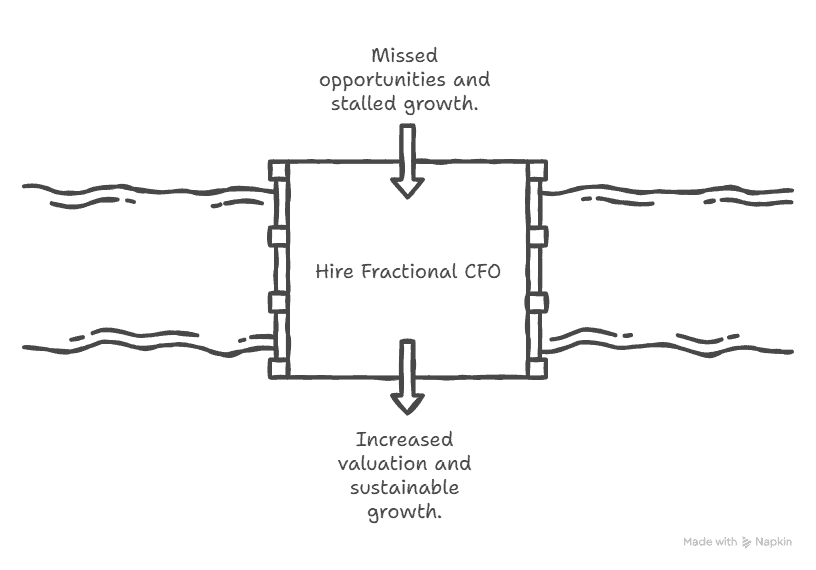
The manufacturing CEO who lost that $8M deal eventually brought in fractional CFO support. Within 90 days, his financial infrastructure met institutional standards, setting the stage for future success.
Six months later, another buyer approached. That deal closed — at a higher valuation.
Saving $200K cost him millions. Investing in expertise made it back and helped shape the business’s future.
Frequently Asked Questions
What’s the difference between what my CPA does and what a fractional CFO provides?
Your CPA focuses on compliance and accuracy — tax filings, accounting standards, regulatory requirements. A fractional CFO provides forward-looking strategic leadership: forecasting, capital planning, cash flow strategy, investor preparation, and decision support. CPAs protect you from mistakes; CFOs position you for growth.
How quickly does ROI show up?
Most companies see impact within 60–90 days through improved cash visibility, better decision-making, and reduced risk. For companies preparing for capital events, ROI can be dramatic — often measured in millions of dollars of preserved or increased valuation.
Can’t I just train my controller to do this?
Controllers excel at operational finance. CFO wocontrollers different experience — guiding companies through fundraising, acquisitions, scaling, and exits. The most effective structure pairs a strong controller with fractional CFO oversight, allowing each to focus on their strengths.

Salvatore Tirabassi is a fractional CFO and financial forecasting expert who helps growing businesses build sophisticated financial models that drive strategic decisions. With expertise in integrating operational data into financial planning, he specializes in creating 3-statement forecasts that serve multiple business functions from budgeting to investor relations.
You can connect with Salvatore on LinkedIn or learn more about his fractional CFO services at CFO Pro+Analytics.
For more on this topic, read our how a fractional CFO manages board communications and financial due diligence 90-day roadmap to an exit.