When Fractional CFO Can Solve Founder Bottlenecks Costing You Growth
in Fractional CFO, CFO, CFO Pro+Analytics, CFO Services, Finance, Financial Leadership, Fractional CFO, Fractional CFO Services, Roles of a Fractional CFO, All Posts
Table of Contents
- The Founder Finance Trap
- What “Bottleneck” Really Means
- Delayed Decisions
- Missed Opportunities
- Exhausted Leadership
- Constrained Hiring
- Evaluating Financial Needs
- The Full-Time CFO Dilemma
- How Fractional CFO Services Bridge the Gap
- What Experienced Fractional CFOs Actually Do
- Strategic Financial Planning
- Cash Flow Management
- Capital Event Preparation
- Infrastructure Development
- The Economics That Actually Matter
- Why Fractional CFO Experience Is Different
- What the Transition Looks Like
- Signs You’re Ready
- Achieving Business Goals
- The Strategic Difference
- Moving Forward
- Frequently Asked Questions
- How much does a fractional CFO typically cost compared to a full-time CFO?
- What’s the difference between a fractional CFO and a consultant?
- How do I know if my business is ready?
Throughout my years working with established businesses, I’ve watched the same pattern unfold dozens of times. A founder bufoundercompany from nothing to $5 million, then $10 million, then $20 million in revenue. Success creates its own set of complex financial challenges. The same hands-on approach that fueled early growth now prevents the business from reaching its next stage.
TL;DR: Founder-led financial operations become bottlenecks as businesses scale beyond $5M in revenue. While full-time CFOs cost $250K–$400K annually, fractional CFO services provide high-level expertise at $5K–$20K monthly, scaling with your needs. This allows founders to focus on growth while experienced professionals handle strategic financial planning, cash flow management, and infrastructure development.
Last month, I met with a manufacturing company CEO who hadn’t taken a full day off in eighteen months. Not because production demanded his presence. Not because sales required his attention. He was trapped in an endless cycle of reviewing expenses, approving payments, reconciling accounts, and preparing reports for his board.
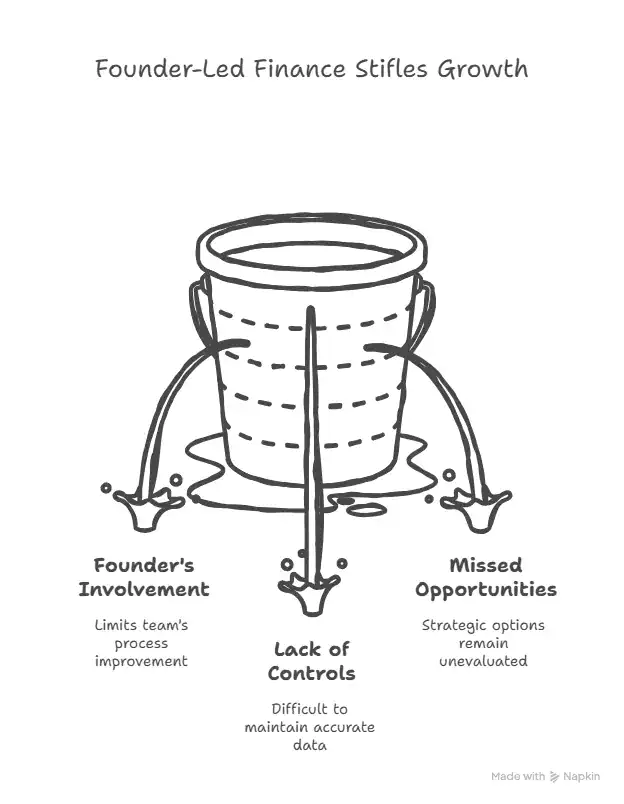
His finance team—including the accounting team—couldn’t move without his signature. The accounting team, in particular, was slowed by the founder’s constant involvement, which limited their ability to improve processes and support strategic planning. The lack of robust internal controls further contributed to this bottleneck, making it difficult to maintain accurate financial data and ensure compliance. His leadership team waited days for answers to basic financial questions. Meanwhile, three strategic opportunities sat untouched because he couldn’t find the time to evaluate them properly.
This is the hidden tax of founder-led finance. You can’t see it on an income statement, but it quietly destroys growth.
The Founder Finance Trap
When a business expands beyond roughly $5 million in annual revenue, something fundamental changes. Financial operations that worked with twenty employees and simple accounting now require a finance professional with specialized expertise developed over years, not weekends—expertise that goes well beyond basic compliance.
Bookkeepers record the past. Accountants ensure compliance. But no one is responsible for translating financial data into forward-looking strategy.
Most companies hit this inflection point between $8 million and $15 million in revenue. Growth outpaces financial clarity. Customer segments multiply. Product lines expand. Suddenly, founders are facing decisions with real consequences:
- Should we raise debt or equity?
- Where are margins actually coming from?
- Which investments create value versus drain cash?
- When should we upgrade systems, such as accounting software, or implement systems to scale financial operations instead of pushing spreadsheets further?
These are not controller questions. These are questions for a chief financial officer—someone who has navigated these transitions repeatedly across different companies.
What “Bottleneck” Really Means
Founder bottlenecks aren’t abstract. They show up in specific, costly ways.
Delayed Decisions
When every financial decision requires founder approval, the business moves at the speed of one person’s calendar. Capital purchases that could improve margins sit idle. Pricing changes wait weeks. Opportunities decay while waiting for attention.
Missed Opportunities
Strategic planning requires uninterrupted thinking. Founders buried in transaction-level finance rarely have space to pursue acquisitions, partnerships, or expansion opportunities. I’ve seen companies lose deals simply because leadership couldn’t dedicate time to financial diligence.
Exhausted Leadership
Founder energy is finite. Every hour spent reviewing expense reports is an hour not spent growing the business. Over time, something breaks — health, relationships, or the business itself.
Constrained Hiring
Talented finance professionals don’t want to operate in environments where everything funnels through the founder. Bottlenecks repel senior talent and trap companies in execution-only finance teams.
Evaluating Financial Needs
The reality is that most business owners jump into fractional CFO relationships without properly diagnosing their financial pain points—and I’ve seen this cost companies $150,000 to $300,000 in misaligned consulting spend. In my CFO travels, I consistently encounter the same scenario: a manufacturing client recently told me their monthly financial close took 22 working days, cash flow forecasting was essentially guesswork (they were off by $247,000 in Q3 alone), and their “strategic planning” consisted of Excel spreadsheets updated whenever someone remembered. Consider this: if your financial statements require three follow-up calls to understand basic variances, or if you’re discovering cash shortfalls with less than 15 days of runway remaining, these aren’t accounting problems—they’re operational blind spots that require sophisticated financial architecture.
Here’s how I approach this evaluation with clients: I spend the first week analyzing their financial reporting velocity, cash conversion cycles, and the precision of their planning assumptions. One client’s books showed 47% variance between projected and actual working capital needs over six months—that’s not market volatility, that’s systematic forecasting failure. A seasoned fractional CFO (myself included) identifies these patterns within the first 30 days and implements measurement frameworks that transform reactive fire-fighting into proactive financial management. What’s particularly fascinating is how granular operational data reveals strategic opportunities: when we implemented proper cash flow modeling for a $8.2 million revenue client, we identified $180,000 in working capital optimization that became their growth funding for the following year. The sophistication extends beyond financial reporting—it’s about building a finance function that generates strategic advantage rather than historical summaries.
The Full-Time CFO Dilemma
When founders recognize the problem, the instinctive response is to hire a full-time CFO.
On paper, it makes sense. In practice, it’s often the wrong move.
A capable CFO costs $250,000–$400,000 annually in salary, benefits, bonuses, and equity. Choosing an in house CFO can create a significant financial burden for companies in the $5M–$20M revenue range, as the total cost is often prohibitive. For companies doing $5M–$20M in revenue, this creates one of two bad outcomes:
- Hiring someone less experienced than required
- Overpaying for expertise that isn’t needed full-time
Fractional CFO cost, by contrast, is much more flexible and affordable, with options such as hourly, daily, monthly retainer, or project-based fees that scale with your needs.
Add hiring risk, long-term commitment, and opportunity cost, and many companies realize they’re stuck between underpowered and overcommitted.
There is another option.
How Fractional CFO Services Bridge the Gap
Fractional CFO services, also known as fractional chief financial officer services, provide experienced financial leadership without the cost or rigidity of a full-time hire.
Instead of paying for 40 hours per week, companies engage CFO-level expertise for the exact level of support required — whether that’s 10 hours monthly or 20 hours weekly during major initiatives. Many businesses work with fractional CFO firms, such as Focus CFO, to source qualified financial executives. This outsourced CFO model offers a flexible way to access specialized expertise and seamlessly integrate with existing teams.
A fractional CFO acts as a strategic partner to the leadership team, delivering strategic insight that supports high-level decision-making and aligns financial strategies with business goals.
These professionals have already guided dozens of companies through:
- Capital raises
- Acquisitions
- Financial system rebuilds
- Growth planning
- Board and investor reporting
They bring pattern recognition and proven frameworks that founders simply don’t have time to develop on their own.
What Experienced Fractional CFOs Actually Do
The value of a fractional CFO isn’t just task relief. It’s strategic transformation powered by the fractional CFO’s expertise and the business benefits they deliver. By providing strategic financial leadership, a fractional CFO supports business growth, helping companies scale and achieve long-term success.
Fractional CFOs bring essential financial skills to your organization, offering the specialized knowledge and insight typically reserved for full-time executives, but at a fraction of the cost. Their expertise is available on-demand, providing critical financial guidance during key decision points and helping your business adapt to changing needs.
In addition to building robust financial infrastructure, fractional CFOs leverage key performance indicators in financial reporting and analysis. This ensures accurate, compliant statements and enables data-driven decision-making by tracking business health and progress through dashboards and regular monitoring.
Strategic Financial Planning
They align financial targets with real operational capacity. Not generic benchmarks — company-specific plans grounded in reality.
Cash Flow Management
Cash management becomes proactive. Patterns are monitored, risks identified early, and contingency plans built before problems emerge.
Capital Event Preparation
Whether raising capital or preparing for exit, experienced CFOs ensure companies aren’t learning during due diligence. They develop a comprehensive fundraising strategy, manage investor relations to facilitate clear communication and trust with stakeholders, and ensure all financial documents are thoroughly prepared and organized. Weaknesses are addressed before they become deal-breakers.
Infrastructure Development
Fractional CFOs don’t just work around limitations — they fix them. Systems, reporting, team structure, and controls are designed to scale beyond their engagement, including optimizing capital structure to ensure financial flexibility and support long-term growth.
The Economics That Actually Matter
A $300,000 full-time CFO is paid regardless of workload. Fractional CFO services typically range from $5,000 to $20,000 monthly depending on scope, making them a highly cost effective solution for startups and small businesses seeking expert financial leadership.
Even at the high end, companies access equivalent expertise at a fraction of the cost — without benefits, bonuses, or long-term commitment. Many fractional CFOs serve multiple clients simultaneously, allowing them to bring broad industry insights and best practices to each engagement. Businesses may also engage many fractional CFOs over time or for different projects to address evolving financial needs.
More importantly, the engagement scales. Support increases during fundraising or budgeting, then scales back once systems are stable, enabling cost saving strategies such as process automation, improved cash flow management, and streamlined accounting functions.
You pay for outcomes, not idle capacity.
Why Fractional CFO Experience Is Different
Fractional CFOs work across multiple companies simultaneously. This isn’t a weakness — it’s an advantage.
They see patterns across industries. Solutions from one sector apply to another. Lessons learned last quarter become advantages today.
They stay current because their credibility depends on it. Banking relationships, investor expectations, regulatory changes — all remain top of mind. By networking with other financial professionals—through industry events, professional organizations, and referrals—fractional CFOs connect with financial professionals to share best practices and stay updated on the latest trends.
What the Transition Looks Like
Most engagements begin with discovery. The CFO assesses not just financials, but goals, systems, team structure, and future plans, ensuring the roadmap aligns with future growth objectives.
From there, a roadmap emerges:
- Immediate cleanup where needed
- System and reporting improvements
- Clear division of responsibilities
- Scaled engagement based on value
This process is particularly beneficial for small business owners and small businesses looking to scale, as it provides strategic financial leadership and positions them for sustainable expansion without the cost of a full-time CFO.
Often, companies start with a project and expand once results are visible.
Signs You’re Ready
Fractional CFO services make sense when:
- Your team can process transactions but not explain strategy
- You’re preparing for fundraising, acquisition, or exit
- Opportunities are delayed due to financial uncertainty
- Reporting takes days instead of hours
- You spend 10+ hours weekly on finance instead of growth
Achieving Business Goals
The reality is that 73% of growing businesses fail not from lack of ambition, but from financial missteps that could have been prevented. Consider the manufacturing client I worked with last quarter—they were projecting $4.2 million in revenue but burning through $180,000 monthly in inefficient cash allocation. Their vision was solid, their market opportunity real, but their financial strategy was killing them slowly. Here’s how a fractional CFO transforms that equation: by delivering the strategic financial expertise that turns ambitious goals into quantified, achievable outcomes. In my CFO travels, I’ve seen companies increase their forecast accuracy by 47% within 90 days through disciplined financial modeling and proactive cash flow management.
What’s particularly fascinating is how specific operational improvements compound into strategic advantage. Take capital allocation challenges—one of my SaaS clients was hemorrhaging $89,000 quarterly on misallocated resources before we implemented systematic financial reporting protocols. Result: 31% improvement in resource efficiency within six months. Whether you’re navigating a Series A raise (where I’ve helped clients secure $2.3 million against initial $1.8 million targets) or optimizing working capital cycles, the sophistication of fractional CFO guidance means your leadership team stops making decisions in financial darkness. The difference between a 12% margin and an 18% margin isn’t luck—it’s the compound effect of informed financial decision-making at every operational touchpoint.
This is where fractional CFO partnership delivers transformational competitive advantage. I’ve watched businesses accelerate their growth trajectory by 156% simply by having expert financial leadership that connects daily operational metrics to long-term strategic positioning. From resolving the cash flow challenges that strangle 34% of otherwise-profitable companies to building financial structures that attract institutional investment, the right fractional CFO becomes your strategic multiplier. In today’s market environment, where 67% of business failures trace back to financial mismanagement, having sophisticated financial leadership isn’t just competitive advantage—it’s survival insurance that drives sustainable, measurable business outcomes.
The Strategic Difference
Companies that thrive with fractional CFO support gain more than financial help — they gain clarity.
Decisions are grounded in data. Growth plans are stress-tested. Founders reclaim time and energy.
Instead of reconciling accounts, leaders build relationships. Instead of preparing reports, they build value.
Moving Forward
The real question isn’t whether you can afford fractional CFO services.
It’s whether you can afford to keep running your business through a financial bottleneck.
Every delayed decision compounds. Every missed opportunity reduces value. Every month spent trapped in finance is a month not spent growing the company.
The founder I mentioned earlier engaged a fractional CFO for 15 hours per week. Within sixty days, approval bottlenecks disappeared. Systems improved. Visibility increased. And for the first time in years, he took a real vacation.
That’s not just better finance. That’s better leadership, better growth, and a more valuable business.
Frequently Asked Questions
How much does a fractional CFO typically cost compared to a full-time CFO?
Fractional CFO services typically range from $5,000 to $20,000 per month, or $60,000–$240,000 annually. A full-time CFO often costs $250,000–$400,000 plus benefits and equity. Fractional engagements focus spending on strategic work rather than operational oversight.
What’s the difference between a fractional CFO and a consultant?
A fractional CFO becomes part of your leadership team, providing ongoing strategic guidance and accountability. Consultants typically deliver defined projects and exit. Fractional CFOs stay engaged over time.
How do I know if my business is ready?
If you’re generating $5M+ annually and spending significant time on finance, struggling with strategic decisions, or preparing for a major transition, you’re likely ready.

At CFO Pro+Analytics, we partner with founders and owners to deliver clarity, confidence, and control. Together, we can design a roadmap that connects your ambition with a sound financial strategy.
CLICK HERE to schedule a free 20-minute consultation call