The Hidden Cost of the Pivot: Why Failing Fast May Be the Most Expensive Strategy in the AI Era
AI has flattened the innovation economy, making product replication faster and cheaper than ever.
And in a market where product differentiation is temporary, customer acquisition and retention becomes the only durable competitive moat.
Those two conclusions lead directly to a third, which challenges one of the most deeply held beliefs in many tech-oriented businesses.
If customer acquisition is your scarcest and most expensive resource, then any strategy that treats acquisition as something you solve after you believe you created the right product is building on a structurally flawed foundation. The “pivot doctrine” does exactly that. And in the AI era, it may be the most expensive path for a founder, because what we are so accustomed to hearing about is built on this.
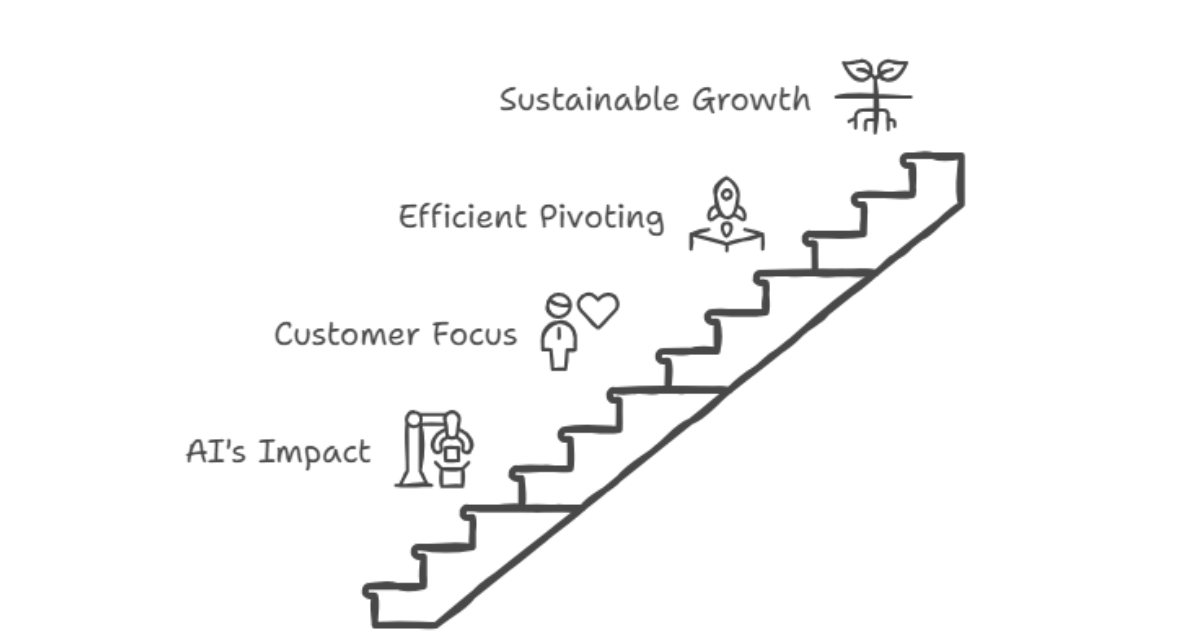
TL;DR: The pivot was always more comfortable for investors than for customers. When building was expensive and customers were patient, failing fast and redirecting was a rational use of capital. AI has collapsed the cost of building while simultaneously making customer acquisition more expensive and competitive. Testing multiple products in series or parallel multiplies CAC without compounding the relationship equity that makes acquisition efficient over time. Customer acquisition was always critical, but now it supersedes product development. Infuse your pivot strategy with AI so it is efficient and seamless. Focus on the client.
The Assumption the Pivot Doctrine Never Examined
The lean startup framework treated the pivot as essentially costless on the customer side. Sunk costs in product development were acknowledged and written off. The team redeployed. The next experiment began. Clean, rational, disciplined.
What was never written off, because it was rarely measured properly, was the customer acquisition cost embedded in the failed experiment. Every customer acquired for a product you are pivoting away from represents capital that cannot be redeployed to the next iteration. The CAC you spent to bring them in does not transfer. The trust you built, or failed to build, during the failed experiment shapes how the market perceives your next attempt. The brand signal you sent during the failed launch lives in the market longer than the product did. It also undermines the relationship capital you want to build and reinvest.
When you are testing products in series, each pivot restarts the relationship bank from a position that is weaker than where you started. When you are testing in parallel, you are running multiple acquisition engines simultaneously, each competing for the same customer attention. The relationship bank drain is not linear. It compounds with every iteration, depleting the relationship bank.
The Series Problem: Asking the Market to Forget
Testing products in series looks disciplined on a roadmap. In practice, it means asking your market to forget what you were yesterday and believe in what you are today. Relationship capital cost was less important before AI flattened innovation.
The internal champion who went to bat for your product is an asset to build on. Otherwise, your relationship bank decreases with every pivot. Deposit and avoid withdrawals.
There is a team dimension that rarely appears in pivot post-mortems. The people who believed in the first product, recruited customers for it, and built their professional identity around it experience a pivot as a loss. The best salespeople and customer success people in your organization are the ones with the deepest customer relationships. Those relationships were built around the product you just walked away from. You are asking them to rebuild from a starting position that is demonstrably weaker than before.
The motivational cost is real and it is rarely captured in the capital allocation models that justify the pivot decision. In a flattened innovation curve, this becomes even more critical to manage.
The Parallel Problem: There Are Big Challenges Here
In an AI innovation economy, testing multiple products simultaneously feels like diversification against failure. There are big challenges here.
Your customer acquisition resources are divided across multiple narratives, none of which is receiving the full organizational weight needed to break through in a noisy market. You are pitching multiple value propositions simultaneously, which almost guarantees that none of them land with the clarity required to build genuine customer relationships.
The deeper problem is that parallel experiments are not independent variables. You are not running multiple experiments. You risk running multiple interactions with buyers whose perception of your company is being shaped by all of them at once, or by weak messages and conviction. Prioritization and communication strategy will drive success.
The compound cost of parallel testing is not just resource allocation. It is the fragmentation of market credibility that makes customer acquisition possible at a sustainable cost.
The Capital Allocation Argument
This is where the financial logic lands with real force. The traditional VC model funds burn across multiple experiments on the assumption that one will find product-market fit and acquisition costs will normalize once the right product is identified. Working sequentially in the traditional pivot doctrine was possible with structured priorities. That math worked when customer acquisition was cheaper and the competitive field was narrower.
In the current environment, the CAC required to acquire a customer for an unproven product in a crowded market is substantially higher than the CAC required to expand an existing relationship or retain a customer who already trusts you. The capital efficiency argument points decisively toward getting the product right before acquiring customers at scale, not after. But if you have to develop in parallel, this feels really challenging.
The smarter sequencing in an AI-flattened market is research deeply, build deliberately, acquire selectively, and scale from a foundation of genuine customer relationships rather than from metrics that look like traction but are actually just activity. But if you have to develop products in parallel, this feels really challenging. AI can help for sure. But you need to be fast, efficient, and effective, as every customer acquired into a product that subsequently gets pivoted is not a neutral sunk cost. It is a debit from the relationship bank you need to succeed.
Who the Pivot Really Serves
The fail fast doctrine was always more comfortable for investors than for customers. Investors diversify across a portfolio of bets and can afford to write off the experiments that do not work. Customers do not diversify in the same way. When you fail fast on a customer, you are not running a clean experiment. You are making a withdrawal from a trust account that took real resources to build and that cannot be instantly replenished with the next product version. In this AI world, the trust account statements must be read and understood.
Burning through customer relationships in the pursuit of product-market fit may be the single most expensive strategy available.
The resource drain is not in the building, which AI has made cheap. It is in the acquiring, the losing, and the starting over, which AI has made more competitive and more costly than at any prior point.
Fail fast made sense when building was hard and customers were patient. Building is now easy and customers have more options than ever. In the AI era, the founders who recognize this earliest will have a significant and compounding advantage over those still running the old playbook, and their relationships with customers will drive success.
The new discipline is not about failing fast. It is about learning thoroughly before you acquire, so that when a customer chooses you, you have built something worth staying for. You have credit in your relationship account to prove it.
FAQ
If you cannot afford to pivot, what do you do when the market signals your product is wrong? The distinction is between a product adjustment and a full pivot. Adjusting based on customer feedback from a well-qualified customer base is healthy iteration. A full pivot that abandons the customer relationships you have already built is where the cost becomes prohibitive. The goal is to get close enough to right before you acquire that adjustments are refinements, not reversals.
How do you know when acquisition costs are compounding negatively from pivoting? Track CAC by cohort across product iterations. If each successive product launch requires higher acquisition cost to achieve the same conversion rate, that is the signal that market credibility is eroding. A healthy iteration cycle shows stable or declining CAC over time as the market learns to trust your direction. Rising CAC across pivots is the quantified cost of the trust deficit.
Does this mean early-stage companies should not experiment at all? Experimentation is essential. The question is what you experiment with and at what cost. Experimenting with positioning, messaging, pricing, and customer segment before acquiring at scale is low cost and high value. Experimenting with fundamentally different products using acquired customers as the test subjects is where you debit from your trust account. Front-load the experimentation to the pre-acquisition phase, where AI gives you more tools than ever to learn without paying the full relationship cost.
This article was originally published on CFOProAnalytics titled “The Hidden Cost of the Pivot: Why Failing Fast May Be the Most Expensive Strategy in the AI Era”,

Connect with CFOProAnalytics to explore how fractional CFO services can support smarter, principle-driven business decisions.
Salvatore Tirabassi is an accomplished leader and strategist with over 25 years of diverse industry experience. His expertise spans finance, accounting, analytics, credit risk, data science, and strategy.
Assess your CFO Needs in 5-Minutes