When Everyone Can Build, the Only Moat Is Who You Have and Why They Stay
in Fractional CFO, #FractionalCFO, AI, CFO Services, Finance, saas fractional cfo, All Posts
In my last post, I explored how AI has flattened the innovation economy, making product replication faster and cheaper than at any point in history. If anyone anywhere can build what you built, the natural follow-on question is uncomfortable:
What, exactly, is your competitive advantage?
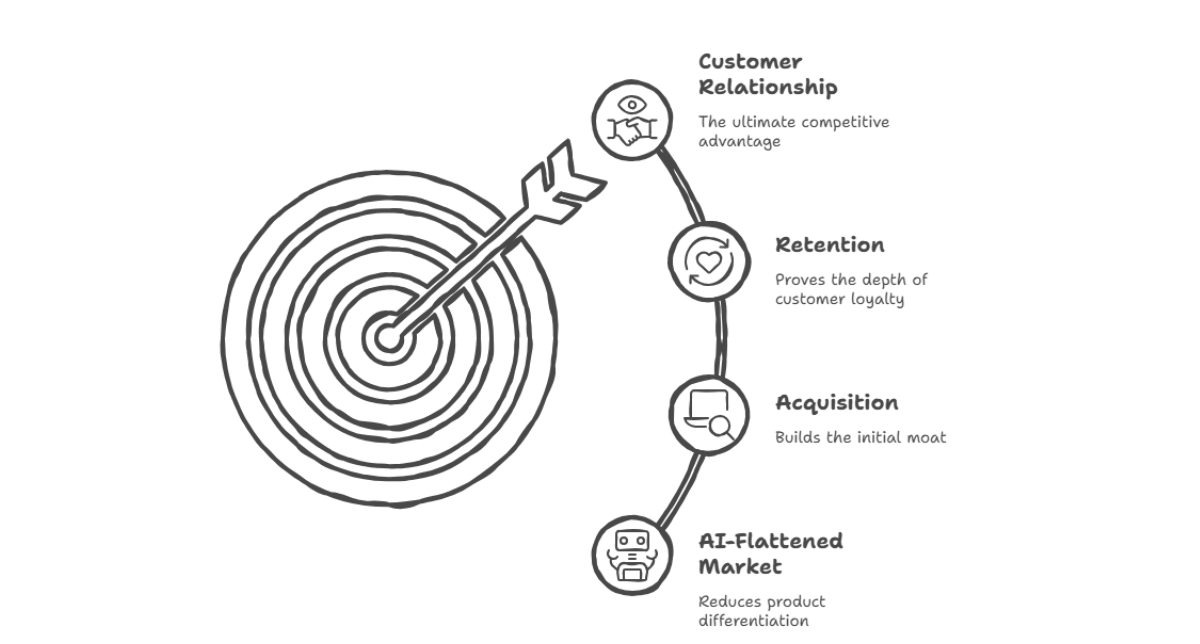
The answer is not your technology. It is not your roadmap. It is the customer who trusts you, has integrated your work into their operations, and would need a compelling reason to look elsewhere. Customer acquisition and retention is the last moat that AI cannot instantly commoditize. Time to make moves and reprioritize.
TL;DR: When product differentiation is temporary by definition, the durable competitive advantage shifts entirely to the customer relationship. Acquisition builds the moat. Retention proves its depth. But companies must avoid metrics that look like loyalty while building relationships that are actually just friction. In an AI-flattened market, that distinction is the difference between a business that has competitive barriers and one that will erode over time.
The Inversion Most Companies Have Not Processed
For most of the last three decades, the innovation economy rewarded builders. Build something nobody else could build, protect it with network effects or switching costs embedded in the product, and extract value from that position. The customer relationship was downstream of the product advantage. Get the product right, then worry about the customer. Some aspects of this still have value. For example, a technical solution deeply embedded in a client workflow. But don’t count on that forever.
AI inverts this sequencing. When product advantage is temporary, the customer relationship has to come first. You need to own the relationship before your product gets replicated, not after. This is a strategic reorientation that most leadership teams, and most investors, must internalize.
The businesses with the longest staying power understood this intuitively long before AI made it urgent. Consider why certain professional service firms survive for decades while technology vendors cycle through every few years. The firm survives because the relationship survives. The vendor gets replaced when something better comes along.
In an AI-flattened world, every product company is at risk of becoming a vendor unless it is also building something a vendor cannot offer: genuine trust.
One thing I want to note: regardless of your relationship strength, pricing pressure is going to affect almost everyone.
Stickiness Is Not the Same as Loyalty
Let’s discuss this because it changes how you should measure retention, and can be influenced with price.
Stickiness is a product characteristic. Switching costs, data lock-in, workflow integration, API dependencies. These are real and they matter. But they are replicable, and can be influenced with price. A well-resourced competitor can build a migration tool, discount the service, and remove the friction with a discounted service that was keeping your customer in place. Stickiness is a moat made of sand in a market where replication is cheap.
Loyalty is a relationship characteristic. The customer stays not because leaving is hard but because staying feels right. They trust your judgment. They believe you understand their problem better than a new entrant who has not earned that understanding yet. They have had experiences with your team that a competitor cannot instantly replicate regardless of product quality.
Loyal customers refer without being asked. They expand their relationship with you when their own business grows. They forgive product failures because they believe you will fix them. They advocate internally when a procurement committee is evaluating alternatives. Sticky customers do none of those things. They tolerate you until something better arrives.
In an AI-flattened market, your retention rate tells you how many customers you have. The behavior underneath that number tells you whether you have a moat or a countdown timer.
The CAC and LTV Reframe
Most discussions of customer acquisition cost and lifetime value treat them as financial metrics to be optimized in isolation. In the new competitive environment, they are strategic metrics that reveal the quality of your market position.
CAC tells you how efficiently you are building the moat. High CAC relative to competitors signals that you are fighting for attention in a crowded field without sufficient differentiation to make acquisition easier over time. That is an early warning signal, not just a unit economics problem.
LTV tells you how deep the moat actually is. But conventional LTV calculations, based on contract value and churn rate, miss the most strategically important dimension: the expansion and referral behavior of customers who have a genuine relationship with you versus customers who are merely retained by switching costs. It might be time for a subjective LTV score that looks at relationship strength, perhaps grounded in repeat buys but also professional relationships.
A customer retained by trust is exponentially more valuable than a customer retained by inconvenience. The first expands, refers, and advocates. The second leaves the moment someone removes the friction. In a world where AI makes friction removal trivially achievable, the composition of your retention matters as much as the rate. Your professional relationships matter more than ever.
Another question worth asking about your customer base is not only what percentage renews. It is what percentage would actively choose you again if starting from scratch today, with full knowledge of all available alternatives. That number is your real moat measurement.
What This Means for How You Acquire
If retention is the moat and acquisition is how you build it, then acquisition strategy has to be reoriented around relationship quality rather than volume. This is a direct challenge to growth-at-all-costs models that optimize for top-of-funnel metrics while treating customer fit as a post-sale problem. Make no mistake, AI will be your best friend here.
Acquiring the wrong customer is not a neutral outcome. It is a liability. A customer who was never a good fit churns visibly, damages your reference base, and consumes retention resources that should be invested in customers with genuine long-term potential. In a market where word of mouth and referral are increasingly the highest-quality acquisition channels, a portfolio of misfit customers is an active drag on your ability to acquire better ones.
The smartest acquisition strategies in the current environment are doing something that looks counterintuitive: they are slowing down at the top of the funnel to move faster at the bottom. More qualification before the sale. More honest conversations about fit. More willingness to walk away from revenue that does not belong in the portfolio. The goal is not to acquire the most customers. It is to acquire customers who will become the foundation of the referral engine that makes every subsequent acquisition cheaper and higher quality.
Spend time with your customers.
This brings us to the third and most challenging implication of the AI-flattened innovation economy. If customer acquisition is your most valuable and most expensive activity, what is the true cost of the “pivot”?
FAQ
If product differentiation is temporary, how do you earn customer trust before you have proven the product works? Spend time with your customers. You earn it through the quality of the sales and onboarding experience before the product fully proves itself. Customers decide whether to trust you based on how you show up in the relationship, not just what the product does. A team that listens carefully, sets honest expectations, and delivers on small commitments builds more trust faster than a superior product with a careless relationship.
How do you measure the difference between sticky customers and loyal ones? The simplest proxy is referral behavior. Sticky customers do not refer because they are not enthusiastic, they are just reluctant to leave. Loyal customers refer because they genuinely want others to have the experience they have had. Track unprompted referrals as a separate metric from overall retention and you will see the composition of your moat clearly.
Does this logic apply to consumer businesses as well as enterprise? Yes, though the mechanisms differ. In consumer, loyalty expresses itself through repeat purchase frequency, organic sharing, and resistance to switching when a cheaper alternative appears. The underlying dynamic is identical: trust retained by relationship outlasts retention retained by friction, and AI is systematically eliminating friction across every consumer category.
This article was originally published on CFOProAnalytics titled “When Everyone Can Build, the Only Moat Is Who You Have and Why They Stay”.

Connect with CFOProAnalytics to explore how fractional CFO services can support smarter, principle-driven business decisions.
Salvatore Tirabassi is an accomplished leader and strategist with over 25 years of diverse industry experience. His expertise spans finance, accounting, analytics, credit risk, data science, and strategy.
Access your CFO Needs in 5-Minutes