Pricing Psychology in Medspa Services for Conversion
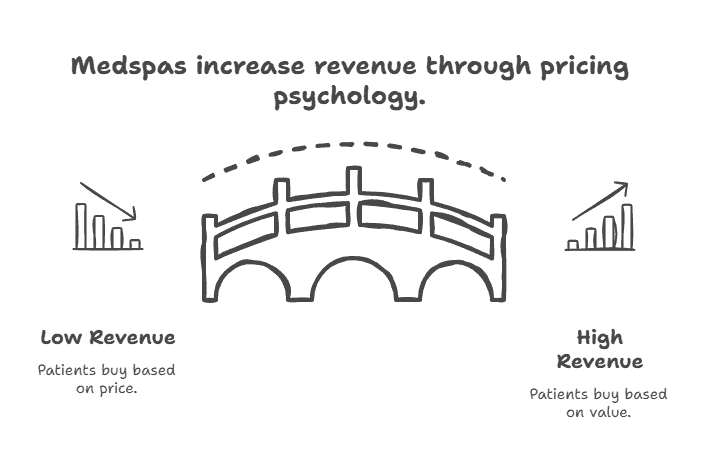
TL;DR: Pricing psychology is one of the most powerful — and underutilized — revenue levers in a medspa. Patients rarely buy based on clinical details; they buy based on perceived value, simplicity, framing, and emotional trust. We’ve seen practices increase average order value by 18–40%, improve conversion, reduce price sensitivity, and drive higher membership adoption simply by redesigning how services are *presented*, not by raising prices. Pricing psychology is not manipulation — it’s aligning pricing structure with how humans actually make decisions.
Why Pricing Psychology Matters More Than “Price”
Most medspa owners assume patients make logical, financially rational decisions:
– Compare price points
– Evaluate the provider
– Choose the best value
But in reality, patient decision-making is driven by:
– Emotion
– Confidence in the provider
– Simplicity of choice
– Anchors and price cues
– Social proof
– Loss aversion
– Trust signals
Patients don’t ask:
> “Is this the best price for this service?”
They ask:
> “Does this feel right for me, and do I trust the person recommending it?”
When pricing works with these psychological triggers instead of against them, conversion climbs dramatically — even if the actual price stays the same.
—
The 7 Psychological Principles Behind Medspa Pricing
We use these principles across hundreds of practices to improve revenue and patient experience simultaneously.
—
1. Anchoring: The First Number Sets the Frame
Anchoring means the first number a patient sees influences how every subsequent price is perceived.
Example:
If the first thing a patient sees is:
– $1,200 Package
Then a $425 neurotoxin appointment feels reasonable.
But if the first thing they see is:
– $11/unit toxin
Then the same $425 appointment feels expensive.
How to use anchoring correctly:
– Lead consultations with a high-value recommendation, even if the patient ultimately chooses less.
– Present a “Gold” tier first, not the cheapest option.
– Always show **full-face treatment pricing** before unit pricing.
Anchoring reframes value and increases average spend without pressure.
—
2. Tiered Pricing: Patients Buy Middle Options
Humans avoid extremes — they gravitate toward the middle choice.
This is called the Goldilocks effect.
Example medspa application:
“`
Signature Facial – $169
Advanced Corrective Facial – $229
Clinical Results Facial – $299
“`
Patients tend to choose the $229 option, even if previously they only purchased $169 services.
A properly designed tier structure:
– Pulls patients upward
– Increases margin
– Makes pricing feel more personalized
—
3. Bundling: Increase Value Perception & Reduce Price Sensitivity
Patients associate bundles with:
– Convenience
– Savings
– Confidence
– Reduced decision friction
But bundles don’t need deep discounts to work — they need clarity.
High-performance bundles include:
– Multiple modalities addressing the same concern
– Clear outcomes (“Full-face rejuvenation”)
– A simple narrative the provider can repeat
– Subtle, not aggressive, price advantages
Example:
– Treatment alone: $400
– Treatment + add-on: $540
– Bundle price: $499
Patients feel they’re receiving value, and the practice raises its average ticket size.
—
4. Scarcity & Urgency: Time-Based Framing
Scarcity increases perceived value. Patients take action when:
– Appointments are limited
– Promotions are clearly time-bound
– Membership benefits reset monthly
– Providers have waitlists
Scarcity works because it signals:
> “This must be valuable — many others want it.”
It must be ethical and accurate, not artificially inflated.
—
5. Social Proof: People Buy What Others Buy
Patients want reassurance that:
– Other patients love this treatment
– The provider specializes in it
– It is safe and tested
– It generates visible results
Examples of integrating social proof:
– “Our most booked peel”
– “Provider Anna performs 120+ lip filler treatments each month”
– “Top-reviewed treatment of 2024”
These statements soften price sensitivity.
—
6. Loss Aversion: People Fear Losing More Than They Want to Gain
Loss aversion is the strongest psychological driver in medspa decision-making.
Patients fear:
– Losing discounts
– Losing membership perks
– Missing results
– Wasting time
– Worsening their appearance
Use loss aversion ethically by framing choices as:
– “This membership *protects your results*.”
– “Without a follow-up, results may fade faster.”
– “This package *locks in today’s pricing* for 12 months.”
Loss aversion drives retention.
—
7. Simplicity: Reduce Cognitive Load
Too many practices overwhelm patients with:
– Long menus
– Complex options
– Unit-based pricing
– Unclear treatment pathways
Confusion kills conversion.
Patients buy when choices are:
– Simple
– Fewer
– Explained visually
– Linked to outcomes
—
How Pricing Psychology Integrates with Financial Strategy
Psychological pricing is not separate from financial modeling — it enhances it.
—
1. Use Psychology to Present High-Margin Services First
High-margin treatments should:
– Lead the menu
– Lead consultations
– Be positioned as “recommended by the provider”
– Sit in the center of tiered options
Most medspas unintentionally highlight low-margin services first — confusing patients and lowering profitability.
—
2. Use Anchoring to Support Annualized Revenue Planning
Annual treatment plans:
– Anchor patient expectations to a higher-value framework
– Smooth provider utilization
– Improve revenue predictability
– Increase patient lifetime value (LTV)
Instead of selling single services, the provider says:
> “For the results you’re looking for, I’d recommend this 12-month pathway. We’ll start with X, then move into Y, and maintain with Z.”
This reframes the patient decision from transactional to long-term.
—
3. Use Tiered Pricing to Increase Average Order Value (AOV)
AOV improvements directly improve:
– Revenue per clinical hour
– Provider ROI
– EBITDA margin
—
4. Use Bundles to Stabilize Scheduling & Reduce Capacity Waste
Bundles allow clinics to:
– Pre-sell multi-visit plans
– Reduce no-shows
– Increase utilization
– Protect revenue during seasonality
—
5. Use Memberships as a Psychological Lock-In Mechanism
Memberships leverage:
– Loss aversion
– Savings psychology
– Habit formation
– Reward loops
– Status cues
This makes retention nearly automatic — but only when the membership:
– Is simple
– Has clear monthly benefits
– Anchors premium options
– Protects the patient’s results
—
Where Practices Go Wrong with Pricing Psychology
1. Over-discounting
Value ≠ discount.
2. Letting providers price emotionally
Discounting during consults erodes margin.
3. Confusing patients with too many options
Decision overload kills conversion.
4. Highlighting low-margin services first
Misaligned framing leads to low AOV.
5. Selling services instead of long-term pathways
Pathways drive retention and revenue.
—
Case Study: 22% Revenue Lift Without Raising Prices
A three-provider medspa saw stagnant revenue despite high demand.
Problems:
– Menu too long
– Unit-based toxin pricing confusing patients
– Providers recommending cheapest option first
– No bundles
– No anchoring
– Membership incorrectly positioned
Fixes:
– Menu reduced from 63 → 28 services
– 3-tier pricing for facials and peels
– Anchored injections with full-face recommendations
– Launched 4 curated bundles
– Reframed membership around savings + protection
– Provider scripting overhaul
Results (90 days):
– AOV: +22%
– Revenue/hour: +18%
– Membership adoption: +31%
– Provider conversion rate: +19%
—
Strategic Takeaways
– Pricing psychology influences revenue more than price adjustments do.
– Patients buy with emotion, not logic.
– Bundling, anchoring, and tiering increase perceived value.
– Memberships work best when tied to ongoing results.
—
FAQ
1. Do we need discounts to apply pricing psychology?
No — structure matters more than discounts.
2. Will psychological pricing seem manipulative?
Not when used ethically. It improves clarity and confidence.
3. How fast can we see improvements?
Within 2–6 weeks in most practices.
Further Reading
Browse more articles in the CFO Pro+Analytics Knowledge Base for in-depth financial frameworks, models, and strategies tailored to your business.
Ready to take action? Explore our Fractional CFO Services → to see how we partner with founders and operators to build financial clarity.
Related Wiki Articles
- The Financial Impact of Package Sales in Medspa Business
- How to Build a Pricing Model for Healthcare Business
- Marketing Spend ROI for Medspas and Healthcare Clinics
