Designing a SaaS Implementation Cost Model
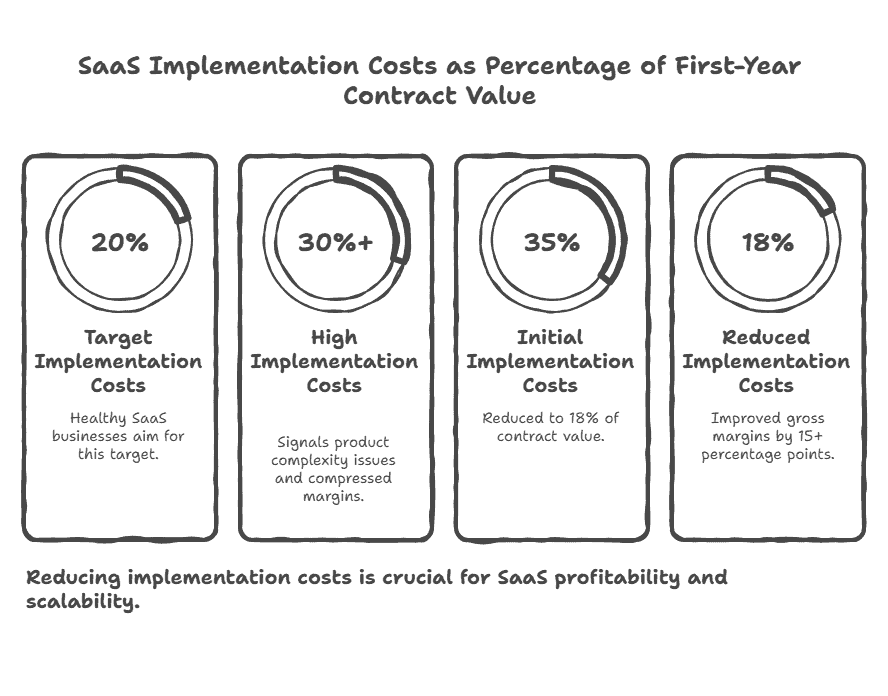
TL;DR: Implementation costs are the services required to get customers live on your product. Key factors influencing SaaS implementation costs include team composition, project scope, and feature complexity, all of which can significantly affect the overall budget and timeline. We track implementation as percentage of first-year contract value—target is under 20% for healthy SaaS businesses. High implementation costs (30%+ of contract value) signal product complexity issues that prevent scaling and compress gross margins. Hidden costs, such as training, customization, and ongoing support, can also significantly increase the total investment required beyond the initial purchase price. The level of desired functionality selected for your SaaS product directly impacts both implementation time and costs. Building an implementation cost model requires tracking time-per-implementation, cost-per-hour, and customer segmentation to identify which customers require expensive onboarding and why. It’s important to distinguish implementation costs from development costs; both must be managed to ensure overall project profitability. Companies that reduce implementation costs from 35% to 18% of contract value improve gross margins by 15+ percentage points, making their business model fundable and scalable.
Why Implementation Costs Kill SaaS Margins
SaaS companies face significant challenges with software implementation costs when bringing new customers onto their platforms. We see a consistent pattern: SaaS companies raise capital, sign customers, then discover that getting customers live requires 40-60 hours of professional services. At $150-200 per hour, that’s $6,000-12,000 in implementation costs per customer. If average contract value is $25,000 annually, implementation is 24-48% of first-year revenue. Each SaaS project typically involves several stages—requirements gathering, configuration, integration, testing, and training—each contributing to the overall cost structure.
This destroys gross margins and makes the business unscalable:
Gross margin compression: If implementation costs are 35% of contract value and hosting/support costs are 15%, gross margins are 50%. Investors expect SaaS gross margins of 70-80%. At 50%, your business model doesn’t work. The complexity of the SaaS product and the associated implementation requirements further drive up these costs.
Capacity constraints: If each implementation takes 50 hours and you have 3 implementation specialists, you can only onboard 1-2 new customers per week. This caps your growth rate regardless of sales performance.
Negative unit economics: If customer acquisition cost (CAC) is $15,000, implementation cost is $8,000, and first-year contract value is $25,000, you’re $8,000 cash-negative in year one per customer. Without expansion revenue or multi-year retention, you’re destroying value. High software implementation costs can undermine the financial viability of a SaaS company.
Professional services trap: You become a consulting company disguised as SaaS. Revenue grows but margins don’t improve. Investors won’t fund this model past Series A.
The companies that scale successfully reduce implementation costs through product improvements, self-service tools, and customer segmentation. They treat high implementation costs as a product failure that engineering must fix, not as an acceptable cost of doing business. Developing a scalable SaaS product requires careful planning across all phases of the SaaS project, from design and technology stack to ongoing maintenance and security.
Understanding Your Current Software Implementation Costs
Before building a model, baseline your current state:
Track time per implementation: How many hours does the average implementation take? Break this down by: – Project scoping and planning (5-10 hours) – Data migration and integration setup (10-20 hours) – Configuration and customization (15-25 hours) – Training and documentation (10-15 hours) – Testing and go-live support (5-10 hours)
Effective project management is essential for accurately capturing and controlling implementation hours, ensuring resources are allocated efficiently, unit economics are optimized, and timelines are met.
Don’t rely on estimates—track actual hours. We consistently see that estimated implementation time is 40-50% lower than actual time once you account for scope creep, customer delays, and rework.
Calculate cost per hour: What does implementation capacity cost you?
If you have 3 full-time implementation specialists at $85K salary each with 30% benefits/overhead, total loaded cost is $332K annually. Assuming 1,920 working hours per person (after vacation, holidays, sick time), that’s 5,760 available hours. With 60% utilization (accounting for meetings, training, admin work), you have 3,456 billable hours capacity at $96 per hour ($332K / 3,456 hours).
Segment by customer type: Implementation costs vary dramatically by customer segment: – Enterprise customers ($100K+ contracts): 80-120 hours average, requiring senior implementation resources – Mid-market customers ($25K-100K contracts): 40-60 hours average – SMB customers ($10K-25K contracts): 20-30 hours average
To ensure accurate financial reporting, it’s important to separate costs for different customer segments, distinguishing between capitalized development costs and expensed operational costs as appropriate. If you’re not segmenting, you’re likely underestimating enterprise costs and overestimating SMB costs.
Calculate implementation as percentage of contract value:
Total implementation cost / first-year contract value = implementation percentage
Examples: – 50 hours × $96/hour = $4,800 implementation cost – $25,000 contract value – 19.2% implementation cost percentage
When calculating, be sure to include related implementation costs that may not be immediately apparent, such as software setup fees or third-party integrations, to get a complete picture.
We target under 20% for healthy SaaS. Above 30% indicates serious problems. Above 50% suggests you’re running a consulting business, not SaaS.
When breaking down implementation activities, remember that such costs as vendor evaluation, consultant fees, and proof-of-concept efforts incurred during the initial project scoping and planning phase should be tracked and expensed as incurred.
Building the Implementation Cost Model
The implementation cost model connects customer volume, customer segment mix, and implementation requirements to financial outcomes. Here’s the structure:
Component 1: Customer Volume Forecast
Project new customer additions monthly by segment:
– Enterprise: 2 customers per month
– Mid-market: 8 customers per month
– SMB: 15 customers per month
– Total: 25 customers per month
Component 2: Implementation Requirements by Segment
Define standard hours and cost per segment:
– Enterprise: 100 hours @ $96/hour = $9,600 per implementation
– Mid-market: 50 hours @ $96/hour = $4,800 per implementation
– SMB: 25 hours @ $96/hour = $2,400 per implementation.
Misestimating these costs or failing to control them is one of several financial red flags in early-stage SaaS companies, so careful planning and monitoring are essential.
The type of hosting arrangement (cloud-based vs. on-premises) can significantly influence implementation requirements and costs, as cloud-based SaaS solutions may require different onboarding, integration, and support resources compared to on-premises deployments.
Component 3: Monthly Implementation Capacity Required
Calculate total hours needed:
– Enterprise: 2 customers × 100 hours = 200 hours
– Mid-market: 8 customers × 50 hours = 400 hours
– SMB: 15 customers × 25 hours = 375 hours
– Total: 975 hours monthly (Learn how to forecast patient volume accurately using a CFO framework.)
With 60% utilization, each FTE provides 96 billable hours monthly (160 working hours × 60%). You need 10.2 FTEs to support this implementation volume (975 hours / 96 hours per FTE).
Component 4: Implementation Cost Forecast
Total monthly implementation cost: 975 hours × $96/hour = $93,600
Compare to monthly new customer contract value to calculate implementation as percentage of revenue:
– Enterprise: 2 × $100K = $200K annual value ($16.7K monthly recognized)
– Mid-market: 8 × $50K = $400K annual value ($33.3K monthly recognized)
– SMB: 15 × $15K = $225K annual value ($18.75K monthly recognized)
– Total: $68.75K monthly recognized revenue from new customers
When evaluating customer volume and contract value, it is critical to ensure the service contract clearly defines all implementation activities and deliverables to avoid scope creep and unplanned costs.
The terms of the SaaS agreement, including payment schedules, implementation milestones, and cost allocation, can affect how and when implementation costs are recognized and forecasted in your financial model.
Implementation costs of $93,600 exceed monthly recognized revenue by 36%. This is unsustainable and will destroy gross margins.
Capitalization and Cost Management
Capitalization and cost management are critical for SaaS companies and businesses developing internal use software, as they directly impact financial reporting, compliance, and the overall health of your software project. Understanding which costs can be capitalized—and which must be expensed—ensures your financial statements accurately reflect the value of your technology investments and support strategic decision-making.
When developing software or implementing a SaaS solution, costs typically fall into three main stages: the preliminary project stage, the application development stage, and the post-implementation/operation stage. According to relevant accounting standards, only certain costs incurred during the application development stage—such as coding, configuration, and testing—can be capitalized as an intangible asset on the balance sheet. These capitalized costs are then amortized over the useful life of the software, smoothing out the impact on your income statement and improving reported profitability.
In contrast, costs related to the preliminary project stage (like evaluating alternatives, feasibility studies, and project planning) and post-implementation activities (such as training, data conversion, and ongoing maintenance) are typically expensed as incurred. Administrative costs, employee costs not directly attributable to software development, and general overhead should also be treated as operating expenses.
For SaaS solutions, the accounting treatment can be more nuanced. Fees paid to a SaaS provider for access to a software as a service application are generally expensed as subscription fees. However, certain implementation costs—such as configuring the SaaS application to meet your business requirements or integrating it with existing data and systems—may be eligible for capitalization if they meet the criteria for internal use software under US GAAP or other relevant authority. It’s essential to distinguish between costs that create additional functionality or enhance the software’s performance (which may be capitalized) and those related to routine setup, data migration, or training (which are expensed).
Effective cost management starts with robust project tracking and clear documentation of all costs related to developing software or implementing a SaaS solution. Segregate directly attributable costs from general administrative expenses, and work closely with your finance team or fractional CFO to ensure appropriate accounting treatment. This not only supports compliance and audit readiness but also provides a clearer picture of your investment in technology on your financial statements.
Ultimately, proper capitalization and cost management help SaaS businesses and companies developing internal use software optimize their cash flow, improve efficiency, and present a stronger case to investors. By aligning your accounting practices with business goals and industry standards, you lay the groundwork for sustainable growth, value creation, and successful financial reporting.
Scenarios for Reducing Implementation Costs
Once you have the baseline model, run scenarios showing how to improve economics:
Scenario 1: Product improvements reduce implementation time 25%
New implementation requirements: – Enterprise: 75 hours (from 100) – Mid-market: 37.5 hours (from 50) – SMB: 18.75 hours (from 25)
New monthly capacity required: 731 hours (down from 975 hours) New FTE requirement: 7.6 FTEs (down from 10.2 FTEs) New monthly cost: $70,176 (down from $93,600). For SaaS companies, understanding revenue recognition is crucial when projecting financials related to capacity and expenses.
Implementation as percentage of recognized revenue: 102% (down from 136%)
This scenario is still unhealthy but shows meaningful improvement. Product changes might include: – Self-service data import tools – Standardized integration templates – Automated configuration wizards – Better documentation and training videos
Defining clear performance requirements at the outset can help reduce unnecessary implementation work and ensure the new system meets operational needs efficiently.
Scenario 2: Customer segmentation and pricing changes
Shift customer mix toward higher-value, lower implementation-intensity customers: – Enterprise: 3 customers per month (up from 2) – Mid-market: 10 customers per month (up from 8) – SMB: 10 customers per month (down from 15)
With 25% product-driven implementation time reduction from Scenario 1:
Monthly capacity required: 787.5 hours Monthly implementation cost: $75,600 Monthly new customer recognized revenue: $83.3K Implementation as percentage of revenue: 90.7%
Better but still suboptimal. Continue improving. Implementing a new system presents unique challenges for each customer segment, requiring tailored approaches to address their specific needs.
Scenario 3: Tiered implementation model
Offer three implementation paths: – Self-serve (free): Customer does all work with documentation – Guided (20% of contract value): Fixed-scope implementation with remote support – Premium (35% of contract value): Full-service white-glove implementation
This shifts implementation from cost center to profit center:
Assume 40% of customers choose self-serve, 50% choose guided, 10% choose premium:
Self-serve customers: – 10 customers monthly (40% of 25) – 0 hours implementation time – $0 cost to company
Guided customers: – 12.5 customers monthly (50% of 25) – Average contract value $35K – Implementation fee: $7K (20% of $35K) – Actual implementation cost: 30 hours × $96 = $2,880 – Contribution margin: $4,120 per implementation
Premium customers: – 2.5 customers monthly (10% of 25) – Average contract value $60K – Implementation fee: $21K (35% of $60K) – Actual implementation cost: 80 hours × $96 = $7,680 – Contribution margin: $13,320 per implementation
ERP systems are a common example of software that often requires premium implementation services due to their complexity and the need for integrated, organization-wide solutions.
Total monthly implementation revenue: $140K Total monthly implementation cost: $55K Implementation contribution margin: $85K monthly
This scenario transforms implementation from margin-destroying cost to profit generator.
Product-Led Approaches to Reducing Implementation Costs
The best SaaS companies treat implementation costs as a product problem:
Self-service onboarding flows:
Build guided onboarding that walks customers through setup without human intervention: – Interactive checklists showing setup progress – Embedded video tutorials at each step – Smart defaults that work for 80% of customers – Sample data and templates they can customize
We helped a client build self-service onboarding that reduced “standard” implementations from 40 hours to 8 hours of verification and go-live support. This 80% reduction in implementation time improved gross margins from 62% to 76%.
Standardized integrations:
Instead of custom integration work for each customer, build native integrations to common platforms: – Pre-built connectors to Salesforce, HubSpot, etc. – OAuth authentication that customers can configure themselves – Field mapping interfaces that don’t require API documentation – Automatic sync scheduling and error handling
Moving from custom integrations (20 hours per customer) to self-service integrations (2 hours of customer time) eliminates implementation hours while improving customer experience.
Configuration templates:
Create templates for common use cases: – “Marketing agency” template with standard workflows – “Financial services” template with compliance settings pre-configured – “Manufacturing” template with industry-specific fields
Templates reduce configuration time from 15-20 hours to 2-3 hours while ensuring best practices.
Better documentation and support:
Comprehensive, searchable documentation reduces support needs: – Video library covering all setup steps – FAQ addressing common implementation questions – Troubleshooting guides for typical issues – API documentation for technical customers
Including clear service level agreements (SLAs) as part of onboarding and ongoing support helps maintain high standards for service quality, security, compliance, and platform uptime, which are critical for customer satisfaction and operational stability.
We see documentation improvements reduce implementation support time by 30-40% by enabling customer self-service.
When to Charge for Implementation in a Service Contract
Many SaaS companies struggle with whether to charge for implementation services. Our framework:
Charge for implementation when:
– Implementation time exceeds 20% of contract value – Customer customization requests exceed standard scope – You’re providing strategic consulting beyond product setup – Implementation generates genuine margin after costs
Include implementation free when:
– Implementation time is under 15% of contract value – Self-service tools enable most setup – Including free implementation shortens sales cycles materially – Customers in target segment expect free onboarding
The key is ensuring implementation costs don’t destroy unit economics. If free implementation costs 35% of contract value, you need to either reduce costs through product improvements or charge for services.
Staffing Your Implementation Team
As implementation requirements scale, staffing becomes critical:
Early stage (0-50 customers):
– Founders do implementations to learn customer needs – 0-1 dedicated implementation person
Growth stage (50-200 customers):
– 2-4 implementation specialists – Start building self-service tools to reduce per-customer time – Segment by complexity (junior staff for simple, senior for complex)
Scale stage (200+ customers):
– 5-10+ implementation specialists organized by customer segment – Dedicated team building self-service tools – Clear escalation paths from self-serve to guided to premium
Avoid the trap of just hiring more implementation people. If you need to hire implementation faster than sales because implementation is a bottleneck, your product has a problem. Fix the product before scaling the implementation team.
Capitalized Costs and Implementation Costs in Financial Planning
Implementation costs affect multiple parts of your financial model:
Income statement:– Directly reduce gross margin (part of COGS) – Create capacity constraints that limit revenue growth – Require investment in product to reduce over time
Cash flow:– Implementation costs are paid immediately (salaries) – Revenue is recognized ratably over contract term – Creates cash flow timing gap for high-implementation businesses
Balance sheet:– Affects deferred revenue (customers paying upfront) – Impacts working capital (paying implementation costs before revenue recognition) – Uncompleted software development costs are typically assigned a fair value of zero and must be written off. When determining whether to capitalize implementation costs, apply the specific capitalization criteria under US GAAP ASC 350-40-25 for internal use software, which distinguishes between preliminary project, application development, and post-implementation stages. Data or software acquired for a project that has an alternative future use can be recognized as a separate intangible asset under ASC 350-30.
Model implementation costs as a driver tied to customer volume and segment mix, not as a fixed percentage. As you improve products and shift customer mix, implementation costs should decrease as percentage of revenue.
Common Implementation Cost Mistakes
Mistake 1: Not tracking actual implementation time. Estimates are always optimistic. Track actual hours to understand real costs.
Mistake 2: Treating implementation as necessary evil rather than product problem. Implementation costs above 20% are product failures that engineering should fix.
Mistake 3: Not segmenting implementation costs by customer type. Enterprise and SMB implementation costs differ 3-5x. Model them separately.
Mistake 4: Scaling implementation team linearly with customer growth. If you’re hiring 1 implementation person for every 10 new customers per month, you’ll never achieve SaaS margins.
Mistake 5: Not charging for material customization. If a customer wants bespoke configuration taking 80 hours, charge them. Don’t subsidize their customization.
Mistake 6: Optimizing for fastest implementation rather than customer success. Rushing implementations creates poor adoption and higher churn. Good implementation takes time, but should become more efficient through product improvements and processes.
—
FAQ
Q: What implementation cost percentage is acceptable for early-stage SaaS companies?
Early stage (pre-PMF, under $1M ARR), implementation costs of 30-50% are common because you’re learning what customers need and building the product. This is acceptable temporarily while you’re figuring out your model. By the time you reach $2-3M ARR, implementation should be under 25%. By $5M ARR, under 20%. If you’re at $10M ARR with 30%+ implementation costs, you have a structural problem preventing scalability. Investors evaluating Series B+ companies expect implementation under 15% of contract value because that’s required for SaaS margins. Use early-stage revenue to fund product improvements that reduce implementation costs before scaling customer acquisition.
Q: Should we build a separate professional services division to handle implementations? For a data-driven approach to decisions like this, consider using a simple MRR growth forecasting model to project the impact on your business.
This depends on your strategy. Professional services divisions can be profitable businesses, but they’re valued at 1-2x revenue vs. 5-10x revenue for SaaS. If you want to build a SaaS business, minimize professional services and keep gross margins high. If you want to build a services-led business, create a separate P&L for services with appropriate margin targets (30-40%) and growth expectations. Don’t accidentally build a services business when you intended to build SaaS—the unit economics, investor expectations, and valuation multiples are completely different. Most SaaS companies should avoid significant professional services revenue (keep it under 20% of total revenue).
Q: How do we reduce implementation costs without hurting customer success?
This is the key tension. The answer is building product features that enable customer self-service without sacrificing outcomes. Start by analyzing what implementation work is truly necessary for customer success vs. what’s just “how we’ve always done it.” Often 40-60% of implementation time is addressing product gaps that could be automated. Focus product development on the features that eliminate implementation work: data import wizards, integration templates, configuration guides, and automated testing. Measure customer outcomes (activation rate, time-to-value, retention) alongside implementation costs to ensure improvements don’t hurt success. Many companies discover that self-service onboarding actually improves customer outcomes because customers learn by doing rather than being set up by consultants.
Further Reading
Browse more articles in the CFO Pro+Analytics Knowledge Base for in-depth financial frameworks, models, and strategies tailored to your business.
Ready to take action? Explore our FP&A Services → to see how we partner with founders and operators to build financial clarity.
