The Fractional CFO Guide to Scaling from $5M to $100M
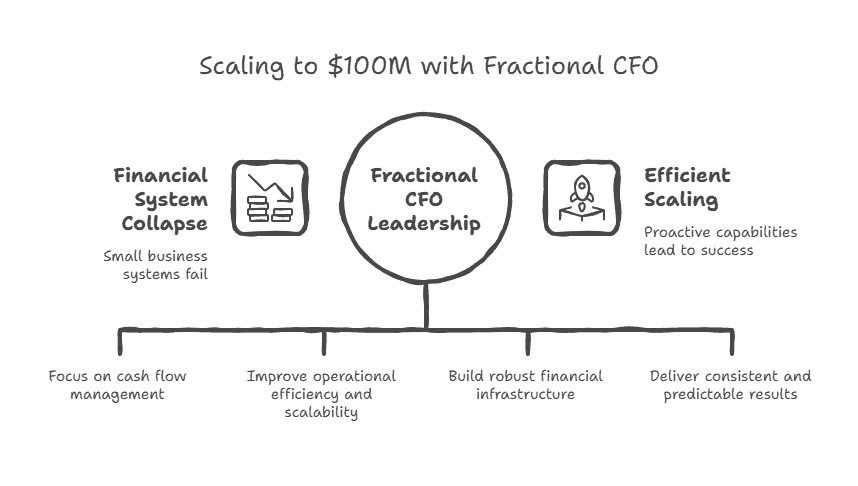
TL;DR: Scaling from $5M to $100M revenue breaks most companies because financial systems designed for small businesses collapse under growth pressure. Tracking business growth and achieving key milestones—such as reaching $100M in annual recurring revenue (ARR)—is essential to the scaling journey, requiring careful progress monitoring and strategic planning. We’ve tracked how successful scale-ups evolve their financial operations across four distinct phases, each requiring different capabilities: $5-10M demands cash flow mastery, $10-25M requires operational leverage, $25-50M needs institutional infrastructure, and $50-100M must deliver predictable performance. Fractional CFO leadership remains effective throughout this journey by evolving from hands-on financial management to strategic oversight, often partnering with a strong VP Finance or Controller to manage operations. Companies that build these capabilities proactively scale efficiently; those that react to crises waste 30-40% of capital on avoidable mistakes.
Why Most Companies Struggle to Scale Past $10M
Last year, we worked with a professional services firm, hitting $8.3M in revenue. From the outside, they looked successful—growing 40% annually, profitable, strong client relationships. The CEO was fielding acquisition interest and planning to double the team. Then the cracks appeared.
Their project management system couldn’t track profitability by client. Their cash flow forecasting consisted of “checking the bank balance weekly.” They had three people spending full-time hours manually consolidating financial reports from different systems — a direct result of having no optimized month-end close process. Most problematically, they had no idea which services or clients were actually profitable once fully loaded costs were allocated.
When a key client delayed a $180K payment by 30 days, the company nearly missed payroll. Not because they weren’t profitable—gross margin ran 42%—but because they had no visibility into committed vs. available cash. The CEO discovered they’d been operating within $50K of their practical cash minimum for six months without realizing it.
This pattern repeats constantly. Companies that successfully navigate from startup to $5M hit a wall somewhere between $5-10M, where intuition and hustle stop working. The financial complexity has exceeded the CEO’s capacity to manage through feel and spreadsheets, but the company hasn’t yet built professional financial operations. As companies find themselves scaling, they encounter new challenges and opportunities that require different strategies and solutions. This process of companies finding and addressing these issues is critical for overcoming growth barriers and unlocking the next stage of expansion.
We see three failure modes that prevent companies from scaling past this threshold:
The Complexity Explosion: At $5M with 15 employees, the CEO can track everything personally. At $8M with 35 employees, three locations, and two product lines, personal tracking becomes impossible. The business has multiple revenue streams, varied cost structures, different customer segments, and complex interdependencies. Financial systems designed for simplicity cannot handle this complexity.
The Cash Flow Crisis: Growth consumes cash in ways that surprise founders. Adding salespeople requires 12-18 months before they generate a positive ROI. Expanding to new markets demands upfront investment. Larger clients negotiate longer payment terms. Suddenly, the company is growing revenue but bleeding cash, with no clear model for when growth becomes self-sustaining.
The Decision-Making Paralysis: As complexity increases, the cost of bad decisions rises dramatically. Hiring the wrong VP costs $300K+ in salary, benefits, lost opportunity, and recovery time. Entering the wrong market can waste 12 months and $500K+ before failure becomes obvious. Without sophisticated financial analysis, leadership teams either become paralyzed by fear of mistakes or make expensive decisions based on intuition.
The companies that successfully scale through $10M and beyond do something fundamentally different: they evolve their financial operations in pace with business complexity. They don’t wait for a crisis to force change; they proactively build the capabilities that the coming growth will require. Many discover that fractional CFO leadership provides the strategic expertise needed throughout this journey—evolving from hands-on financial management at $8M to strategic oversight at $65M while operational finance teams handle growing complexity.
The Four Phases of Financial Evolution
We’ve studied how companies successfully scale from $5M to $50M+ and identified four distinct phases, each requiring different financial capabilities and systems. Understanding these phases helps leadership teams build appropriate infrastructure before growth outpaces capacity. To navigate these phases effectively, it’s essential to establish a ‘north star’ metric—such as Annual Recurring Revenue (ARR)—to guide decision-making and track progress as the company scales.
Phase 1: Cash Flow Mastery ($5M-$10M)
Companies in this phase have proven product-market fit and repeatable revenue models. The existential risk isn’t failure to sell; it’s running out of cash while growing. The financial priority is building visibility and control over cash conversion cycles.
13-Week Cash Flow Forecasting: At this stage, monthly cash flow visibility is insufficient. We implement rolling 13-week cash forecasts that show exactly when money comes in and goes out. This enables proactive decisions: “We have a $75K gap hitting in week 7, so we’ll need to delay that equipment purchase or accelerate collections from our top three clients.”
One manufacturing client discovered through 13-week forecasting that they had a systematic cash crunch every third month due to quarterly rent, insurance, and tax payments clustering together. Simply spreading some payments differently eliminated what had been a recurring crisis.
Revenue Quality Analysis: Not all revenue is equal. We segment revenue by payment terms, customer concentration, churn risk, and gross margin. A $500K contract paid over 90 days with 30% gross margin is fundamentally different from $500K paid upfront with 70% gross margin. Understanding these differences enables smarter growth decisions.
Burn Multiple Optimization: For companies still burning cash or running break-even, we track net burn per dollar of net new ARR (for recurring revenue businesses) or net burn per dollar of gross profit growth (for others). We’ve found that companies maintaining burn multiples under 1.5x while scaling have sufficient capital efficiency to reach cash flow positive without additional financing. Those running 3x+ burn multiples typically hit funding crises.
Working Capital Management: We implement systematic approaches to improving Days Sales Outstanding (DSO), Days Payable Outstanding (DPO), and inventory turns where applicable. A 10-day improvement in DSO for a $7M revenue business unlocks approximately $190K in cash, equivalent to avoiding dilution from raising that amount in equity.
The milestone for Phase 1 is predictable cash flow—leadership should be able to forecast cash position 90 days forward within 10% accuracy and never be surprised by cash shortfalls.
Phase 2: Operational Leverage ($10M-$25M)
Once cash flow is under control, the priority shifts to building operational leverage that enables profitable growth. The challenge at this phase is growing revenue faster than expenses while maintaining quality.
Unit Economics by Segment: We build detailed profitability models for each revenue stream, customer segment, and geographic market. This reveals where the company makes money and where it loses money. One SaaS client discovered their SMB segment had negative lifetime value once fully loaded CAC and support costs were allocated. They’d been spending $800 to acquire customers worth $600. Eliminating that segment and doubling down on mid-market immediately improved capital efficiency by 40%. It’s important to recognize that achieving operational leverage and market fit is not a single-point event; rather, it’s an ongoing process that requires continuous adaptation as the company grows.
Revenue Per Employee Optimization: As companies scale, revenue per employee becomes a critical efficiency metric. We’ve found that technology-enabled services businesses should target $200K+ revenue per FTE at this phase, while pure SaaS businesses should aim for $250K+. Companies falling below these thresholds either need better systems, different talent, or strategic repositioning.
Contribution Margin Analysis: We move beyond gross margin to track contribution margin—what remains after variable costs AND semi-variable costs like sales commissions, account management, and customer support. This shows the true profitability available to cover fixed costs and generate profit. Many companies discover they’re pricing based on gross margin targets while losing money at the contribution margin level.
Sales Efficiency Metrics: We implement CAC (Customer Acquisition Cost) payback analysis and track magic numbers (net new ARR per dollar of sales & marketing spend). Companies should achieve CAC payback within 12-18 months at this phase. Those requiring 24+ months either have unit economics that won’t support scale or inefficient sales models requiring restructuring.
The milestone for Phase 2 is efficient scaling—the company should be able to grow revenue 30%+ annually while maintaining or improving EBITDA margin. Growth should generate cash rather than consume it.
Phase 3: Institutional Infrastructure ($25M-$40M)
At this phase, the business has outgrown founder-centric decision-making. The priority is building institutional capabilities that enable professional management and prepare for potential liquidity events.
Three-Statement Financial Modeling: We implement integrated P&L, balance sheet, and cash flow forecasts that roll up from operational drivers. This enables sophisticated analysis: “If we grow the sales team by 25%, it will drive $4.2M in additional revenue in year two, require $680K in working capital investment, and generate $1.1M in incremental EBITDA.”
Department-Level P&Ls: We create contribution income statements for each business unit showing direct revenue, direct costs, and allocated shared costs. This enables holding department leaders accountable for financial performance, not just operational metrics. The VP of Enterprise Sales should own not just quota attainment but customer acquisition cost, contract value, and gross margin for the enterprise segment.
Annual Planning and Budgeting: We establish formal annual planning processes that connect strategy to resource allocation. This includes bottom-up department budgets, top-down strategic allocation, variance analysis, and monthly budget vs. actual reviews with accountability. One client’s annual planning process identified that they were spending 28% of their operating budget on a product line generating 11% of revenue—leading to a strategic pivot that improved profitability by 7 percentage points.
Board-Grade Reporting: We implement monthly reporting packages that would satisfy institutional investors or acquirers: executive summary with key decisions/risks, detailed financial statements, KPI dashboards, variance analysis, and forward-looking commentary. Leading portfolio companies set the benchmark for this level of financial reporting and institutional credibility, serving as models for scaling companies 5m to 100m, navigating this phase. This serves two purposes: it imposes discipline on management team communication, and it accelerates due diligence when fundraising or M&A opportunities emerge.
Audit-Ready Financials: We establish controls and documentation that would pass an external audit. This means proper revenue recognition, expense accrual policies, documented approval workflows, and reconciled balance sheets. Many companies discover during acquisition diligence that their financials won’t withstand scrutiny—killing deals or reducing valuations by 20-30%. Building audit-ready financials before you need them eliminates this risk.
The milestone for Phase 3 is institutional credibility—the company should be able to enter due diligence for acquisition, PE investment, or debt financing with financial systems that accelerate rather than derail the process.
Phase 4: Predictable Performance ($50M-$100M+)
At $50M+, the business has reached a substantial scale where predictability becomes paramount. Investors, lenders, and potential acquirers expect sophisticated forecasting and consistent execution against plan. At this phase, fractional CFOs typically shift to strategic oversight—board relations, major initiatives, M&A, and investor relations—while an experienced VP Finance or operational CFO manages the finance organization.
Rolling 18-Month Forecasts: We implement detailed quarterly forecasting with monthly updates, showing expected performance 18 months forward. This enables proactive resource allocation: identifying hiring needs 6 months before demand, planning facility expansions 12 months in advance, and staging investments to match growth trajectory. The fractional CFO owns forecast accuracy and board communication while the VP Finance manages data collection and model updates.
Cohort Analysis and Retention Economics: We track customer cohorts to understand how retention, expansion, and profitability evolve over time. This reveals whether recent growth is sustainable or masking deteriorating unit economics. One subscription business discovered their 2023 cohorts had 15% worse retention than 2022 cohorts—signaling an emerging quality problem that would have gone unnoticed for 12+ months using aggregate metrics.
Operational KPIs Driving Financial Outcomes: We establish leading indicators that predict lagging financial results. If sales pipeline coverage drops below 3x quota, we know revenue will miss targets in 90 days. If customer health scores decline, we know retention will suffer in 180 days. This enables intervention before financial impact materializes.
Scenario Planning for Strategic Decisions: We model multiple scenarios for every major decision—acquisitions, product launches, market expansions, pricing changes. Each scenario includes best-case, expected-case, and conservative assumptions with probabilistic weighting. This replaces “should we do this?” with “under what conditions does this succeed, and how likely are those conditions?”
Rule of 40 Optimization: For recurring revenue businesses, we track the combined growth rate plus profit margin, targeting 40%+. A company growing 30% with 10% EBITDA margin meets this threshold; so does one growing 15% with 25% margin. This framework forces explicit trade-offs between growth and profitability based on strategic priorities and market conditions.
The milestone for Phase 4 is predictable execution—the company should consistently hit forecasted targets within 5% variance and be able to articulate clear drivers of over/under performance when variance occurs. Companies that achieve this level of predictable performance are able to maintain their lead in the market, reinforcing their competitive advantage and making it more difficult for competitors to catch up.
The Common Financial Pitfalls That Destroy Scale-Up Value
Even with awareness of these phases, companies make predictable mistakes that waste capital and destroy value. Understanding these failure patterns helps avoid them.
Premature Infrastructure Building: We see companies at $8M building financial systems appropriate for $30M businesses. They implement enterprise ERP systems that cost $200K+ to deploy and require dedicated personnel to maintain. They hire senior finance executives who become frustrated by lack of complexity and leave within 18 months. Over-building infrastructure is as dangerous as under-building—it consumes cash that should fuel growth and creates organizational drag.
The right approach is “just enough, just in time” infrastructure. Build systems that support your current phase plus one phase forward. When you’re at $8M, build for $15M. When you’re at $20M, build for $35M. This maintains efficiency while ensuring you’re not constantly in crisis mode.
Growth-At-All-Costs Mentality: Some companies chase revenue growth without tracking unit economics or cash conversion. They celebrate crossing $20M revenue while burning through their Series B and requiring emergency bridge financing. Growth without profitable unit economics and manageable cash conversion doesn’t scale—it just delays failure while consuming more capital.
Ignoring Operational Leverage: Other companies remain profitable while growing, but fail to build operational leverage. They add headcount in direct proportion to revenue, maintaining steady margins but never improving them. At $50M, they have the same EBITDA margin as they had at $10M—leaving substantial value uncaptured. Successful scaling requires systematically improving efficiency as size increases.
Founder Bottleneck Syndrome: Many founders struggle to transition from doing to leading. The CEO who personally approved every expense and reviewed every contract at $5M cannot maintain this involvement at $25M—but tries anyway. Founders often attempt to manage multiple things themselves, from customer needs to operational challenges, which creates bottlenecks and hinders scaling. This creates bottlenecks that slow decision-making and frustrate talented leaders who feel micromanaged. Scaling requires building trust in systems and teams, not just building systems and teams.
How Fractional CFO Leadership Evolves Through Scale
One of the most common misconceptions about fractional CFO services is that they’re only appropriate for small companies. We’ve found the opposite: fractional CFO partnerships become more valuable as companies scale, but the engagement model evolves to match changing needs.
At $5-10M: The fractional CFO provides 2-3 days per week of hands-on financial leadership—building forecasting models, establishing KPI dashboards, managing cash flow, and often working directly in the accounting system. At this stage, the company may have a bookkeeper or part-time controller, with the fractional CFO serving as the senior financial leader, making strategic decisions.
At $10-25M: The engagement shifts to 1.5-2 days per week of strategic leadership and team development. The company has hired a full-time Controller or VP Finance to manage daily operations, monthly close, and the growing finance team. The fractional CFO focuses on board reporting, forecasting, scenario planning, major strategic initiatives, and developing the Controller into a stronger finance leader. This model provides both operational management (from the Controller) and strategic expertise (from the fractional CFO) at a combined cost below a single experienced CFO. The distribution of financial leadership roles—fractional CFO, VP Finance, Controller—is key to supporting growth and ensuring the right expertise is applied at each stage, much like aligning distribution channels for product channel fit in scaling companies.
At $25-50M: The fractional CFO typically works 1-1.5 days per week, concentrating on the highest-value activities: board relations and investor communication, strategic planning and major initiatives, M&A evaluation and execution, complex financial modeling and scenario planning, and acting as a strategic advisor to the CEO. Meanwhile, a strong VP Finance or experienced Controller manages the finance organization, owns operational processes, and handles day-to-day financial leadership. This division of labor allows the fractional CFO to focus on activities where seasoned judgment and board-level communication skills create the most value.
At $50-100M+: Many companies maintain fractional CFO relationships even at substantial scale, often 0.5-1 days per week focused on: independent board perspective (particularly valuable when the company has a full-time CFO who may need outside perspective), special projects and major transactions, strategic initiative leadership, and periodic deep-dive analysis on complex issues. Some companies at this scale bring in fractional CFOs specifically for their board relationships and ability to challenge assumptions without the organizational politics that can constrain full-time executives.
The key advantage of this evolving model is continuity. Rather than hiring a CFO at $20M who becomes overwhelmed at $60M and needs replacing, or hiring too senior too early and wasting expensive talent on basic work, companies maintain consistent strategic financial leadership while building operational capabilities that match their scale. The fractional CFO who helped establish financial foundations at $7M provides invaluable continuity when guiding strategy at $45M because they understand the business’s complete evolution.
This model also solves the “CFO skill mismatch” problem. A CFO perfect for building systems at $15M often lacks the board relationships and strategic sophistication needed at $75M. A CFO experienced at $100M+ companies is typically bored and ineffective at the $20M operational intensity. Fractional CFOs can be “right-sized” throughout the journey—their engagement level scales with the company while their expertise remains consistently senior.
The Investment Required for Successful Scaling
Professional financial operations for scaling companies require investment. We find that companies successfully navigating $5M to $100M typically invest 3-5% of revenue in financial systems, tools, and talent—with fractional CFO leadership providing strategic direction throughout this journey:
At $5-10M: $150K-500K annually (fractional CFO leading financial strategy, upgraded bookkeeping, forecasting tools, initial automation)
At $10-25M: $500K-1M annually (fractional CFO providing strategic leadership, full-time controller managing operations, ERP/accounting system, FP&A capability, departmental tools)
At $25-50M: $1M-1.75M annually (fractional CFO driving strategic initiatives and board relations, VP Finance or strong controller managing day-to-day operations, complete finance team including AR/AP/payroll specialists, audit costs, enhanced systems, business intelligence infrastructure)
At $50-100M: $1.75M-2.5M annually (fractional CFO maintaining strategic oversight and special projects, experienced VP Finance or operational CFO managing team and processes, comprehensive finance organization, sophisticated tools, audit and advisory services)
At $100M+: Companies typically evaluate whether to transition to a full-time CFO or maintain a fractional CFO model, depending on complexity, transaction activity, and strategic priorities
This fractional CFO model delivers several advantages over prematurely hiring full-time CFO talent. Companies get seasoned expertise (typically 15-20 years of experience) at 30-50% of the full-time CFO cost. They maintain flexibility to scale CFO involvement up or down based on strategic initiatives. They access a broader perspective from a CFO working across multiple companies and industries. Most importantly, they avoid the common trap of hiring a full-time CFO at $25-30M revenue who becomes bored or overwhelmed as the company scales to $75M, requiring expensive replacement.
The investment typically returns 5-10x through better capital allocation, improved margins, avoided mistakes, faster decision-making, and enhanced enterprise value. Improved financial systems and strategic leadership also support better sales and marketing processes, helping generate more leads by enabling stronger outreach, more effective touchpoints, and higher conversion rates. Companies that under-invest in financial operations during scaling tend to waste far more capital through inefficiency, errors, and missed opportunities.
Building Financial Operations That Scale
The companies that successfully navigate from $5M to $100M share common practices that enable sustainable scaling:
They invest in financial operations proactively, before crisis forces reactive spending. They view financial infrastructure as a strategic enabler rather than operational expense. They make data-driven decisions backed by sophisticated analysis rather than intuition. They build systems that scale ahead of demand rather than playing catch-up. They recognize that fractional CFO expertise can effectively guide companies through $100M+ revenue when paired with strong operational finance leadership. Most importantly, they understand that financial excellence isn’t about perfect historical reporting—it’s about providing the visibility and analysis that enables better forward-looking decisions.
The journey from $5M to $100M typically takes 7-15 years for successful companies. Those who build appropriate financial capabilities at each phase navigate this journey efficiently, capturing maximum value with minimum wasted capital. For additional business growth insights, discover how fractional CFO expertise can support every stage of expansion. Those that skip phases or ignore financial operations waste millions in inefficiency and often fail to complete the journey at all. The right fractional CFO partnership evolves with the business, providing consistent strategic leadership while operational teams scale to meet growing complexity.
Introduction to Scaling
The reality is that scaling a business from $5.2M to $97M in revenue (the actual range I’ve seen in my CFO travels) is a journey that exposes every weakness in your financial systems, leadership alignment, and growth infrastructure. In my experience working with mid-market companies, the difference between businesses that thrive and those that stall comes down to one critical factor: how precisely they understand and manage the interplay between cash flow operations, product-market fit, and customer acquisition costs. Consider this—as companies grow, the complexity of market dynamics increases exponentially, customer demands become more sophisticated, and the need for cohesive leadership becomes mission-critical. Without a data-driven growth strategy and relentless focus on customer lifetime value, even promising businesses with solid fundamentals can lose momentum within 18-24 months.
Here’s what successful scaling actually looks like in practice: it demands more than increasing top-line revenue by 15-20% quarterly. What I’ve observed across dozens of consulting engagements is that winning companies develop deep market intelligence, maintain leadership teams aligned around measurable KPIs, and systematically adapt their business models as they move through predictable growth curves. The companies that prioritize customer acquisition cost optimization (typically achieving 3:1 LTV: CAC ratios), invest in building truly scalable operational systems, and continually refine their approach to market fit are positioned to capture the most profitable revenue opportunities. In the following sections, we’ll break down the essential elements of this scaling framework—from aligning your product strategy with market realities to leveraging financial insights that drive sustainable expansion.
Product and Market: Aligning Financial Strategy with Growth Opportunities
The reality is that most scaling companies I work with struggle with one fundamental disconnect: their financial strategy operates in isolation from actual growth opportunities. Consider a SaaS client of mine that was burning $847,000 monthly while chasing every possible market segment—their CAC payback period had ballooned to 47 months because they’d lost sight of where their core product actually delivered measurable value. Here’s how successful scaling starts: with a laser-focused understanding of your niche market dynamics and the specific needs driving your highest-value customer segments. In my CFO travels, I’ve seen companies increase capital efficiency by 340% simply by realigning resources toward segments where their unit economics actually work, which is why PLG companies must track the right product-led growth KPIs from day one, not just revenue metrics.
What’s particularly fascinating about great SaaS companies and other high-growth businesses is how they treat sales efficiency and customer acquisition costs as precision instruments, not blunt-force tools. I recently worked with a company that discovered their enterprise segment generated 12.3x higher lifetime value than their SMB segment, despite identical acquisition costs—but only after we implemented granular customer segment analysis and variable cost tracking. The sophistication extends to understanding market fit at the micro level: one client reduced their blended CAC by 67% when we identified that prospects from specific industry verticals converted at 43% higher rates. Tools like robust forecasting models and detailed gross margin analysis (we track gross margin down to individual customer cohorts, not just product lines) help you allocate capital to opportunities with proven 18-24 month payback periods rather than spreading investment across hopeful initiatives.
Here’s where expansion discipline becomes critical—and where I see most companies stumble. As you expand into multiple products or new markets, each decision point requires the same analytical rigor that got you to scale in the first place. I’ve guided companies through expansions where maintaining CAC payback discipline (we target sub-24-month payback across all initiatives) and gross margin thresholds (minimum 70% for SaaS, adjusted by industry) prevented costly mistakes that could have set growth back by 12-18 months. The whole point isn’t just supporting current operations—it’s creating a financial strategy that positions your company to scale efficiently regardless of market volatility, economic shifts, or competitive pressures that inevitably emerge.
Portfolio and Product Strategy for Scalable Value Creation
The reality is that most companies I’ve worked with struggle with portfolio strategy once they hit $10-15 million in ARR. Consider one of my SaaS clients who had built three distinct products but couldn’t figure out why their growth rate was decelerating from 127% to 89% year-over-year despite healthy individual product metrics. Here’s what I discovered: they were treating portfolio management like a collection of independent P&Ls rather than an interconnected value creation engine. A robust portfolio strategy isn’t just about having multiple products—it’s about architecting scalable value creation that compounds across your entire customer base. In my CFO travels, I’ve seen companies increase their net new ARR by 34-47% simply by optimizing how their products work together rather than compete for the same customer wallet share.
Customer success becomes exponentially more critical when you’re operating a multi-product environment. The reality is that a 5% improvement in customer expansion rates can translate into millions of additional revenue when compounded across a diversified portfolio. I worked with a manufacturing software company where we discovered that customers using two products had a 312% higher lifetime value and 67% lower churn than single-product users. Here’s how this transforms the economics: instead of viewing customer success as a cost center supporting individual products, we repositioned it as the revenue multiplier that drives cross-product adoption and expansion. By investing $847,000 in integrated onboarding systems and expansion playbooks, they generated an additional $3.2 million in ARR within 18 months—a 378% return on that customer success investment.
What’s particularly fascinating is how performance analysis changes when you’re optimizing across multiple products rather than within silos. Consider this approach: instead of tracking standard SaaS metrics in isolation, I help companies build what I call “portfolio velocity indicators”—metrics that show how customer behavior across one product predicts expansion opportunities in others. For instance, tracking feature adoption patterns in Product A can predict which customers are 73% more likely to adopt Product B within six months. This level of sophisticated performance analysis enables companies to allocate resources based on compound growth potential rather than individual product performance, creating a foundation for sustained revenue growth that most competitors simply cannot replicate.
Customer and Market Analysis: Financial Insights for Expansion
The reality is, most expansion strategies fail because companies skip the foundational work. In my CFO travels, I’ve seen too many businesses chase growth without understanding their customer economics—burning through $500K+ in expansion capital before realizing their target market had fundamentally different needs than their core customers. Consider one manufacturing client who assumed their SMB success would translate directly to enterprise accounts. Wrong. Their enterprise prospects required 18-month implementation cycles versus the 45-day turnarounds that made their SMB model profitable. Here’s how to avoid that costly misstep: start with rigorous customer segmentation and market fit analysis. When you understand the unique behaviors and needs of each customer segment—not just demographics, but actual purchasing patterns and success metrics—you can tailor your sales and marketing efforts with surgical precision. Result: improved sales efficiency and measurable customer success.
What’s particularly fascinating is how financial metrics tell the real story of expansion viability. I’ve watched companies get excited about revenue growth while completely ignoring CAC payback periods that stretched from 8 months to 24 months in new markets. One SaaS client discovered their SMB customers had a 6.2-month payback period with 78% gross margins, while their enterprise segment showed 22.4-month payback with only 62% margins—despite higher absolute revenue numbers. The sophistication extends to benchmarking against industry standards and tracking retention curves by segment. When you analyze these metrics with precision (not rounded estimates), patterns emerge that transform expansion decisions from gut feelings into data-driven choices. Here’s what this looks like in practice: systematic tracking of customer acquisition costs, lifetime value ratios, and churn rates across different market segments and geographic regions.
By leveraging these financial insights—and I mean granular, month-over-month operational data, not quarterly summaries—companies create expansion strategies that actually work. One of my retail clients used this approach to identify that their West Coast expansion would require 34% higher customer acquisition costs but delivered 127% longer customer lifespans. They adjusted their pricing model accordingly and achieved 23% higher profitability than their original East Coast operations within 18 months. The result isn’t just growth; it’s resilient, profitable growth that creates competitive advantage in saturated markets and drives sustainable long-term revenue expansion.
Conclusion and Key Takeaways
The reality is, scaling from $5M to $100M in revenue isn’t just about doing more of what got you to $5M—it’s a fundamentally different operational challenge that I’ve watched trip up dozens of promising companies in my CFO travels. Consider one of my manufacturing clients who hit $4.8M in year three, thinking the path to $50M was simply linear growth. Within 18 months, they were burning through $280,000 monthly while revenue stagnated at $6.2M because their unit economics completely broke down at scale. What’s particularly fascinating is how this mirrors the pattern I see repeatedly: companies that nail the transition focus obsessively on three interconnected levers—customer acquisition cost efficiency (driving CAC from $1,200 to $340 in their case), systematic financial modeling that anticipates working capital needs 24 months ahead, and data architecture robust enough to surface leading indicators before lagging metrics show the damage.
Here’s how the sophisticated operators differentiate themselves: they treat financial strategy as the foundation, not an afterthought, building product portfolios where each SKU contributes measurably to overhead absorption (one SaaS client increased gross margin from 67% to 84% by eliminating three underperforming features that consumed 31% of development resources). The customer and market analysis becomes forensic—tracking cohort LTV progression across 16+ variables rather than relying on basic demographic segmentation, and leveraging financial metrics to guide every expansion decision with mathematical precision. In my experience, companies that master this systematic approach create what I call “scaling momentum”—where each growth phase strengthens the foundation for the next, ultimately building a market position that competitors simply cannot replicate through tactics alone.
—
FAQ
At what revenue point do we need a full-time CFO versus fractional CFO services?
The conventional wisdom that companies must hire full-time CFOs at $15-30M is increasingly outdated. We’ve successfully served companies with fractional CFO services through $100M+ revenue, and many of our clients explicitly choose to maintain the fractional model even at substantial scale. The decision isn’t primarily about revenue size—it’s about engagement model, complexity, and strategic priorities.
The fractional CFO model evolves as companies scale. At $8M, a fractional CFO might provide 2-3 days per week of hands-on financial management. At $35M, that same fractional CFO provides 1-2 days per week of strategic leadership while a full-time VP Finance or Controller manages daily operations. At $75M, the fractional CFO might focus exclusively on board relations, strategic planning, M&A, and special projects while an experienced VP Finance runs the finance organization.
Several factors make fractional CFO services effective at high revenue levels. First, expertise depth—fractional CFOs typically have 15-20 years of experience including time as full-time CFOs at $50M+ companies. They bring sophisticated capabilities that would cost $300K-500K+ in full-time compensation. Second, strategic focus—by not being consumed with operational management, fractional CFOs can concentrate on the highest-value activities: board relations, fundraising, M&A, strategic planning, and major initiative leadership. Third, flexibility—companies can scale fractional CFO involvement up during intensive periods (fundraising, acquisition) and down during steady-state operations. Fourth, cost efficiency—even at $100M revenue, fractional CFO fees of $15K-25K monthly ($180K-300K annually) deliver CFO-level strategic leadership at 50-70% of full-time CFO cost.
The complexity multipliers matter more than revenue. A $40M company with straightforward operations, a single product, a predictable business model, and no near-term transaction activity thrives with fractional CFO services. A $25M company with multiple business units, international operations, complex revenue recognition, an active M&A pipeline, and demanding institutional investors may need full-time CFO attention sooner.
We evaluate this through “CFO workload drivers”: board meeting frequency and intensity (4 meetings annually with simple reporting suggests fractional works; monthly board meetings with institutional investors suggests full-time need), active transaction activity (fundraising, M&A, debt financing all require intensive CFO involvement for 3-6 month periods), regulatory and audit complexity (companies requiring audited financials, SOX compliance, or operating in regulated industries need more CFO bandwidth), strategic complexity (number of products, markets, and initiatives increases analytical demands), team development requirements (building finance teams from scratch requires daily leadership), and founder/CEO preference (some leaders want daily CFO partnership; others prefer weekly strategic engagement).
We’ve found that companies in the $25M-$75M range often implement a “fractional CFO + strong VP Finance” model that delivers better results than hiring a mid-career full-time CFO. The VP Finance (typically $150K-200K total comp) manages operations, team, and monthly close, while the fractional CFO ($180K-250K annually) provides strategic leadership, board relations, and sophisticated analysis. This combination costs less than a single experienced CFO ($300K-450K+) while providing both operational management and strategic expertise.
The transition to full-time CFO becomes compelling when: (1) the company requires daily CFO-level decision-making rather than weekly strategic engagement, (2) board or investor expectations specifically require full-time CFO presence, (3) the complexity of operations demands someone owning finance leadership as their sole focus, or (4) the company is preparing for major liquidity event (IPO, large acquisition) requiring 18+ months of intensive CFO focus. Even then, many companies maintain fractional CFO relationships for board relations, special projects, or acting as a sounding board for the full-time CFO.
The key insight: fractional CFO services aren’t just for small companies. When properly structured with strong operational finance leadership underneath, fractional CFOs effectively serve companies through $100M+ revenue by focusing on the strategic activities that create the most value.
How do we know if our financial systems are adequate for our current growth stage?
We’ve developed a diagnostic framework that assesses financial operations maturity across six dimensions. First, timeliness: can you produce accurate month-end financials within 10 business days? Companies taking 20+ days to close the books lack adequate systems. Second, granularity: can you break down profitability by customer segment, product line, and geographic region? If you only track at the company-wide level, you can’t make informed strategic decisions. Third, predictability: Do you forecast cash position 90 days forward and achieve within 15% accuracy? Poor forecasting indicates inadequate systems. Fourth, automation: what percentage of financial reporting requires manual work? If your team spends 20+ hours monthly just consolidating data, you need better tools. Fifth, decision-support: Does leadership request financial analysis for major decisions, or do they bypass finance because getting answers takes too long? If finance isn’t involved in strategic decisions, your systems aren’t meeting business needs. Sixth, scalability: could your financial systems handle 2x current transaction volume without adding headcount? If doubling revenue would require doubling the finance team size, you have systemic efficiency problems. Companies struggling in 3+ of these dimensions should prioritize financial systems upgrades before scaling further.
What are the most common financial metrics we should track at each growth stage?
The metrics that matter evolve as companies scale, but we’ve established core frameworks for each phase. At $5-10M (Cash Flow Mastery), track: cash runway in months, 13-week rolling cash forecast, Days Sales Outstanding, burn multiple if pre-profitability, and monthly revenue vs. burn rate crossover. At $10-25M (Operational Leverage), add: revenue per employee, contribution margin by segment, CAC payback period, net dollar retention for recurring revenue models, and gross margin by product/service line. At $25-40M (Institutional Infrastructure), include: departmental P&Ls with allocated costs, year-over-year quarterly growth rates, EBITDA and EBITDA margin trends, working capital efficiency metrics, and budget variance analysis by department. At $40M+ (Predictable Performance), monitor: Rule of 40 score for recurring revenue businesses, cohort-based retention curves, sales efficiency (magic number for SaaS), operational leverage indicators (revenue growth vs. expense growth), and strategic initiative ROI tracking. Every business should track these, but the sophistication required increases with scale. At $7M, tracking revenue per employee quarterly is sufficient; at $35M, you should track it monthly by department with trending analysis and benchmarking against industry standards. The mistake companies make is either tracking too few metrics (operating blind) or too many metrics (drowning in data without actionable insight). We generally recommend 8-12 core metrics at any given stage, reviewed weekly or monthly, with deep-dive analysis quarterly.
Further Reading
Browse more articles in the CFO Pro+Analytics Knowledge Base for in-depth financial frameworks, models, and strategies tailored to your business.
Ready to take action? Explore our Fractional CFO Services → to see how we partner with founders and operators to build financial clarity.
