Designing SaaS KPIs for Product-Led Growth
Product-led growth requires fundamentally different KPIs than sales-led SaaS. The standard metrics of monthly recurring revenue, customer acquisition cost, and lifetime value are still relevant, but they are lagging indicators. They tell you what already happened. PLG success depends on leading indicators that live inside the product: activation rate, time-to-value, product qualified lead conversion, and viral coefficient. Companies that master these metrics can forecast revenue from product usage patterns 60 to 90 days before it appears in the income statement.
Why PLG Metrics Are Different From Sales-Led Metrics
Every month, conversations with SaaS founders reveal the same confusion: they are tracking MRR, CAC, and LTV diligently but missing the early signals that tell them whether their product-led motion is actually working.
The fundamental difference comes down to what drives revenue. In sales-led SaaS, deals get signed, revenue gets recognized, and sales efficiency gets measured. The sales team and the pipeline are the primary drivers. Revenue is the signal. In product-led growth, users experience value before they pay anything. Product usage is the leading indicator, and revenue follows it by weeks or months.
A company with 10,000 free users and $50,000 MRR might look like it has traction. But if only 0.5% of users are converting to paid, that is not a traction problem. It is a product-market fit problem, and traditional SaaS metrics will never surface it.
The companies that excel at PLG build measurement systems that connect product behavior directly to revenue outcomes. They know which in-product actions predict paid conversion, how long it takes users to reach genuine value, and which engagement patterns correlate with long-term retention. This data transforms revenue forecasting from educated guessing into something closer to precision.
PLG vs. Sales-Led SaaS: Metrics Comparison
| Metric Category | Sales-Led SaaS | Product-Led Growth | Signal Type |
| Primary Revenue Driver | Sales pipeline & team | Product usage & engagement | Leading vs. Lagging |
| Revenue Indicator | Signed deals, recognized revenue | Activation rate, PQL volume | Lagging vs. Leading |
| Conversion Signal | Proposal stage in CRM | In-product usage thresholds | External vs. Internal |
| Forecast Method | Pipeline coverage | Product engagement trends | Subjective vs. Data-driven |
| CAC Benchmark | $50K–$150K enterprise | Under $5K SMB, Under $50K enterprise | Higher vs. Lower |
The Four Categories of Essential PLG Metrics
PLG metrics are organized into four categories: acquisition, activation, monetization, and retention. Each category requires specific measurements that most out-of-the-box analytics tools do not calculate automatically.
Acquisition Metrics
Signup volume alone is not enough to evaluate acquisition quality. Track signup source, time from landing page to signup completion, and signup quality measured by how many profile fields users complete during onboarding. A user who completes their full profile during signup converts to paid 3.2 times more often than someone who skips optional fields. That is not vanity data. It is a predictive signal worth acting on.
Top-of-funnel volume matters far less than top-of-funnel quality. One hundred signups from users who found the product through a comparison site outperform 1,000 signups driven by a viral social post that attracted the wrong audience. Track channel-specific activation rates to understand which acquisition sources produce users who genuinely engage with the product.
Activation Metrics
Activation is the moment users experience the core value of the product. For Slack, it was sending 2,000 team messages. For Dropbox, it was placing a file on one device and accessing it from another. For every product, the activation moment is whatever makes a user say, “Now I understand why this exists.”
Three numbers matter here. Activation rate is the percentage of signups who reach the value moment. Time to activation is the number of days from signup to that moment. Activation by cohort tracks how these rates change over time and across different user segments.
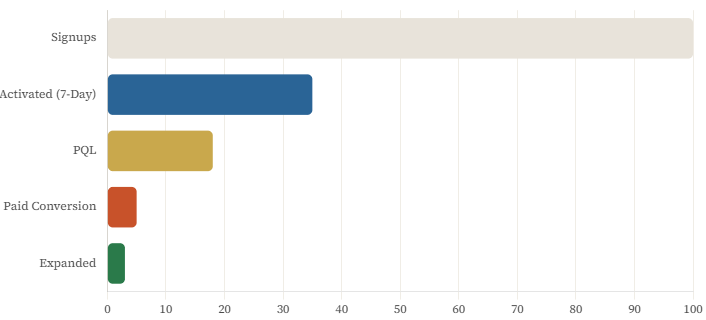
A typical pattern looks like this: 35% of users activate within 7 days, 10% activate between days 8 and 30, 5% activate after day 30, and the remaining 50% never activate and will never convert to paid.
This creates a critical strategic decision. Should the focus be on convincing the 50% who never activate, or on accelerating the 35% who will activate anyway? In practice, reducing time-to-activation for the 35% who are already on a path to value generates faster, more reliable results than trying to pull the unconverted 50% across a line they are not moving toward.
Product Qualified Lead Metrics
Product-qualified leads are users whose in-product behavior indicates genuine buying intent. This is where PLG metrics shift from being descriptive to being revenue-predictive.
PQL criteria should be built on observable usage thresholds: creating 10 or more projects, inviting 3 or more team members, using the product on 15 or more days within a 30-day window, or hitting a feature paywall or usage limit. The specific thresholds will differ by product, but they should be grounded in observed behavior, not assumptions.
The process for finding the right PQL signal is analytical. For one client, the data showed that users who integrated the product with their CRM converted to paid at 47%, while users who did not integrate converted at 8%. CRM integration became the primary PQL signal for that business. The right signal is the one that predicts conversion in your specific product, not a generic benchmark.
Track PQL volume, PQL-to-paid conversion rate, and average time from PQL to conversion. If 100 PQLs are generated monthly but only 5 convert, the problem is in the sales or conversion experience, not the product. If only 10 PQLs are generated monthly, the product is not moving enough users to the point of buying intent, and that is a product problem.
Monetization Metrics
Free-to-play conversion rate is the most closely watched PLG metric, but it needs to be tracked by cohort to be meaningful. Three time windows matter: conversion within the first 7 days, conversion within the first 30 days, and conversion by the 90-day mark.
Healthy ranges by model type provide useful benchmarks. For 14-day trials, a 20 to 25% trial-to-paid conversion is healthy. For freemium models, 2 to 5% conversion over 12 months is typical. For usage-based products with a free tier, a 10 to 15% conversion once users hit usage limits is reasonable.
Expansion revenue from existing customers is equally important. PLG companies should target 110 to 130% net revenue retention, with expansion driven by increased product usage rather than by sales team intervention. Breaking this into a revenue bridge showing new revenue, expansion revenue, contraction, and churn makes clear which motions are actually driving net growth.
Conversion Rate Benchmarks by PLG Model
| PLG Model | Healthy Conversion Rate | Time Window | Key Driver |
| 14-day free trial | 20–25% | Trial period | Feature experience speed |
| Freemium (self-serve) | 2–5% | 12 months | Usage limit triggers |
| Usage-based free tier | 10–15% | At usage limit | Limit design and upgrade UX |
| Product-qualified lead (PQL) | 30–50% | 30–60 days | Behavioral signal accuracy |
| CRM-integrated users (example) | 47% | 30 days | Integration as PQL signal |
Retention Metrics
Churn in PLG products looks different from churn in sales-led businesses. Users often stop logging in weeks or months before they formally cancel, which can be called engagement churn. Others log in regularly but stop using core features, which is value churn. Both are early warning signs that traditional churn reporting will miss.
Three retention checkpoints reveal the most. Day 7 retention shows whether users return after the first week. Day 30 retention shows whether the product is becoming a habit. Day 90 retention shows whether users are extracting sustained, repeated value over time.
Users who return on day 7 have 4 times the lifetime value of users who do not. That single data point makes early retention the most important predictor of long-term revenue in any PLG business.
Building the PLG Metrics Dashboard
Most companies track too many metrics or the wrong ones. The right PLG dashboard has 8 to 12 KPIs organized by stage and updated weekly. Monthly updates are too slow for PLG, where user behavior changes faster than monthly reporting can capture.
- For acquisition: track weekly signups by channel and signup-to-activation rate by channel
- For activation: track weekly activation rate, median time-to-activation, and 7-day retention rate
- For monetization: track PQL volume, PQL-to-paid conversion rate, free-to-paid conversion by cohort, and average revenue per paying user
- For retention: track logo retention monthly, net revenue retention monthly, and product engagement score (weekly active users divided by monthly active users)
Segment results by cohort so that different signup periods can be compared independently. An aggregate conversion rate of 5% might mask the fact that January cohorts convert at 8% while June cohorts convert at 3%, which signals a deteriorating product experience that requires immediate investigation.
Common PLG Metrics Mistakes
Tracking vanity metrics instead of value metrics. Total signups, page views, and social media followers do not predict revenue. Every metric on the dashboard should have a demonstrable correlation with paid conversion or retention.
Not segmenting by cohort. Aggregate conversion rates hide trends that cohort analysis surfaces immediately. A product experience that is quietly degrading over six months will be invisible in aggregate data until it becomes a revenue crisis.
Ignoring time-to-value. Two products with identical activation rates can have very different business outcomes if one activates users in 2 days and the other takes 14 days. Faster time-to-value produces better conversion rates, higher retention, and more organic growth.
Measuring product engagement without connecting it to revenue. Engagement metrics are only meaningful if they predict monetization outcomes. Track the correlation between specific product behaviors and paid conversion, and cut any engagement metric that has no relationship to revenue.
Not defining PQL criteria with precision. Calling someone an “engaged user” is not a PQL definition. Sales and product teams need to agree on explicit, measurable behavioral criteria that trigger a PQL designation.
Treating all users as equivalent. A user who found the product through a detailed comparison review is fundamentally different from a user who clicked a viral social post. Segment every metric by acquisition source to understand which channels produce users who actually pay.
Using PLG Metrics for Financial Forecasting
The real power of a well-built PLG metrics system is financial forecasting. When the relationship between product usage and revenue is understood at a quantitative level, revenue can be forecast from leading indicators rather than lagging ones.
The forecasting model works in five steps. First, model signup volume by channel based on historical growth rates and planned marketing spend. Second, apply channel-specific activation rates to calculate the expected number of activated users. Third, apply usage-based PQL criteria to forecast PQL volume from activated users. Fourth, apply historical PQL-to-paid conversion rates and average time-to-conversion to forecast new paid customers. Fifth, layer in expansion revenue from existing customers based on usage growth patterns.
This creates a forecast that flows from acquisition through product engagement to revenue. When product engagement is strong, revenue follows 60 to 90 days later. When engagement weakens, it appears in PQL volume before it ever touches the income statement.
One PLG company was forecasting revenue entirely from the sales pipeline. They missed their Q2 target by 30% because they had not noticed that product activation had dropped from 40% to 28% in Q1. The users who would have become Q2 paid customers simply never activated. After implementing a full PLG metrics system, they were able to forecast revenue with 12% variance based on activation and PQL trends, giving them 60-day advance warning when growth was slowing and time to address product issues before they became revenue problems.
How Investors Evaluate PLG Metrics
Investors evaluating PLG companies look at different signals than they apply to sales-led SaaS businesses.
Capital efficiency is the starting point. What is the fully loaded CAC for a paying customer? PLG companies should achieve a CAC under $5,000 for SMB and under $50,000 for enterprise, which is significantly lower than sales-led equivalents at the same scale.
Viral coefficient measures how many new users each existing user brings into the product. Above 0.6 is good. Above 0.9 is exceptional and indicates genuine organic compounding.
Organic growth rate tracks the percentage of new users who arrive through non-paid channels. Strong PLG businesses see 60% or more of signups from organic, product-led, or viral sources.
Product engagement at scale tests whether user engagement holds as the business grows. Declining engagement at scale signals product problems that will eventually kill growth, and sophisticated investors look for this pattern specifically.
When presenting to investors, show the full funnel from signups through activation, PQL, and paid conversion with historical trend lines. Investors want evidence that the company understands its own conversion mechanics well enough to forecast revenue from product data, and that unit economics, including CAC, LTV, and payback period, are moving in the right direction.
Further Reading
Browse more articles in the CFO Pro+Analytics Knowledge Base for in-depth financial frameworks, models, and strategies tailored to your business.
Ready to take action? Explore our BI & Analytics Services → to see how we partner with founders and operators to build financial clarity.
