Gross Margin Targets for SaaS Companies
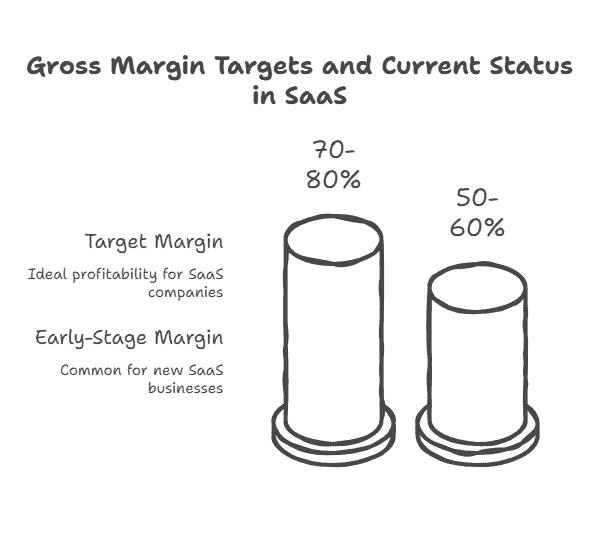
Gross margin is the percentage of revenue left after direct costs like hosting, support, and implementation. Gross margin for SaaS refers specifically to the proportion of recurring revenue remaining after subtracting the direct costs of delivering cloud-based software services, and is a critical indicator of profitability, scalability, and operational efficiency in the SaaS industry. SaaS companies should target 70-80% gross margin, but most early-stage companies sit at 50-60% because of inefficiencies they’ll eventually eliminate. Investors care about gross margin because it determines how much revenue flows to R&D, sales, and profit. Gross margin is one of the key financial metrics investors use to assess a SaaS company’s overall financial health and long-term success. Low gross margin means you need more revenue to cover operating expenses and reach profitability. Track gross margin monthly, understand what drives it, and have a concrete plan to reach 70%+ as you scale. Achieving target gross margins is essential for enabling sustainable growth in SaaS businesses.
Why Gross Margin Determines Valuation
We talk with founders who celebrate 100% revenue growth but can’t understand why investors seem unimpressed. The answer is usually in gross margin, and Fractional CFOs can help startups optimize financial strategies to impress investors.
Revenue growth matters, but gross margin determines how much of that revenue you can reinvest in growth or keep as profit. For example, consider Company A and Company B, each with $10M in revenue generated. Company A operates at an 80% gross margin, giving it $8M to spend on sales, marketing, R&D, and overhead. Company B, with a 50% gross margin, only has $5M available. Same revenue, completely different economics—and Company A will command a higher valuation multiple due to its stronger gross profit.
Investors know this. They calculate gross margin within the first five minutes of looking at your business. Below 60%, questions start. Below 50%, many investors pass regardless of growth rate. Revenue generated and gross margin together directly impact valuation multiples like EV/Revenue and gross profit multiples, making both critical in investor assessments.
Public SaaS companies average 70-75% gross margin. The median gross margin is often used as a benchmark for SaaS company performance and valuation. That’s the benchmark investors use. If you’re at 55% gross margin, they want to see a clear path to 70%+. If you can’t articulate how you’ll get there, they assume you won’t and value your business accordingly.
What Actually Goes Into and How to Calculate Gross Margin
Gross margin is revenue minus cost of goods sold (COGS), divided by revenue. For SaaS, COGS includes direct costs required to deliver your service, such as delivery costs:
Hosting and infrastructure: AWS, GCP, Azure costs for running your application. Data storage, compute, bandwidth.
Support costs: Customer support salaries, ticketing systems, phone systems. Anyone directly helping customers use the product.
Implementation and onboarding: Professional services team that configures software for new customers. Onboarding specialists who train users.
Payment processing: Stripe fees, credit card merchant fees. Usually 2.5-3% of revenue.
Third-party software directly embedded in product: APIs you call, data you license, services you resell.
What doesn’t go in COGS: These are operational expenses, such as engineering salaries (that’s R&D), sales and marketing costs, general overhead, legal fees, advertising, and management team. Operational expenses are not included in COGS but are crucial for understanding overall business efficiency.
It’s important to distinguish between COGS and operating costs. Operating costs include both COGS and broader operational expenses required to run the business.
The distinction matters because investors scrutinize what you include in COGS. Some companies try to inflate gross margin by excluding costs that should clearly be in COGS. This backfires in due diligence when investors reclassify expenses and your gross margin drops 10 points.
To calculate profitability, use the saas gross margin formula: (Revenue – COGS) / Revenue. This formula helps you understand the proportion of revenue left after covering the direct costs of delivering your SaaS product. You can also estimate target gross and net profit margins using our Profit Margin Calculator to test different cost and pricing scenarios.
Recurring Revenue and Service Margins
Recurring revenue is the backbone of any successful SaaS company, providing a steady income stream that supports predictable growth and long-term financial health. This recurring revenue—typically generated from subscription-based software services—enables SaaS businesses to forecast revenue with greater accuracy, plan investments, and demonstrate stability to investors.
Alongside recurring revenue, many SaaS companies offer professional services such as implementation, consulting, and training. The profit generated from these services is known as service margin. While these services can help onboard new customers and drive adoption, they often carry lower gross profit margins compared to core software subscriptions. Understanding the balance between high-margin recurring revenue and lower-margin services is essential for optimizing a SaaS company’s gross margin.
To calculate gross margin, SaaS businesses use the formula: Gross Margin = (Total Revenue – Cost of Goods Sold) / Total RevenueHere, total revenue includes both recurring software subscriptions and any professional services, while cost of goods sold (COGS) covers all direct costs required to deliver those services. By analyzing these revenue streams and their associated direct costs, SaaS companies can identify opportunities to improve gross margin and drive higher profitability.
Achieving higher gross margins is often a result of efficient cost management, effective pricing strategies, and a scalable business model. SaaS businesses with higher gross margins—typically above 70%—have more resources to reinvest in growth initiatives like sales, marketing, R&D, and customer acquisition. Industry gross margin benchmarks vary, but a good SaaS gross margin is generally considered to be above 75%, with top performers reaching 80% or more.
Typical Gross Margin by Stage and Model
Early-stage SaaS companies typically have lower gross margins than mature companies because they haven’t optimized costs yet. SaaS gross margin benchmarks are commonly used to evaluate performance at each stage and guide improvement strategies:
Pre-$1M ARR: 40-60% gross margin is typical. You’re over-provisioned on infrastructure, providing high-touch support, doing manual implementations. This is acceptable if you have a clear path to improvement.
$1M-5M ARR: 50-70% gross margin. You’re automating some processes, negotiating better hosting rates, shifting from high-touch to self-serve where possible.
$5M-20M ARR: 60-75% gross margin. Infrastructure is right-sized, support is mostly systematized, implementations are partially automated.
$20M+ ARR: 70-80% gross margin. Mature operational efficiency. Enterprise SaaS might be 70-75%, pure software-only SaaS might be 80-85%. These figures reflect saas industry standards and are important for benchmarking against public company averages.
Business model also affects target margins. SaaS gross margin benchmarks help set expectations for each model:
Pure SaaS with self-serve: 80-85% gross margin. No services component, automated onboarding, minimal support.
SaaS with implementation services: 65-75% gross margin. Professional services to configure and deploy drag down margins.
Vertical SaaS with payment processing: 60-70% gross margin. Payment processing fees (which are COGS) reduce margins but the volume often makes up for it.
Hardware-enabled SaaS: 40-60% gross margin. If you sell hardware that connects to your software, hardware costs kill margins but can be strategic for customer lock-in.
Investors expect you to know where your model should land and show progress toward that target. In the SaaS industry, a good gross margin is typically considered to be in the 70-85% range, which signals strong financial health and scalability to investors.
The Path from 55% to 75% Gross Margin
Most companies we work with enter engagements at 50-60% gross margin and need to reach 70%+ to be fundable or profitable. Here’s how that progression typically works:
Infrastructure optimization (adds 5-10 points): Right-size your servers, use reserved instances instead of on-demand, implement caching to reduce compute. Analyze usage patterns to identify opportunities for cost savings and resource allocation. Leverage cloud infrastructure and cloud cost management tools to optimize operational expenses, taking advantage of scalability and cost-efficiency. Negotiate volume discounts once you hit scale. Move to more efficient architectures. We had a client spending $45K monthly on AWS for 500 customers ($90 per customer monthly). After optimization: $28K monthly ($56 per customer). That’s $204K annually—dropping infrastructure from 18% of revenue to 11%, adding 7 points to gross margin.
Support automation (adds 3-5 points): Build self-service help centers, knowledge bases, chatbots. Train customers to solve common problems themselves. Tier support so simple questions get handled by junior staff or automation, complex issues escalate to experts. The goal is reducing support cost per customer as you scale.
Implementation efficiency (adds 5-8 points): Standardize implementation processes, build configuration tools customers can use themselves, create templates for common use cases. Early-stage SaaS might spend 40 hours implementing each customer. Mature SaaS spends 2 hours. That’s the difference between implementation costs of 30% of first-year revenue versus 3%.
Payment processing optimization (adds 1-2 points): Negotiate better rates with processors once you have volume. Use ACH/bank payments for large customers instead of credit cards (much lower fees). Build incentives for customers to choose lower-cost payment methods.
Vendor negotiation (adds 2-4 points): Every third-party service you use should be renegotiated annually. Twilio, SendGrid, authentication services, monitoring tools. At scale, you have leverage. A company growing from $2M to $5M ARR should renegotiate every vendor contract. We typically save clients 20-40% on vendor costs through structured negotiation.
As you improve these areas, your pricing model and gross profit margin become key indicators of SaaS business health, profitability, and investor appeal. SaaS businesses benefit from low incremental costs and relatively low incremental costs as they scale, meaning additional revenue can be generated without significantly increasing direct expenses. Managing marginal cost is crucial—once initial development costs are covered, the cost of serving each new customer remains low, supporting scalability, profitability, and long-term sustainability.
Common Gross Margin Mistakes
We see the same mistakes repeatedly when auditing SaaS gross margin calculations:
Excluding costs that belong in COGS. Support managers who spend 80% of their time managing customer issues are COGS, not overhead. Implementation specialists are COGS, not R&D. Include everything directly required to deliver service.
Not tracking hosting costs per customer. If you don’t know what it costs to serve a customer, you can’t optimize. Break down infrastructure costs by customer segment. Often you’ll find small customers cost the same to serve as large ones, but pay 10x less. This informs pricing and targeting, and analyzing different customer segments helps identify where cost optimizations and margin improvements are possible.
Accepting vendor pricing without negotiation. Every SaaS tool charges list price until you push back. Negotiate everything. “We’re growing fast and will be a bigger customer in 12 months. What’s your volume pricing?”
Over-provisioning infrastructure “just in case.” Size infrastructure for actual usage plus reasonable buffer, not theoretical maximum load. We see companies running at 15% infrastructure utilization because they’re scared of outages. That’s burning money.
Manual processes that should be automated. If you’re manually configuring every new customer, that’s COGS that could be eliminated with investment in tooling. Failing to automate can lead to proportionally increasing costs as your customer base grows, eroding gross margin.
Not separating one-time costs from recurring costs. Implementation might have 40% margin but SaaS revenue after implementation has 85% margin. Track both. Show investors that as customers mature past implementation, margins improve.
Finally, always monitor your overall gross margin to ensure accurate financial reporting and to assess the true profitability of your SaaS business.
When Low Gross Margin Is Strategic
Sometimes low gross margin is an acceptable strategic choice, not a problem to fix immediately:
Land-and-expand model with loss-leader implementation. You might do implementations at break-even or loss to land customers, knowing the recurring revenue—especially subscription revenue—has 80% margins and will dominate over time.
Market penetration phase. You might subsidize hosting to acquire customers rapidly, planning to optimize later once you have scale and lock-in. In some SaaS business models, other revenue streams beyond subscriptions, such as professional services or transaction fees, can also impact overall gross margin dynamics.
Building moat through services. Some companies deliberately provide high-touch implementation and support to create switching costs. The low margin is the price of customer stickiness.
Payment processing as strategic advantage. Payment-enabled SaaS has lower gross margin (payment fees are COGS) but the payment processing creates lock-in and lets you monetize transaction volume not just software usage.
The key is being intentional and having a plan. “We’re at 55% gross margin now because we provide white-glove onboarding. As we add self-serve onboarding tools, we’ll reach 70% by $5M ARR” is fine. “We’re at 55% gross margin and haven’t really thought about it” is not fine.
Over the long term, focusing on recurring revenue models—where predictable subscription revenue drives profitability—can significantly improve gross margin and create a strong foundation for scalable growth.
Modeling Gross Margin Improvement
Build a simple model tracking your company’s gross margin evolution over time:
Current state: Revenue $2M, COGS $900K, gross margin percentage 55% – Hosting: $360K (18% of revenue) – Support: $280K (14% of revenue) – Implementation: $180K (9% of revenue) – Processing fees: $60K (3% of revenue) – Other: $20K (1% of revenue)
Future state at $5M revenue: – Hosting: $550K (11% of revenue) – optimization + volume discounts – Support: $400K (8% of revenue) – automation + efficiency – Implementation: $200K (4% of revenue) – self-serve tools – Processing fees: $125K (2.5% of revenue) – better rates – Other: $35K (0.7% of revenue) – Total COGS: $1.31M (26% of revenue) – Gross margin percentage: 74%
Show this to investors. It demonstrates you understand your cost structure and have concrete plans to improve your company’s gross margin. When you compare your SaaS company’s gross margin to industry benchmarks, it highlights your operational efficiency and potential for higher valuation. This is infinitely better than saying “we think margins will improve as we scale.”
Benchmarking Your Gross Margin Benchmarks
Don’t just compare yourself to public SaaS averages—benchmark against the broader SaaS sector and its specific metrics. Segment by business model:
Pure software SaaS (Datadog, Atlassian): 80-85%
SaaS with services component (Veeva, Guidewire): 65-75%
Marketplace/platform SaaS (Shopify, Toast): 40-60% due to payment processing
Infrastructure SaaS (Snowflake, MongoDB): 70-75%
Compare yourself to companies at a similar stage and model within the SaaS sector. If you’re a $3M ARR SaaS-plus-services company at 62% gross margin, you’re probably fine. If you’re a pure software company at 62% gross margin, you need to figure out why hosting and support costs are so high. Also, consider the impact of your customer mix—targeting enterprise customers often leads to higher gross margins due to premium pricing and tailored solutions.
To improve margins, focus on strategies to raise revenue, such as upselling, cross-selling, and targeting high-margin customer segments.
Use public company earnings reports to see margin evolution. Many companies report gross margin by product line, showing how margins improve as products mature. This helps you model realistic improvement trajectories.
The Gross Margin Conversation with Investors
Investors will ask about gross margin in every conversation. Here’s how to handle it:
Know your current gross margin and how you calculate it. “We’re at 64% gross margin. That includes all hosting, support, implementation, and processing fees.” Be prepared to discuss key SaaS metrics and financial metrics, as investors will want to understand how gross margin fits into your company’s financial health and overall business model.
Explain why you’re at current margin. “We’re doing high-touch implementations for early customers to learn. This costs us 12% of revenue but creates product insights worth way more than the margin hit.” Also, segment your customer base to identify high-margin opportunities and consider strategies to upsell existing customers, which can further improve gross margin by expanding relationships with your most valuable clients.
Show the path to target margin. “As we automate implementation and optimize infrastructure, we’ll reach 72% gross margin at $5M ARR.” Highlight how improving customer retention and increasing customer lifetime value are part of your long-term profitability strategy. Reducing customer churn through better onboarding, product quality, and customer success initiatives will also support margin expansion.
Provide proof points. “We’ve cut hosting costs per customer by 30% in the last 6 months through optimization. That improvement will continue.” Managing customer acquisition costs is also critical for profitability and growth, so be ready to discuss how you’re optimizing these expenses.
Be honest about challenges. “Support costs are higher than we’d like because our product still has rough edges. We’re investing in product quality which will reduce support load.” Improving customer satisfaction is key here, as higher satisfaction leads to lower support costs, increased loyalty, and better margins. Customer success teams play a vital role in supporting retention, satisfaction, and upsell opportunities.
The worst answer is “we haven’t really analyzed gross margin.” That signals you don’t understand your business economics or the importance of tracking SaaS metrics and your company’s financial health.
Q: What gross margin is good enough to raise funding?
For seed/Series A, investors want to see 55-65% minimum with a credible path to 70%+. Below 55%, you’ll face tough questions. For Series B+, you should be at 65-70% or higher. Investors become less forgiving of low margins as you mature. The exception is if you have a strategic reason for low margins (payment processing, hardware component) that you can explain clearly. Pure software SaaS below 60% at Series B will struggle to raise.
Q: Should we sacrifice gross margin for growth?
Sometimes yes, strategically. If spending more on implementation or support helps you land customers in a competitive market, that can be worth the margin hit short-term. But have a plan to improve margins as you scale. Investors will accept “we’re at 58% margin now, we’ll be at 72% at scale” if you can show how. They won’t accept “we’re growing fast and don’t care about margins.” That’s a recipe for unprofitable growth that can’t sustain itself. Make sure you’re also monitoring customer acquisition costs to ensure growth is efficient and sustainable.
Q: How do professional services and implementation fees affect gross margin calculations?
Implementation fees are revenue. Implementation costs are COGS. If you charge $10K for implementation that costs you $8K to deliver, that’s 20% margin revenue. The key is separating one-time implementation margin from recurring SaaS margin in your reporting. Show investors that while blended gross margin is 65%, your recurring SaaS gross margin is 78% once customers are live. This proves the business model works at scale even if early implementations are lower margin. Track and report both numbers, and be ready to discuss how customer success, customer retention, and strategies to reduce customer churn contribute to improving these margins over time.
Further Reading
Browse more articles in the CFO Pro+Analytics Knowledge Base for in-depth financial frameworks, models, and strategies tailored to your business.
Ready to take action? Explore our Financial Modeling Services → to see how we partner with founders and operators to build financial clarity.
