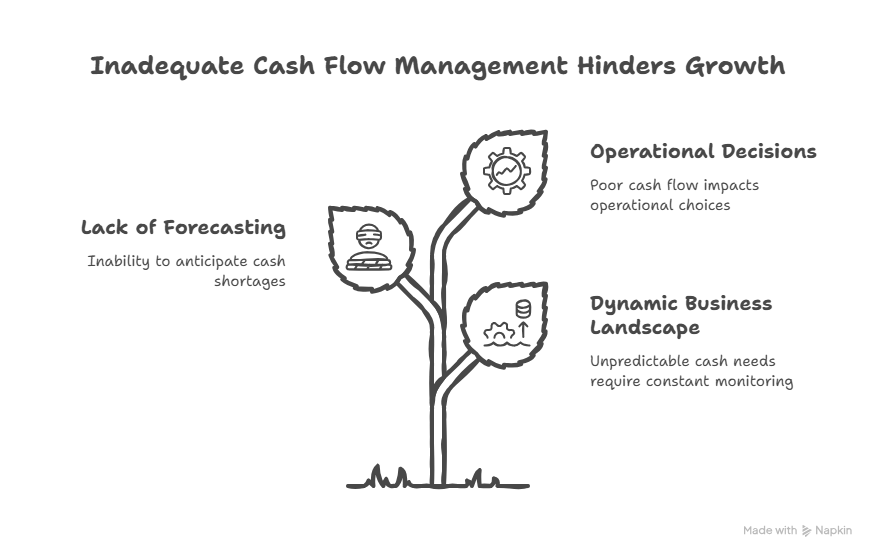
Why Every Growing Company Needs a Rolling 13-Week Cash Flow Forecast
in Strategy, Cash Flow Improvement, Cash Flow Management, CFO Services, Financial Leadership, Financial Modeling, financial planning, Fractional CFO, All Posts
Most founders come to me thinking about cash flow forecasting only when they’re worried about making payroll, paying vendors, or making sure there’s enough in the bank to cover next month. Those are legitimate concerns. But they’re a small fraction of what a well-built weekly cash flow forecast actually does for a business.
An income statement tells you if you’re profitable. A balance sheet tells you where you stand today. Neither one answers the question I care about most when I sit down with a client: what operational decisions do we need to make right now to avoid a cash constraint three months from now?
That distinction matters because cash shortages rarely come out of nowhere. In my experience, they build slowly, over weeks, out of things that look manageable in isolation. A round of hiring that ran ahead of plan. Inventory is creeping up. Receivables slipping. Individually, none of it looks alarming. Together, it puts real pressure on working capital long before the financial statements catch up to the story.
The point of a rolling forecast isn’t to measure cash. It’s to catch these trends early enough that management still has options.
TL;DR:
Profitable companies run out of cash all the time. Not because the business model is broken, but because nobody was watching the timing of cash in and cash out until it was too late. A rolling 13-week cash flow forecast fixes that. It’s an underused tool in a growing company’s arsenal, and I’ve built dozens of them for clients over the years.
Why Thirteen Weeks?
Thirteen weeks is the sweet spot. It’s far enough out to catch a liquidity problem before it forms, and close enough that the numbers still mean something.
Annual budgets are useful for setting direction, but they go stale fast once the year gets underway. Monthly financials tell you what already happened, which is fine, except by then the decision window has usually closed.
A rolling 13-week forecast lives in the gap between those two. Every week you drop one week off the front and add a new one to the back, so you’re always looking thirteen weeks ahead: customer collections, payroll, vendor payments, debt service, taxes, capex, whatever moves cash. I’m not trying to predict every transaction down to the dollar. I’m giving leadership enough visibility to see a trend before it becomes a fire drill.
Profit and Cash Are Not the Same Thing
This is the single biggest misconception I run into, and I hear a version of it in nearly every new client conversation: people assume that if profitability is improving, cash flow will take care of itself. It doesn’t work that way.
Revenue is recognized on one clock, and cash is collected on another. You can be growing sales nicely while your customers are still sitting on 60- or 90-day terms. Meanwhile, payroll, rent, software, supplier invoices, dedebtervice, and taxes are all running on their own schedules, and none of them waits for your receivables to catch up.
So you end up with a business that looks profitable on paper and is quietly getting squeezed on liquidity. This is exactly why I push cash flow forecasting so hard with clients. It’s the tool that shows you not just how much cash you’ll generate, but when it actually shows up. For a growing company, timing is often just as important as profitability.
An Early Warning System, Not a Report
The real value of the 13-week forecast is that it works like an early warning system, not a financial report you file away.
Say the forecast shows cash getting tight in eight weeks. That single data point changes the entire conversation. Instead of reacting to a crisis after it hits, leadership has time to do something about it: tighten up collections, prioritize deals with faster-paying customers over bigger ones with slower terms, push back on supplier terms, delay a capex decision, or slow down a hiring plan until cash catches up.
None of that requires emergency measures. It just requires seeing it coming.
A Case Study
I’ll walk through a scenario I see often. A SaaS company doing roughly $10 million in ARR, growing steadily, demand is strong, and the latest financials show improving profitability. Leadership, feeling good about the numbers, plans to expand the sales team, invest more in product, and ramp up marketing spend.
Then the 13-week forecast tells a different story.
Several of the company’s largest enterprise accounts are on 60-day terms. At the same time, annual software renewals, quarterly tax payments, payroll from recent hires, and a large cloud infrastructure invoice are all landing inside the same six-week window. The company is still profitable on paper, but the timing of those flows creates a projected shortfall in week nine.
Because leadership sees this nearly two months out, they have real options. In this case:
- Finance works with sales to accelerate collections on outstanding invoices
- Procurement negotiates extended terms with key suppliers
- A discretionary tech investment gets pushed to next quarter
- Hiring gets staggered instead of being onboarded all at once
None of this changes the company’s strategy. It just shifts the timing of cash moving through the business, without a scramble for short-term financing or painful cuts. And, all the stress that creates. By week nine, the projected shortfall has basically disappeared. Not because revenue jumped, but because leadership had enough runway to make deliberate decisions instead of reactive ones.
That’s the whole case for this tool. It doesn’t remove uncertainty, and it won’t predict every dollar. What leadership gives is time, and time is the one thing that becomes more valuable, not less, as a company scales.
Cash Flow Isn’t Just Finance’s Job
Here’s a mistake I see constantly: treating the 13-week forecast as something that lives entirely inside the finance function. It doesn’t. Nearly every part of the business touches cash in some way.
Sales control how fast receivables turn into cash. Operations drives inventory and purchasing. Procurement sets supplier terms. HR shapes payroll commitments. Leadership decides the pace of investment and growth. All of it feeds the same forecast.
That’s why I push clients to make the 13-week forecast part of the business’s regular operating rhythm, not an accounting exercise that lives in a spreadsheet nobody else opens. When department heads understand how their decisions ripple through liquidity, conversations become sharper and capital allocation becomes more disciplined. Finance stops being the group that reports what already happened and starts being the group that helps the business make better calls before the constraints show up.
Conclusion
A rolling 13 week cash flow forecast will never eliminate uncertainty, and it will never predict every financial outcome with perfect accuracy. That isn’t its purpose. Its value lies in extending management’s decision horizon, giving leadership the visibility to identify potential cash constraints while there is still time to respond thoughtfully.
The businesses that manage cash most effectively are rarely those with perfect forecasts. They are the ones that consistently use forecasting to guide operational decisions, allocate capital more deliberately, and adapt before liquidity becomes a constraint. Over time, that discipline strengthens not only cash flow but the quality of decision making across the organization.
At CFOPro+Analytics, we work with growth stage companies to build practical financial systems that support better decisions, stronger cash management, and sustainable growth. A well designed 13 week cash flow forecast is often one of the first steps toward giving leadership the financial clarity needed to scale with confidence.
FAQ
Is a 13-week cash flow forecast only for companies with cash problems?
No, and honestly, companies with healthy cash positions often get the most value from it. The goal isn’t just to avoid running out of money, it’s to make better operational calls. A forecast helps you time hiring, capex, debt repayment, inventory purchases, and growth spending correctly while keeping enough liquidity to support the business.
How often should it be updated?
Weekly. Every week, you drop one and add one to keep a continuous thirteen-week view. If you’re not updating it consistently, it loses its value quickly; it becomes a snapshot rather than a living tool.
What’s the biggest mistake companies make with this?
Treating it as a finance-only exercise instead of a management process. Cash flow gets shaped by decisions across the whole company, not just finance. The forecasts that actually work are built collaboratively and reviewed regularly by leadership, so operational decisions get made with a clear line of sight to what they’ll do to future liquidity.

Assess your CFO needs in 5-minutes
For more on this topic, read our cash flow forecasting for growth companies and cash flow mistakes startups commonly make.