Why Family-Owned Businesses Need to Start Thinking Like SaaS Companies
in Fractional CFO, Financial Leadership, financial planning, Fractional CFO Services, All Posts
Most family-owned and small businesses operate with a critical blind spot: they are “Cash Rich but Data Poor.” The bank account balance dictates their sense of security, often masking deeper financial inefficiencies. They celebrate when cash flow is strong, yet remain oblivious to their true profitability or the hidden risks lurking in their revenue streams.
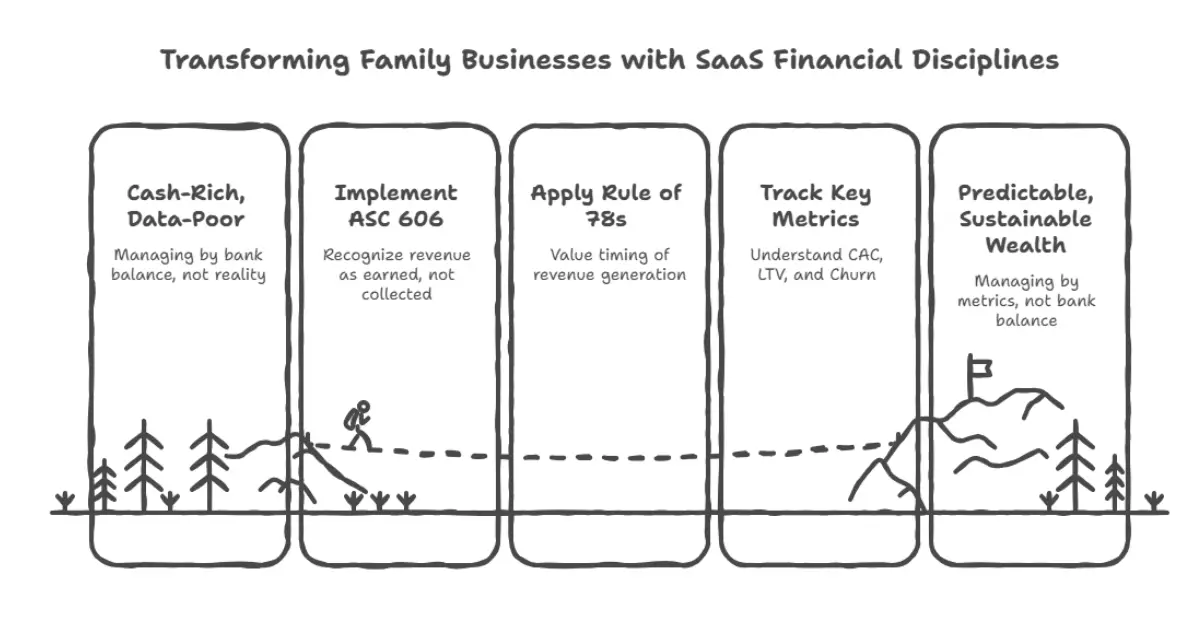
However, by embracing the disciplined, forward-looking financial principles typically associated with SaaS companies, you can transform your business from managing by bank balance to building predictable, sustainable wealth.
TL;DR:
Family-owned businesses often manage by cash balance rather than financial reality. By adopting SaaS-style disciplines such as ASC 606 revenue recognition, the Rule of 78s, and metrics like CAC, LTV, and Churn, owners can improve forecasting, strengthen cash flow decisions, and build more predictable, sustainable long-term value.
Picture a thriving family business landing a significant $50,000 contract. The client pays upfront for a year of service. The owner, seeing the healthy bank balance, feels a surge of success. They may invest in a new company truck or hire an additional assistant, confident in their newfound prosperity.
Fast forward three months, and despite the work being actively delivered, the business finds itself struggling for cash. How can this be? The $50,000 is gone, and the remaining nine months of service still need to be funded.
ASC 606
This scenario highlights precisely why a seemingly complex accounting standard like ASC 606 (Revenue from Contracts with Customers) is not just for large corporations; it’s a vital discipline for every growing business. ASC 606 isn’t merely a regulation; it’s a framework for financial integrity. It forces a critical distinction:
“Revenue isn’t what you collect; it’s what you earn.”
If you haven’t done the work, that $50,000 isn’t yours yet—it’s a liability. ASC 606 keeps you from spending tomorrow’s payroll on today’s whims.
By recognizing revenue only as performance obligations are met, ASC 606 provides a clear, unvarnished view of your business’s true financial health, preventing premature spending and fostering a more disciplined approach to cash management.
The Rule of 78s
Beyond revenue recognition, understanding the Rule of 78s can fundamentally shift how you approach sales and goal-setting. This principle, often used in loan interest calculations, powerfully illustrates the accelerating impact of early contributions.
For a business reliant on recurring contracts, it reveals why “timing is everything.”
Consider a $1,000/month contract:
- A contract signed in January is worth $12,000 in annual revenue.
- That same contract signed in June is only worth $7,000 for the current year.
“In a family business, ‘waiting until next month’ to close a deal isn’t just a quiet period; it’s a mathematical suicide mission for your annual goals.”
The Rule of 78s teaches owners to value the timing of revenue generation as much as the volume. Early wins compound throughout the year, making annual targets significantly more achievable and reducing the frantic scramble in Q4.
Metrics That Matter
SaaS companies are valued for their predictable, recurring revenue and their rigorous focus on key performance indicators. These aren’t exclusive to tech giants; they are powerful tools for any business seeking sustainable growth:
Customer Acquisition Cost (CAC):
What did it actually cost to acquire that new client? If you spent $2,000 in marketing, sales efforts, and even that “free lunch” to land a client who generates $1,000 in profit, you’re losing money on day one. Understanding your CAC is crucial for profitable growth.
Customer Lifetime Value (LTV)
Is this client a “one-night stand” or a “marriage”? Family businesses often focus on the immediate transaction, but true wealth is built on long-term relationships. Knowing your LTV helps you prioritize client retention and invest wisely in customer satisfaction.
Churn Rate
If you’re losing old customers through the back door as fast as you’re bringing new ones in through the front, your “growth” is an illusion. You’re not building a business; you’re running on a treadmill. A low churn rate is a testament to product-market fit and customer loyalty.
I’ll dive deeper into these metrics in subsequent articles.
The ROI of Boring Financial Arithmetic
Many family businesses operate on a cash accounting basis—money in, money out.
While simple, this approach is a trap for anyone aspiring to scale and build lasting wealth. By adopting “SaaS-style” metrics and accrual-based thinking, guided by principles such as ASC 606 and the Rule of 78s, you elevate your business from mere survival to strategic, predictable wealth-building.
“SaaS companies command high valuations because their revenue streams are predictable.”
Your family business deserves that same stability and foresight. Stop managing by your bank account balance and start managing by your metrics to secure your future wealth.
Embrace these boring financial disciplines, and you’ll unlock a level of clarity, control, and predictable growth that will transform your family business for generations. It’s not about selling software; it’s about adopting a mindset that builds enduring value.
Conclusion
Thinking like a SaaS company does not mean changing what you sell. It means changing how you measure, manage, and forecast performance. Revenue recognition principles such as ASC 606 help create financial clarity. Concepts like the Rule of 78s reinforce the value of timing and execution. Metrics such as Customer Acquisition Cost, Lifetime Value, and Churn provide insight into whether growth is truly creating value.
The goal is not simply to generate more revenue. The goal is to create predictable, sustainable, and transferable value.
The right financial insights can transform the way you operate and position your business for sustainable growth.
Frequently Asked Questions
1. Why should a family-owned business care about SaaS metrics?
SaaS metrics help business owners understand the quality and sustainability of their revenue. Metrics such as Customer Acquisition Cost (CAC), Customer Lifetime Value (LTV), and Churn Rate provide insight into profitability, customer retention, and long-term business value. These concepts apply to nearly every business model, not just software companies.
2. What is the biggest risk of managing a business based solely on cash in the bank?
Cash balances can create a false sense of security. A large payment received today may need to be used to fund future obligations, payroll, inventory, or service delivery. Without accrual-based financial reporting and proper revenue recognition, owners may make spending decisions that create future cash flow challenges.
3. How can a family business begin adopting SaaS-style financial discipline?
Start by implementing accurate financial reporting, forecasting future cash flows, tracking customer acquisition and retention metrics, and understanding revenue recognition principles. Working with a fractional CFO can help establish these processes and provide the financial visibility needed to support sustainable growth.
At CFOPro+Analytics, we help family-owned businesses, startups, and growth-stage companies move beyond managing by bank balance. Through fractional CFO services, financial analytics, forecasting, cash flow planning, and strategic finance leadership, we provide the financial visibility needed to make confident decisions and build sustainable enterprise value.
If your business is generating revenue but lacks clarity around profitability, cash flow, customer economics, or growth planning, take our 5-minute assessment to evaluate your CFO needs and identify opportunities for stronger financial performance.

Salvatore Tirabassi is the Founder of CFOPro+Analytics, providing fractional CFO services to growth-stage companies. Based in New York, he leverages over 24 years of experience in venture capital and strategic finance to help entrepreneurs master cash flow, unit economics, and equity value creation through data-driven financial clarity.
Assess your CFO needs in 5-minutes
For more on this topic, read our scaling from $5M to $100M with fractional CFO guidance and fractional CFO framework for headcount planning.