Financial Clarity, 13-Week Cash Flow Models, and Capital Raising Networks
in Strategy, CFO Pro+Analytics, Fractional CFO, Fractional CFO Services, Roles of a Fractional CFO, All Posts
In this episode of the Founders Podcast, host Ash sits down with Salvatore Tirabassi, Founder and Managing Director of CFO Pro+Analytics. Drawing on 24 years of financial wisdom, Tirabassi discusses the strategic necessity of CFO support for early-stage founders, the role of unit economics in product-market fit, and why capital raising is a networking marathon rather than a transactional sprint.
Table of Contents
Ash: Do you want to talk through and tell our listeners about what CFOPro+Analytics is — what is the service, who is it for, and what’s the main problem you’re trying to solve?
Salvatore Tirabassi: CFO Pro+Analytics is a CFO services business. We have a very talented group of people that apply a methodology for strategic finance based on three things: a single source of truth on data; due diligence readiness, which means your finances and the way you present your business are ready for discussion with target audiences; and equity value creation—helping business owners focus on decisions that drive the underlying value of their business.
We provide everything from strategic CFO services down to bookkeeping if needed. Because we operate on a permanent part-time basis, entrepreneurs get high-level capability without the overhead of a full-time staff. Our typical clients are US-based businesses with $3 million to $50 million in revenue.
Ash: One of the biggest challenges founders face is getting financial clarity. How do you define that?
Salvatore Tirabassi: Financial clarity is aligning the finances of the business with its priorities and objectives. A founder has an idea and perhaps product-market fit, but clarity comes from looking at the mechanics—CAC, staffing, and AI productivity—through a financial projection. This allows founders to run “what-if” scenarios.
There’s a saying: “The words founder and CFO are not used in the same sentence until it’s too late.” Founders should realize that a CFO is a high-functioning advisory role. Even a few hours a month at the early stage can provide insights into the financial implications of the product-market fit you’re trying to achieve.
Salvatore Tirabassi: Take a SaaS product, like aSaaS meeting recorder. A CFO might look at your product-market fit and realize that while you’re focused on an English-speaking market, the real value might be for non-English speakers working with English teams—shifting the focus to markets like China or India. A strategic CFO thinks a few moves down the chessboard, identifying proof points and financial aspects you haven’t considered yet.
Ash: Could you take us through a use case from your experience?
Salvatore Tirabassi: I worked with an e-commerce client in the tens of millions in revenue. They considered a full-time CFO, which would have cost $300,000–$400,000 including support. We provided the service for $150,000.
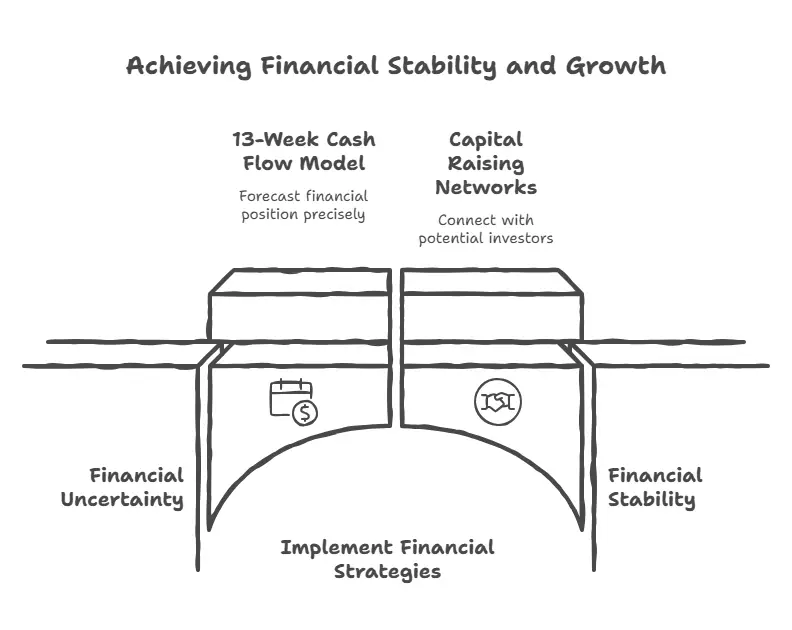
Within two weeks, I noticed recurring working capital deficiencies. Instead of a five-year forecast, we pivoted to a 13-week cash flow model. Every Monday, we reviewed the cash balance and payouts to remove uncertainty. We eventually upsized their lending facility by 25% at a lower rate because we had that clarity.
Ash: What is the single most important financial lesson for early founders?
Salvatore Tirabassi: Understand your Customer Acquisition Cost (CAC). Once you have a product-market fit, you must prove the sale is repeatable and that the margins are sufficient to fund a virtuous cycle of reinvestment. The more confidently you can demonstrate this, the easier it is to attract investors.
Ash: What common myths about venture capital should entrepreneurs watch out for?
Salvatore Tirabassi: It’s not transactional; it’s a networking process. You need to get your story in front of the right people often. There is a massive difference between doing 108 C-grade pitches and 108 A-grade pitches. The quality is in the storytelling. If an investor says no, ask for five minutes of honest feedback—it’s the most valuable input you can get.
Ash: What are your top three strategies for raising capital in 2025?
Salvatore Tirabassi:
-
Network: Go to events and meet as many investors as possible.
-
Storytelling: Have an effective story tied to your capabilities and motivations.
-
Fill the Gaps: If you have a skill set weakness, add a co-founder or advisor to fill it.
Ash: What characteristic defines a successful founder?
Salvatore Tirabassi: Being forge-ahead decisive but sensitive to pivot points. You need a strong point of view to enter the unknown, but the awareness to realize what you don’t know and adjust based on market feedback.
Ash: What’s your favorite productivity habit?
Salvatore Tirabassi: Waking up at 5:00 a.m. I also have two hacks:
-
The Destination Workout: I run to the gym, work out, and run home.
-
Unified Messaging: I use an app called Beeper. It unifies LinkedIn, WhatsApp, Slack, and others into one desktop inbox. I never have to look at my phone during the workday.
Ash: How can people get in touch?
Salvatore Tirabassi: Find me on LinkedIn as Salvatore Tirabassi. Our website is cfoproanalytics.com, and I blog about digestible finance topics at tirabassi.com.

Salvatore Tirabassi is the Founder of CFOPro+Analytics, providing fractional CFO services to growth-stage companies. Based in New York, he leverages over 24 years of experience in venture capital and strategic finance to help entrepreneurs master cash flow, unit economics, and equity value creation through data-driven financial clarity.
Assess your CFO needs in 5-minutes
For more on this topic, read our how a fractional CFO manages board communications and fractional CFO guide to scaling from $5M to $100M.