Debt vs. Equity, S-Corp Tax Strategy, and AI Automation
in Strategy, CFO, CFO Pro+Analytics, CFO Services, Fractional CFO, All Posts
On the Entrepreneurous Podcast, host Randolph Love III sits down with Salvatore Tirabassi, Founder and Managing Director of CFO Pro+Analytics, to dig into the financial decisions that make or break entrepreneurs. The conversation spans capital strategy, AI in lead generation, tax structures, and what an ideal fractional CFO engagement looks like.
Table of Contents
-
How Founders Actually Raise Capital: Debt vs. Working Capital vs. Crowdfunding
-
The Basic Tax Strategy Every Entrepreneur Should Know: LLC Taxed as S-Corp
Randolph Love III: Is there anything that you know now that you wish you knew when you first started?
Salvatore Tirabassi: I probably would have learned earlier on—because I started out in venture capital and growth equity. This was the late ’90s, early 2000s, and organizational structure, people, and culture weren’t really as much of a “thing” at that time. As an investor, when you’re involved in growing businesses, you’re sitting on the outside on the board. You get a view of the people, but valuing the culture and understanding how the organization worked wasn’t something we paid as much attention to. It wasn’t something I was being trained to focus on, and I think I would have benefited from being coached on that earlier in my career.
When you’re operating at the investor level, you can run into the concept of being hard-headed about the numbers and not seeing how the whole thing fits together. That equates to culture and how an organization works cooperatively to move in one direction to achieve the objective.
Randolph Love III: It sounds like it’s more than just the hard numbers.
Salvatore Tirabassi: It’s much more than the hard numbers. I use that know-how all the time when I’m working with clients now. For my whole team and my firm, these are issues I try to discuss with them—how to navigate the inner workings of the organization. Not the politics, but really demonstrating appreciation and understanding that at our level, we may be operating with a finance or operating team that hasn’t dealt with our level of capabilities. We need to incorporate training and bring people along so they can keep up with us. They learn a lot, and it benefits them in their careers. We want to be much more constructive in how we do things.
Randolph Love III: When it comes to building teams and building cultures—how do you raise capital around these things?
Salvatore Tirabassi: It depends on the type. With entrepreneurs, oftentimes they may not be ready to bring in an equity partner, and that’s a whole other dynamic of expectation setting. For the family and founder-owned businesses we work with, they’re mainly looking for debt financing—working capital facilities. Sometimes it’s a revolving line of credit. A lot of times it’s a working capital facility that leverages their receivables and gives them additional capital so they can turn the gears faster on sales.
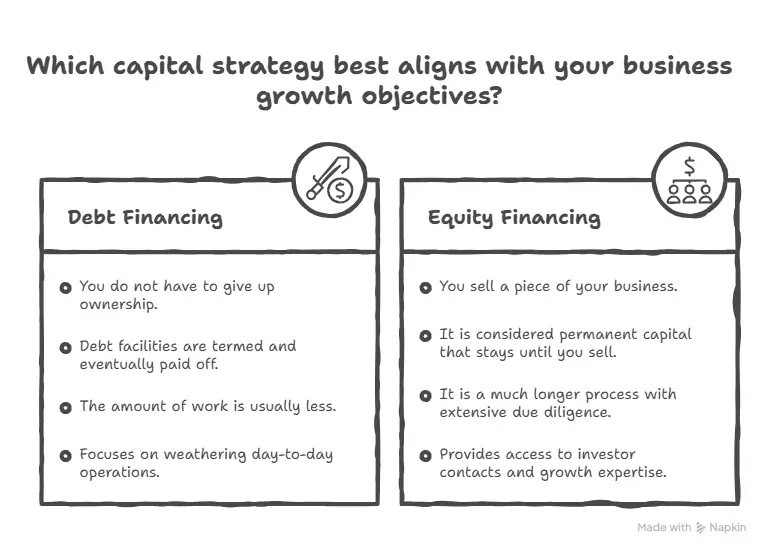
When you get into the equity side, it’s a much longer process. There’s a lot more information presented to investors. Their due diligence cycles are longer. In my previous career, there were a lot of equity financings I was involved in, but in this latest career direction as a CFO services firm, it’s usually a lot of debt financing. Coincidentally, right now I’ve got one company we work with where we’re actually exploring crowdfunding. That’ll be an interesting thing to examine and figure out whether it works or not.
Randolph Love III: Which is better—raising debt or equity? Is one worse than the other?
Salvatore Tirabassi: It depends on what your objectives are. There’s a term people use in finance called permanent capital. Permanent capital really means capital that’s going to stay with you until you sell the business. If you are an entrepreneur or business owner thinking about raising equity, “permanent capital” is a useful way to phrase it.
As a business owner, when you think about your cash flow—money in, money out every month—if you knew you had another $1 million or $5 million to put into the business that was just going to stay there, what are the things that would stabilize? What would that give you the opportunity to invest in? When you’re thinking about equity capital, think about it as permanent capital. It’s going to be with you for the long haul. You’ll know that you need it when the term “permanent capital” makes sense to you.
It’s not that one is necessarily better than the other—it’s situational. On the debt side, you obviously don’t have to give up ownership. The reporting requirements are generally the same—anybody who puts money into your business wants to know how it’s performing. The amount of work that needs to go into raising debt is usually less than what you need to put in to raise equity in terms of legal fees. Debt facilities are termed, so it’s easier to navigate what the deal is going to be. But that shouldn’t be the reason you choose debt over equity; it’s just a feature of it.
Choosing debt over equity is saying: “I can bring the money in and cycle the business so I can pay that off and own the full business with the benefit of paying off the debt in the future.” You need to think through the pluses and minuses. There really is a right answer for each one—it just depends on the company.
Randolph Love III: Equity is more of a long-term thing, maybe even strategic partnerships, whereas debt is, “All right, we still can weather the day-to-day operations and get into the right rooms ourselves for now.”
Salvatore Tirabassi: This is true. There’s also the relationship part of the equity piece—what contacts do they have? How can they help you grow your business? You need to really think about whether that’s a true value you’re going to get out of the relationship. It would be unfortunate if you sold a piece of your business and the strategic relationships didn’t come along with it when that was part of the reason for the deal. That would be pretty disappointing.
Randolph Love III: What is a pitch deck and does it even still matter?
Salvatore Tirabassi: A pitch deck does matter. It can take a lot of different forms, but the key components from my perspective—especially with the types of clients I’m dealing with—you want a really clear story of what your objectives are and why it matters, and then how that produces a Return on Investment (ROI) for the investor.
If you can accomplish those things, the content can take the form of storytelling, an analysis of your market size, the historical timeline of your business, the trajectory of growth, and some financial numbers. You can keep it pretty tight and concise—10 to 15 pages for an initial conversation. When it comes to doing the due diligence, you may want to expand that into a much more comprehensive 30 to 100 pages of really detailed information. That’s the main playbook investors will work off of to do their due diligence. The pitch deck is the first step, and then you can build off of that.
Randolph Love III: How are business owners utilizing artificial intelligence in their positions as small and emerging businesses?
Salvatore Tirabassi: The ones I see doing it successfully use a combination of AI and automation technologies such as Zapier, Make.com, and n8n. Those are integration platforms that allow you to connect different systems, and then one of the systems you can connect into is AI. The AI runs a procedure as part of the workflow that allows it to do something smart that normally you might have a person do—or it might be something you’ve never really done before because if you had people doing it, it would be impossibly expensive or it would have a lot of errors.
When you set up these systems with automation and you set them on a schedule, they run like clockwork or they’re triggered by an event. Suddenly everything happens, and at the other end, you get a result you end up using in your business. The companies I work with that are successful with AI are generally building those types of systems. A lot of them DIY it. They’ve got IT people on staff who are curious and smart, and they figure things out, build out the infrastructure, and start using it.
Randolph Love III: Is that affecting customer acquisition costs?
Salvatore Tirabassi: Yeah. One of our clients uses a lot of Zapier and a little bit of AI in their integrated workflows between their CRM and their call center system. They’ve got another system that gathers information on customer interactions. They can funnel activities happening from the CRM in terms of lead generation into Slack channels for immediate action, and also take phone interactions and activate them based on what’s happening in the CRM. The glue that does all of that is Zapier.
Does it improve customer acquisition costs? Absolutely. If they didn’t have these integrations built, there would be steps they’d have to either automate some other way, or have a person maintaining it, or just not do it because it would be impossible. Efficiency in your lead funnel is going to have an immediate impact on customer acquisition costs.
Salvatore Tirabassi: I have a technology vendor I work with that’s working in a couple of my clients now. They have an AI agent that will make appointment-setting phone calls for you. So if you have a lead generation funnel—let’s say you’re contacting people by email, sending direct mail, or connecting on LinkedIn—their system will manage that funnel using AI. The AI agent will pick up the phone, call the person, and if they get in touch, actually talk to them over the phone and set up the appointment for you.
Randolph Love III: Wow. Talk about saving on customer acquisition.
Salvatore Tirabassi: It’s pretty impressive. The first time I came across them, I was introduced by the CEO of a cybersecurity business. He told me he had replaced his whole SDR (Sales Development Representative) function—the people setting up meetings. I think he had three people working in it. He replaced that whole function with just this AI system, and it works 24 hours.
Randolph Love III: What’s the best tax plan for a business owner?
Salvatore Tirabassi: There’s a lot of nuances to it. The very basic one if you’re an entrepreneur and you own a small business is the trade-off between filing as a partnership as an LLC and filing your taxes—now, you could still be an LLC, but you file your taxes as an S-corp.
The savings: once you pay yourself a salary in the S-corp, you no longer have to pay FICA and Medicare taxes on any of the profits you pull out of the business. So you can save up to a certain amount of income. On the Medicare piece, it goes all the way to any infinite number of dollars, because Medicare is 2.9% of every dollar you make. If you do it as an S-corp, you eliminate that tail of taxes. If you’re an LLC taxed as a partnership, you’ll pay all your FICA taxes on every dollar you pull out up to a certain amount, and after that, you’ll continue to pay Medicare.
The trade-off: if you’re an entrepreneur, maybe working with a family member, the S-corp strategy might be better for you, especially as you start making more income. Once you’re pulling $200,000, $300,000, $500,000, $1 million, $2 million out of the business, the S-corp will definitely make more sense. That’s one very basic tax strategy.
Randolph Love III: It’s important to understand that the government has deemed that money making money doesn’t have to be taken care of by Social Security and Medicare. Having that LLC treated as an S-corp allows you to say, “Hey, this is my salary—charge me self-employment tax on that. But this other money, because I was an original investor in my company, this is my return on investment. This is my money making money. Treat that as such.”
Randolph Love III: Who is the ideal person for us to introduce you to?
Salvatore Tirabassi: The best clients for us are family and founder-owned businesses that are $3 million to $50 million of revenue. You basically want to have a strategic advisor operating in your business who is also keeping all your books and records perfectly clean, doing your forecasting, and making sure you’re on point for all your tax filings, but week to week providing strategic advice on key decisions.
Those could be hard decisions—getting out of a certain product line you’ve invested in, staffing issues, deciding to change payroll companies, or figuring out a strategic plan for managing cash flow every week. It can be lonely at the top for a CEO or founder. Usually, they’ve got a bookkeeper and some accounting capability, but not a high-level CFO person who can really be their strategic advisor with all the numbers behind them.
Randolph Love III: Please let everybody know your name, what you do, and how they can get in touch.
Salvatore Tirabassi: Salvatore Tirabassi, Founder and Managing Director of CFO Pro+Analytics. We’re at cfoproanalytics.com. I’ve got a terrific team of super-experienced CFO and finance people, and they’re ready to help you grow your business and make great decisions.

Salvatore Tirabassi is a fractional CFO and founder of CFO Pro+Analytics, helping founder-owned and family businesses build the financial infrastructure to grow, delegate, and exit on their terms.
Assess your CFO needs in 5-minutes
For more on this topic, read our how fractional CFOs support pricing and margin growth and 9 business model templates for financial success.