Cash Flow Forecasting, Fractional vs. Interim CFO, and AI Workflow Automation
in Strategy, Cash Flow Improvement, CFO Pro+Analytics, Finance, Fractional CFO Services, All Posts
On the Growth Capital Podcast, host Justin Dixon talks with Salvatore Tirabassi, Founder and Managing Director of CFO Pro+Analytics, about how a fractional CFO actually engages, when a business owner should start the conversation, and where AI and Excel automation are quietly making finance teams faster.
Table of Contents
-
The Typical Engagement: Cash Flow First, Then Driver-Based Forecasting
-
Why “Plus Analytics” — and the Case for the CFO as Chief Data Officer
-
Yellow Flags: When a Founder Should Talk to a Fractional CFO
Justin Dixon: Give the audience a little overview of who you are and what you’re up to.
Salvatore Tirabassi: Salvatore Tirabassi, Founder anFoundering Director of CFO Pro+Analytics. We’re a boutique CFO services firm offering fractional and interim CFO services to family and founder-owned businesses, mainly on the fractional side. We deliver services in a cost-effective manner to companies that normally don’t have access to high-level CFO capabilities.
Justin Dixon: What are some of your niches?
Salvatore Tirabassi: We’re actually industry-agnostic. Most businesses fit into one of about seven different types of business models from a revenue and scaling standpoint. We’ve worked with SaaS, CPG, construction, fund management, and asset managers. We try to be consultative at the outset to understand the business model, then match talent capability with the company.
Justin Dixon: What’s a typical engagement look like?
Salvatore Tirabassi: Typically we roll right into cash flow planning with a weekly model. Then we’ll build a monthly financial forecast that’s driver-based. It’s a private-equity-grade financial projection that serves as a conversational tool for planning.
As part of both of those, accounting and reporting get wrapped in. If the books are messy—which they are eight or nine times out of ten—we provide the care they need. Even for something like an SBA loan, it’s more powerful to go in with a projection and prepared financial statements rather than just tax returns.
Justin Dixon: What about prep-for-sale work?
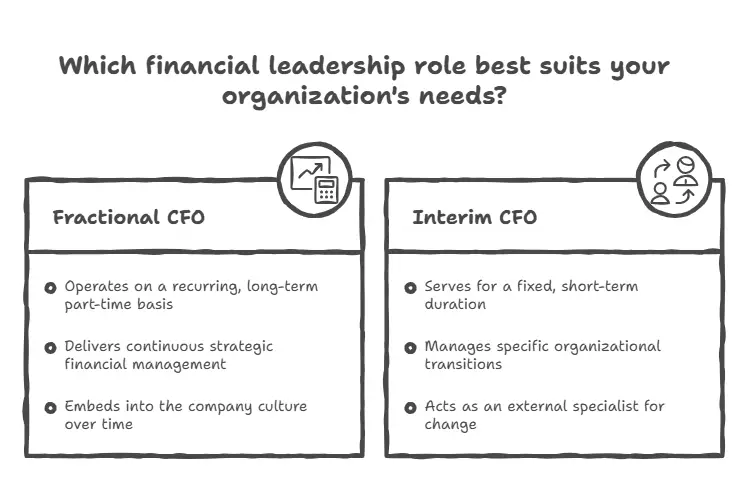
Salvatore Tirabassi: To define the terms: Fractional is permanent part-time. We’re part of your team for the foreseeable future as the main advisor to the CEO. Interim is the inverse—temporary full-time.
On the interim side, we might spend 90 to 120 days systematizing the finance function so an investment bank has a much easier pitch when selling the business to private equity. We might also step in for a PE firm that needs additional support while searching for a permanent team.
Justin Dixon: I was curious about the name — CFO Pro+Analytics.
Salvatore Tirabassi: Forward-looking finance is analytics-driven. You need business intelligence and predictive analytics. My view is that a really good CFO could actually be the Chief Data Officer of a company, where all data is owned by the finance function and pushed out to the organization. We package that know-how into the service for clients who need specific analytics-driven insights.
Justin Dixon: What are some yellow flags that should guide a founder to think, “I might need some CFO support”?
Salvatore Tirabassi: If you’re doing $5 million of revenue—or even $3 million—you should be thinking about it. If you have questions about your financial future and don’t have the time or expertise to figure them out, you need that insight.
Spending too much time assessing whether you’re actually making money, struggling with tax season, or botching a lender pitch are all indicators. You can have someone with expertise take you from looking “good enough” to looking great.
Justin Dixon: Are senior CFOs interested in being fractional later in their careers?
Salvatore Tirabassi: Yes. Since COVID, video communication has made it easy to shopped for talent in faraway places. On the talent side, executives want more schedule flexibility and variety. They might work on three or four different clients a month, working directly with the CEO, which is very attractive compared to being embedded in one large organization.
Justin Dixon: Are you guys leveraging AI tools?
Salvatore Tirabassi: I’m an early adopter. AI agents like Claude or ChatGPT become powerful when integrated through workflow tools like Zapier, Make, or n8n.
For example, when you produce an invoice in QuickBooks, you can have Claude transform that data and dump it into a Google Sheet you can check on your phone. You don’t need a monolithic AI system; you just need the “glue” to bring intelligence together with your data repositories.
Salvatore Tirabassi: I use Claude a lot for cleaning data. I might tell Claude, “This is what my data looks like. Write the Power Query code to transform it into this.” Usually, it gets it in two or three attempts.
Microsoft Copilot in Excel is also powerful. You can prompt it directly inside a table to “add a column that categorizes these expenses by vendor,” and it will scan the sheet and make intelligent categories for you. These tools help finance people work much more effectively.
Justin Dixon: Financial data is sensitive. Is there a way to make this less risky?
Salvatore Tirabassi: You must use a paid version and you must move the slider over to “don’t use my data for training.” That is the price of admission. Pay the $20 or $30 a month to ensure your sensitive financial information isn’t being fed back into the model.
Justin Dixon: If people want to reach out, what’s the best way?
Salvatore Tirabassi: Visit us at cfoproanalytics.com or find me on LinkedIn — Salvatore Tirabassi. I’m pretty good at responding and always happy to connect.

Salvatore Tirabassi is the Founder of CFOPro+Analytics, providing fractional CFO services to growth-stage companies. Based in New York, he leverages over 24 years of experience in venture capital and strategic finance to help entrepreneurs master cash flow, unit economics, and equity value creation through data-driven financial clarity.
Assess your CFO needs in 5-minutes