CFO’s Complete Guide to AI Tools That Actually Work
in Analytics, AI, Finance, Fractional CFO Services, Strategic Planning, All Posts
Over the past several months, I have been doing something most finance professionals don’t have time for: systematically researching and taking demos from AI companies claiming to solve problems for CFOs, controllers, and finance teams. Yes, it is a pain and fortunately, I have some help from my awesome team at CFO Pro+Analytics and found a way to kind of make this efficient. Also.we didn’t let any demo take more than 30 minutes of my time.
Just a CFO trying to make sense of a very crowded, very noisy space. I don’t have any affiliation with any of these businesses.
We have built a database of 50+ companies targeting the CFO function across accounting, bookkeeping, FP&A, AP/AR, tax, audit, cash flow, and treasury. Every single one of them leads with AI.
Here is what we found: there are no silver bullets. That may or may not surprise me. But, I’ve been around financial tech for a long time and it did not surprise me.
TL;DR
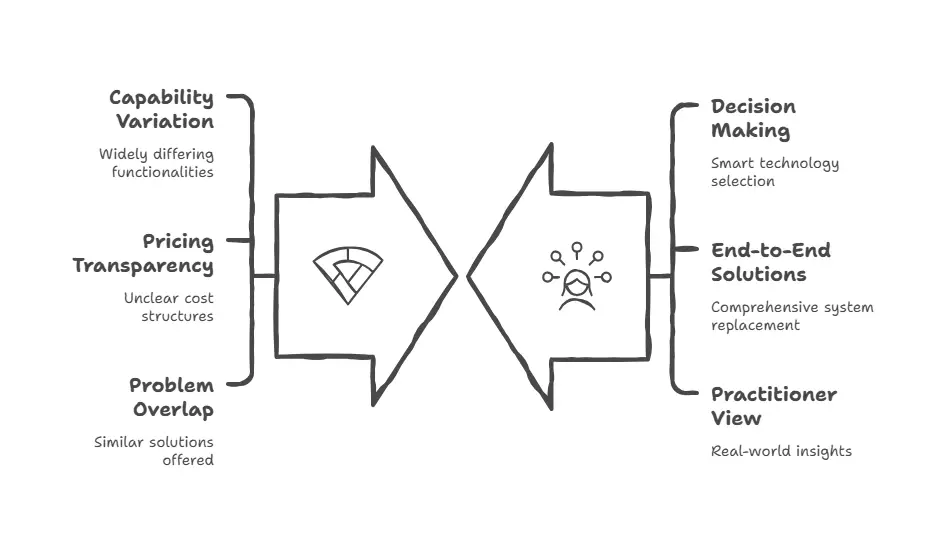
The AI vendor landscape targeting the CFO function is real, large, and deeply fragmented. Capabilities vary wildly. Pricing is rarely transparent. Many vendors solve the same problem in slightly different ways. Some tools are genuinely impressive in narrow use cases. Most are not ready to replace anything end-to-end. What follows is a practitioner’s view, not vendor marketing.
The landscape is fragmented. Many vendors are solving the same problem in slightly different ways, with significant category overlap. It is a genuinely confusing time for any finance leader trying to make smart technology decisions.
I am going to summarize some thoughts and provide a couple of comparisons here to provide some background. All the companies are hyperlinked, so you can explore directly what they are offering.
The Three Questions That Actually Matter
Before you book a single demo, get clear on three things.
First: what specific problem are you trying to solve? “Improve our finance function with AI” is not a problem. “We spend 40 hours per month on manual bank reconciliations” is a problem. Vendors will answer whatever question you put in front of them. The more specific your problem, the more honest the demo becomes.
Second: what does your current stack look like? Most AI tools are not replacing QuickBooks, NetSuite, or Sage. They are layering on top of them. The integration story matters enormously. A beautiful demo built on clean sample data is very different from a live connection to your actual books. Know your ERP, modeling and reporting stack before you go into the meeting and have some ideas of how they integrate already.
Third: have a few use cases in mind that you think they should be able to solve. For example if you are looking for solutions related to financial forecasting be prepared to discuss this like chart of account mapping, integration of actuals, driver based assumptions, etc… Tell the demonstrator to show you how they do those things.
Accounting and Bookkeeping: A Tale of Two Philosophies
This is the most crowded AI category targeting finance teams, and the one with the starkest philosophical divide. We will use two vendors to illustrate: Digits and Botkeeper.
Digits: Full Automation, Full Ownership
Digits positions itself as the world’s first AI-native accounting platform. Its Autonomous General Ledger uses specialized AI agents to handle bookkeeping, financial dashboards, invoicing, and bill pay, end to end, 24/7, with human oversight only when the AI flags uncertainty.
The pitch is aggressive. Trained on $825B+ in SMB transactions, Digits claims its Bookkeeping Agent delivers 97.8% categorization accuracy versus 79.1% for outsourced human bookkeepers, at a fraction of the cost. Pricing starts at $100 per month for the AI Accounting plan.
For small businesses and early-stage startups that want to ditch manual bookkeeping without hiring a controller, Digits demcontrollerully. Setup is fast. The dashboards are clean. You feel the AI working.
The trade-off is real: this is a proprietary general ledger. If your business model shifts, if you move to accrual accounting, or if you need investor-ready financials reviewed by a CPA, Digits may not grow with you. You are not building on QuickBooks. You are building on Digits. Lock-in risk is worth thinking through before you commit.
Botkeeper: Hybrid by Design
Botkeeper takes the opposite approach. It is purpose-built for accounting firms, not businesses directly. The AI handles the repetitive 80% of bookkeeping, categorization, reconciliation, bank feeds, and posts to the general ledger only when confidence is high. Anything below that threshold is surfaced for human review.
This hybrid model is honest about what AI can and cannot do reliably. It integrates with QuickBooks Online, which means your data stays in a system you control. It scales with accounting firms managing dozens or hundreds of client entities.
The trade-off: if you are a business owner looking for a self-serve bookkeeping solution, Botkeeper is not for you. It runs through accounting firms. Per-entity pricing of $69 to $499 per month depending on the service tier also adds up quickly in a multi-client firm context.
Summary Thoughts on Bookkeeping
Small business wanting autopilot bookkeeping: talk to Digits. Accounting firm wanting to scale capacity without hiring: talk to Botkeeper. Growing company with complex accounting, multiple entities, or investor reporting requirements: neither of these is likely your answer without additional support.
Other vendors in this category worth evaluating: Puzzle, Docyt, Fincent, Zeni, Decimal, Campfire, Rillet, Pilot, Trullion, Accrual, DualEntry, Pennylane (Europe-focused).
FP&A: Same Category, Completely Different Conversations
The FP&A software market is enormous and equally fragmented. We will use Pigment and Mosaic to show why “FP&A software” is not a useful category without more context.
Pigment: Enterprise Planning Power
Pigment is one of the fastest-growing FP&A platforms in the market. It is built for mid-market to enterprise organizations, think 500 to 5,000 employees, where financial planning involves multiple departments, complex scenario modeling, and real-time data sync across ERPs, HRIS systems, and CRM platforms.
The scenario planning capabilities are genuinely impressive: one-click what-if modeling, AI agents that scan for anomalies, automated variance analysis. For a CFO trying to keep finance, HR, and revenue teams aligned on a single business plan, Pigment is purpose-built.
The trade-off: implementation typically runs 3 to 4 months. There is a real learning curve. Pricing is enterprise-contract territory, not disclosed publicly, and not SMB-friendly. If your finance team is one or two people, or your company is under $20M in revenue, your finance team is one or two people, Pigment is almost certainly overkill.
Mosaic: Strategic Finance for Growth-Stage Companies
Mosaic targets a completely different buyer: Series B to pre-IPO companies where the CFO needs real-time financial intelligence, strategic reporting, and scenario analysis, fast, without a 6-month implementation project.
The differentiator is speed to value. Finance teams can typically be live in weeks. Mosaic connects ERP, CRM, HRIS, and billing systems into a single data layer and surfaces CFO-level reporting automatically. Its AI assistant lets you query your financials in natural language.
The trade-off: Mosaic is stronger as a real-time BI and reporting layer than as a heavy-duty planning engine. Complex multi-entity modeling, deep workforce planning, and highly customized financial architecture are better served by enterprise tools. If you are at that stage, Pigment or Planful is the right conversation, not Mosaic.
My Take on the Bottom Line for FP&A
The question is not which FP&A tool is best. The question is: what stage are you at, what is your technical complexity, and how much implementation runway do you have? Both Pigment and Mosaic demo extremely well. The danger is getting sold on the demo experience rather than the operational fit.
Other vendors in this category worth evaluating: Planful, Drivetrain, Datarails, Clockwork, Jirav, Cube, LiveFlow, Helcyon, HeronAI, Abacum, Aleph, Parallel.
The Full Vendor Map
Here is the database as it stands. We will keep updating it as we take more demos.
Accounting and Bookkeeping: Digits, Puzzle, Docyt, Fincent, Zeni, Decimal, Campfire, Rillet, Pilot, Trullion, Accrual, DualEntry, Pennylane.
FP&A: Pigment, Mosaic, Planful, Drivetrain, Datarails, Clockwork, Jirav, Cube, LiveFlow, Helcyon, HeronAI, Abacum, Aleph, Parallel.
AP/AR and Payments: Vic.ai, Stampli, Rossum, Inscribe, Centime, Paystand, Tesorio, Kolleno, YayPay, Invoiced, OpenCFO.
Audit and Compliance: Workiva, Vena, AuditBoard, Fieldguide, Numeric, DataSnipper.
Tax: TaxBit, Ledgible, TaxDome, April, Rivet, Kintsugi.
Cash Flow and Treasury: Trovata, Cashbook, Float, Agicap, HighRadius, Obol, Alidade.
Other and Emerging: Brex, Ramp, Paro, Basis, Leapfin, Triumph ManeFrame, Shortcut, SableFin, Hello Frank AI.
What We Would Tell Any CFO Right Now
Start with the problem, not the vendor. Every one of these tools will tell you they solve your problem. Define the problem in measurable terms first.
Ask about the integration story in depth. Not “do you integrate with NetSuite” but “show me a live connection to a client with a similar tech stack.”
Find someone who has been in production for 90 or more days. Demo environments are clean. Production environments are not. Vendor-provided references are curated. Find your own.
Do not buy the category; buy the specific use case. “AI bookkeeping” is not a purchase decision. “Automating bank reconciliation for a 3-entity company on QuickBooks” is.
Pricing opacity is a red flag. If a vendor will not give you a number before a demo, build that into your evaluation.
The landscape is evolving fast. More vendors are coming. Some of the ones on this list will not exist in two years. A few will become genuinely transformative. But right now, there are no silver bullets. Just trade-offs, and the work of matching the right tool to the right problem.
FAQs
Q: Do I need to replace my existing accounting system to use any of these AI tools?
No. Most of the tools in this database are designed to layer on top of your existing stack, not replace it. Whether you are on QuickBooks, NetSuite, or Sage, the integration story is the first thing to pressure-test in any demo. The exception worth noting is Digits, which runs on a proprietary general ledger. If you move to Digits, you are leaving your current system behind. For every other category, the tools connect to your existing books and work from there.
Q: How do I know if a vendor’s AI claims are real or just marketing?
Ask them to show you, not tell you. Request a live connection to a real client environment, not a demo sandbox with clean sample data. Ask for references who have been in production for 90 or more days, and find those references yourself rather than accepting the ones the vendor provides. Vendors that cannot or will not do either of those things are answering your question for you.
Q: Is there a single platform that covers the full CFO stack?
Not yet. That is the core finding from 50+ demos. Every platform has a lane: bookkeeping, FP&A, AP automation, cash flow, tax, audit. Some are expanding into adjacent categories, but no single tool reliably covers the full function. The right approach is to define your highest-priority problem, find the best tool for that specific use case, and build your stack from there rather than searching for one platform to rule everything.

Salvatore Tirabassi is the Founder of CFOPro+Analytics, providing fractional CFO services to growth-stage companies. Based in New York, he leverages over 24 years of experience in venture capital and strategic finance to help entrepreneurs master cash flow, unit economics, and equity value creation through data-driven financial clarity.
Assess your CFO needs in 5-minutes
For more on this topic, read our building a 3-statement financial model for forecasting and how CFOs improve unit economics across business models.