The Peril of Rented Infrastructure: Lessons from Shield’s Demise for Strategic Entrepreneurs
in Strategy, CFO Services, Fractional CFO, Strategic Planning, All Posts
Here’s a small lesson in entrepreneurship in the SaaS realm. In the last two years, I became a subscriber and heavy user of a product called Shield. It was plugged into my LinkedIn profile and generated professional-quality analytics for my social media on that platform. They had even introduced an LLM agent that would generate reports and trends I could share with my team and use for reporting on sponsored posts.
Much to my surprise and chagrin, I got a message from the CEO to subscribers that they were shutting down. This surprised me because unlike automated content posting services that use AI to generate poorly constructed comments, Shield was an analytics platform. In my view, those posting tools would be more likely to get shut down. They don’t generate strong social content. None of this exists for Reddit, by the way, because Reddit blocks it entirely and the user culture there is authenticity-driven. Regardless of my surprise, Shield determined they could not operate within LinkedIn’s rules and Google’s rules, which I believe centers on the Chrome extension they used to monitor LinkedIn activity. I lost a good data source and a convenient way to generate results for sponsors.
Not all is lost. LinkedIn’s native analytics page handles static metrics reasonably well. What Shield delivered was something different: analytical stories built from trended data, engagement sliced in ways the native tool won’t do, and an LLM layer that surfaced new ways to interpret and present the data. That combination is hard to replace.
From this experience, there is a cautionary tale for every AI piggyback model emerging today. You can build something genuinely useful on top of another platform’s infrastructure. But it can all get shut off. The ecosystem you relied upon can force you out, overnight, with no recourse.
TL;DR
After seven years, LinkedIn analytics tool Shield shut down due to sudden enforcement actions by Google and LinkedIn. The case warns entrepreneurs entrepreneurform risk—building on infrastructure you don’t control. To survive, businesses must diversify across ecosystems, use official APIs, and own their direct customer relationships.
For seven years, Shield carved out a vital niche, empowering LinkedIn creators, marketers, and businesses with granular insights into their content performance. It provided analytics far beyond LinkedIn’s native offerings, tracking post-level engagement, follower growth, and earned media value. Its utility was undeniable, building a loyal user base of tens of thousands.
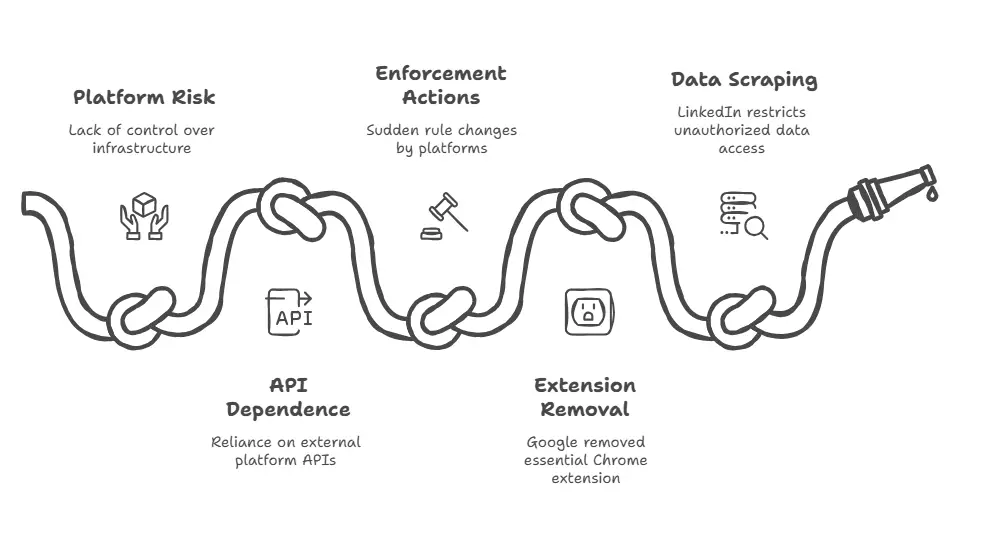
However, Shield’s operational foundation was deeply intertwined with the very platforms it sought to analyze. Its core functionality relied on a Chrome extension to interface with LinkedIn’s data. This dependency ultimately proved to be its Achilles’ heel.
Andreas Jonsson, CEO and co-founder of Shield, succinctly explained the decision in a letter to users: “Both Google and LinkedIn made it clear we couldn’t continue operating the way we had built Shield, and we decided not to fight it.”
The specifics point to a dual challenge: Google’s removal of their Chrome extension, which was essential for data synchronization, and LinkedIn’s broader enforcement against third-party tools operating outside its official API. LinkedIn has a history of actively monitoring and restricting extensions that scrape data, modify its interface, or automate behavior, often leading to their removal from the Chrome Web Store.
This wasn’t a business failure in the traditional sense. Shield had product-market fit and a paying customer base. It was a platform enforcement action—a sudden shift in the rules of the rented infrastructure that rendered their core technology unviable.
Understanding Platform Risk
Shield’s story underscores a fundamental challenge for many digital businesses: the inherent vulnerability when a significant portion of your value proposition is built upon a platform you do not control. This scenario presents several critical risks.
Policy Changes: Platforms can unilaterally alter their terms of service, API access, or app store policies, directly impacting your ability to operate. These changes can be sudden and without recourse.
Technical Restrictions: Updates to platform infrastructure—browser changes, API deprecations—can break existing functionality, requiring costly and time-consuming re-engineering.
Competitive Threats: The platform owner can introduce competing features, leverage their ecosystem advantage, or acquire successful third-party solutions, effectively squeezing out independent players.
Lack of Control: You lack ultimate control over your distribution, data access, and user experience, making your business susceptible to the platform’s strategic decisions.
Strategic Lessons for Entrepreneurs and Financial Leaders
For entrepreneurs and financial leaders, the Shield case offers concrete strategic insights into mitigating platform dependency risks.
- Diversify Your Foundations
Avoid single points of failure. If your business relies heavily on one platform for distribution, data, or functionality, explore diversification strategies early.
Multi-Platform Presence. Can your product or service operate across multiple ecosystems? This reduces reliance on any single gatekeeper.
Direct Relationships. Prioritize building direct relationships with your customers, independent of any platform. Own your customer data and communication channels.
Proprietary Technology. Invest in developing proprietary technology for core functionality that differentiates your offering, rather than relying solely on third-party integrations.
- Understand the Platform’s Incentives
Platforms are not benevolent. They operate with their own strategic and financial objectives. Your success might eventually conflict with theirs.
Strategic Alignment. Continuously assess whether your business model aligns with the long-term strategic interests of the platforms you build on. If there’s a potential conflict, plan for alternatives.
API vs. Scraping. Always prioritize official APIs and sanctioned integration methods. Unofficial methods may offer short-term gains but carry existential risk. Shield’s Chrome extension approach is the clearest possible illustration of this.
Monitor Policy Changes. Stay vigilant about platform policy updates and anticipate their potential impact on your operations before they become your problem.
- Build a Moat Beyond the Platform
Your competitive advantage should extend beyond functionality on a rented platform. It needs to be something that cannot be easily replicated or revoked.
Unique Data and Insights. Can you generate data or insights that are not directly available from the platform itself? If the answer is no, you are in a fragile position.
Community and Brand. Cultivate a strong brand and a loyal community that follows you regardless of the platform. Shield had this. It wasn’t enough to survive, but a stronger direct relationship with users might have enabled a pivot.
Exceptional Service. Provide a level of customer service and support that creates stickiness and differentiates you from generic platform offerings.
- Financial Prudence and Contingency Planning
The financial implications of a platform shutdown can be catastrophic. Strategic financial planning must account for this risk before it materializes.
Scenario Plannin:. Conduct what-if analyses for platform-related disruptions. What would be the financial impact of a sudden loss of access or a significant policy change? Run those numbers now, not after the fact.
Cash Reserves: Maintain adequate cash reserves to weather disruptions, fund pivots, or invest in alternative solutions.
Exit Strategy: Consider the feasibility and cost of migrating users and data if a platform relationship deteriorates. This is not a pessimistic exercise. It is basic risk management.
Owning Your Digital Destiny
Shield’s closure is a clear reminder that in the digital economy, true resilience comes from owning your core infrastructure and customer relationships. Leveraging powerful platforms can accelerate growth, but entrepreneurs must adopt a strategic mindset that anticipates and mitigates the inherent risks of building on rented land.
For financial leaders, this translates into a mandate for robust risk assessment, diversified strategic planning, and a clear understanding of where the business’s true value and vulnerability lies. The goal is not to avoid platforms entirely, but to build with eyes open, ensuring that your business stands on foundations you control, rather than on shifting sands.
FAQs
Why did Shield shut down if it had paying customers and product-market fit?
Shield’s core technology depended on a Chrome extension and unofficial access to LinkedIn data. When Google removed the extension and LinkedIn tightened enforcement against tools operating outside its official API, Shield lost the technical and legal basis to continue. This was a platform enforcement action, not a lack of demand. It demonstrates how dependence on infrastructure you don’t control can instantly make a viable business unviable.
What is platform risk and how can my business reduce it?
Platform risk is the danger that a third-party platform changes policies, APIs, or technical rules in ways that break your business. To reduce it: use official APIs and sanctioned integrations; diversify across platforms and distribution channels; build direct customer relationships through email lists and owned data; invest in proprietary capabilities that aren’t simply thin wrappers over a platform; and monitor policy changes continuously.
If my product relies on a platform, what should I do now to protect the business?
Start with a three-part plan. First, technical: audit all dependencies and prioritize migrating critical flows to official APIs or platform-independent solutions. Second, customer: capture direct contact details and create non-platform touchpoints so you can communicate and migrate users if needed. Third, financial: run scenario simulations for sudden platform loss, build cash reserves, and design a migration or pivot roadmap. Execute this in a 90 to 180 day sprint to reduce single-point-of-failure exposure.

Salvatore Tirabassi is the Founder of CFOPro+Analytics, providing fractional CFO services to growth-stage companies. Based in New York, he leverages over 24 years of experience in venture capital and strategic finance to help entrepreneurs master cash flow, unit economics, and equity value creation through data-driven financial clarity.
Assess your CFO needs in 5-minutes
For more on this topic, read our role of a fractional CFO in risk management and how a fractional CFO strengthens internal controls.