Building a SaaS Scenario Planning Framework
Scenario planning means building multiple versions of your financial forecast showing what happens under different conditions. This article presents a structured impact analysis framework for SaaS scenario planning, providing a comprehensive approach to decision-making and strategic planning, grounded in comprehensive scenario analysis as a foundation for robust planning. Present research in SaaS impact analysis and scenario planning highlights the need for formal methodologies to guide organizations through technology adoption and change, while aligning scenario planning with strategic goals to facilitate better resource allocation and decision-making. Scenario planning is especially valuable for managing uncertainty in complex systems, where even minor changes can have far-reaching effects. The principles of computer science underpin scenario modeling and forecasting, supporting both technical and business decision-making.
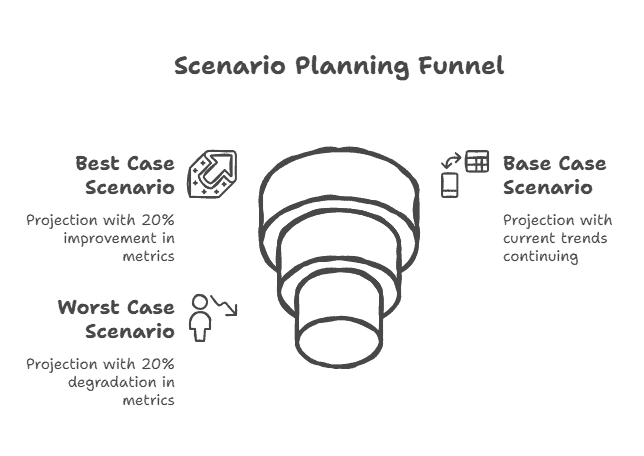
Most SaaS companies have one forecast that assumes everything goes perfectly. Smart companies model best case (everything improves 20%), base case (current trends continue), and worst case (key metrics degrade 20%). Evaluating impacts is a core goal of scenario planning, as it helps organizations anticipate the consequences of different choices. Scenario planning allows you to break down complex changes into manageable scenarios, making it easier to identify risks and opportunities. Scenario planning capabilities enable organizations to anticipate and prepare for multiple future possibilities, ensuring readiness for a range of potential developments. This lets you plan for uncertainty, understand which metrics matter most, and make contingency decisions before you’re forced to. Scenario planning transforms forecasting from wishful thinking into a risk management and strategic tool. Regular practice of scenario planning is essential for effective risk management and ongoing organizational resilience.
Introduction to Scenario Planning
Scenario planning is a critical component of impact analysis for any organization looking to future-proof its business processes and revenue streams. As companies increasingly consider adopting SaaS solutions, the ability to anticipate and prepare for a range of possible outcomes becomes essential. Leveraging AI tools and advanced financial analysis, organizations can gain deeper insights into how SaaS adoption might affect their operations, from streamlining workflows to optimizing expense management. However, before implementing any new technology, it’s vital to assess the current state of the business and identify non-negotiable requirements that must be met to support ongoing success. By integrating structured scenario planning for strategic decisions into their evaluation process, companies can make informed decisions about which SaaS tools and solutions will best support their future growth, ensuring that every step aligns with their strategic objectives and critical business needs. Utilizing a scenario planning template or planning template enables users to systematically evaluate different options, compare scenarios, and make data-driven, informed decisions.
Assessing the Current State
Before adopting SaaS solutions, organizations must conduct a thorough assessment of their current state. This means evaluating existing business processes, technology infrastructure, and financial analysis practices to determine where SaaS can deliver the most value. Business users and software developers should collaborate to establish a SaaS Impact Evaluation (SIE) framework, which provides clear guidelines for data analysis, impact assessment, and decision-making. Effective scenario planning also relies on data integration, allowing organizations to combine information from various sources—such as Excel and Power BI—to enhance analysis and support better strategic decisions. By systematically reviewing how current systems operate and identifying inefficiencies or gaps, companies can pinpoint opportunities to improve efficiency, reduce expenses, and increase revenue. The SIE framework ensures that all stakeholders are aligned and that the evaluation process supports the development of robust strategic plans. Involving finance teams in this process is essential to ensure that financial analysis and scenario planning are both rigorous and aligned with organizational goals. Ultimately, this approach enables organizations to make data-driven decisions about SaaS adoption, ensuring that new solutions are tailored to their unique needs and positioned to drive measurable business impact, especially when combined with a disciplined SaaS budget vs. actuals framework to monitor performance against plan.
Understanding Business Processes and Key Drivers
A deep understanding of business processes is fundamental to effective SaaS impact evaluation. By mapping out current workflows and systems, companies can identify areas where SaaS adoption could streamline operations, reduce complexity, and mitigate risk. This process involves analyzing how information flows through the organization, pinpointing bottlenecks, and determining the biggest risks associated with transitioning to new solutions. AI tools, SaaS cohort analysis, and comparison pages can be invaluable in this stage, helping businesses evaluate the potential impact of different SaaS platforms, use leading indicators to predict SaaS demand, and develop targeted mitigation strategies for any identified risks. By proactively addressing complexity and uncertainty, organizations can ensure that their SaaS adoption strategy is both resilient and aligned with their broader business objectives. This comprehensive evaluation not only supports better decision-making but also lays the groundwork for sustainable growth and operational excellence.
Why Single-Point Forecasts Are Useless
Every quarter, we see SaaS companies present one forecast to their board: revenue will grow 25% quarterly, churn will stay at 2%, CAC will remain at $3,500. The board approves the plan and everyone moves forward.
Three months later, reality differs from the forecast. Maybe growth was only 18% because a key channel underperformed. Maybe churn spiked to 3.5% due to a product issue. Maybe CAC increased to $4,200 because competition intensified.
The company is now scrambling to adjust. Should they cut spending? Shift resources? Raise prices? Nobody planned for this scenario so every decision is reactive rather than prepared.
This is the core problem with single-point forecasts. They assume the future is knowable and predictable. It’s not. Market conditions change, execution falters, unexpected opportunities emerge. If you are wrong in your assumptions, even by a small margin, the business consequences can be significant and disruptive, and the potential consequences of inadequate scenario planning can include missed opportunities, poor resource allocation, and increased risk exposure. Single-point forecasts often fail to account for technical risks or hidden system dependencies, so overlooked technical issues can amplify the impact of being wrong. A single forecast leaves you unprepared for reality.
Scenario planning fixes this by building multiple forecasts that bracket likely outcomes. When reality unfolds, you’ve already modeled something close to it. Your response plan exists. Decisions become execution of pre-planned strategies rather than panic reactions, which is exactly how fractional CFOs use scenario planning for strategic decisions.
The Three Core Scenarios Every SaaS Company Needs
Build your scenario planning framework around three versions of your forecast:
Base case represents your most likely outcome given current trends. This is your primary forecast. Use historical trends for your key drivers: growth rate, churn, CAC, expansion. If you’ve been growing 20% quarterly for the last four quarters, assume 20% continues. Base case should have 50% probability of happening. The biggest risk in the base case is analysis paralysis—over-relying on historical data without adapting to market shifts or new AI-driven competitors. By analyzing different scenarios, you can better understand a range of possible outcomes and prepare for both expected and unexpected changes.
Best case shows what happens if things go better than expected. Typically we model 15-20% improvement across key metrics. Growth accelerates to 24% quarterly, churn improves to 1.6%, CAC drops to $2,800 due to channel optimization, expansion increases. Best case should have 25% probability. The biggest risk in the best case is misalignment with company positioning or overspending on AI tools, leading to unrealistic expectations or resource misallocation.
Worst case shows what happens if things deteriorate. Model 15-20% degradation across key metrics. Growth slows to 16% quarterly, churn spikes to 2.4%, CAC increases to $4,200, expansion stagnates. Worst case should have 25% probability. The biggest risk in the worst case is misinformation or misapplication of AI insights, which could result in poor decision-making or legal exposure, especially if you are not accurately forecasting SaaS churn across segments.
This three-scenario framework brackets likely outcomes. Reality will probably land somewhere between your base and best case, or between your base and worst case. Rarely does everything improve or everything degrade simultaneously. Scenario planning leads to more informed and strategic decisions by guiding organizations and decision-makers to understand the impact of each scenario. Evaluating each particular scenario helps inform decision-making by highlighting the implications and risks unique to that situation, ultimately helping them adopt SaaS solutions with greater confidence and clarity.
Building Scenarios: What to Vary
Don’t vary every number in your model. Focus on the five to seven drivers that actually determine outcomes—these are your key variables:
New customer acquisition: What if you add 20% more customers monthly than base case? 20% fewer?
Customer retention: What if churn improves from 2% to 1.5% monthly? Degrades to 2.5%? In many SaaS models, improvements here start with systematically improving SaaS gross retention.
Expansion rate: What if existing customers expand at 5% monthly instead of 4%? Or at 3%? Robust planning depends on modeling NRR and GRR accurately so these expansion dynamics are captured correctly.
Average revenue per customer: What if new customers pay $900 instead of $750? Or $600?
CAC by channel: What if your most efficient channel gets 30% better? Or 30% worse? (Customer acquisition cost is a critical metric for SaaS financial modeling and scenario analysis.)
Sales rep productivity: What if reps ramp to quota faster? Or slower?
Pricing: What if you increase prices 15%? What if you need to discount 10% to stay competitive? How do different SaaS pricing models and their financial implications change the risk profile of these moves?
Customer demand: How do shifts in demand, identified through customer reviews and engagement data, affect your forecasts and scenario outcomes, particularly when using a simple model to predict MRR growth?
Pick the drivers that have biggest impact on revenue and cash flow—these key variables typically differ by business model and stage. An early-stage company with limited acquisition channels should focus on customer acquisition and retention. A mature company with established acquisition should focus on expansion and pricing.
Research into customer behavior, competitor content, and market trends helps determine which variables are most relevant to prioritize in scenario planning.
Run sensitivity analysis to find out what matters. Change each driver by 20% and see impact on 12-month revenue and cash burn. The drivers with biggest impact are the ones to vary in scenarios.
Scenario Planning for Different Time Horizons
Build different scenario frameworks depending on planning horizon:
13-week cash flow scenarios: Best case, base case, worst case for cash collections, spending, and burn. This is about surviving near-term uncertainty. Focus on collection timing, spending flexibility, and runway implicationrunwayerage improving cash collections in SaaS to shorten cycles, and avoid common cash flow mistakes SaaS startups must avoid
Annual operating plan scenarios: Three versions of your full-year plan showing revenue, expenses, hiring, and cash position. This drives budget decisions and integrates financial planning into scenario analysis to ensure resources are allocated effectively. If worst case shows cash running out in month 10 or exposes other financial red flags in early-stage SaaS companies, you need contingency plans.
3-year strategic scenarios: Multiple paths for how the business could evolve. This is less about precision, more about understanding strategic choices and developing flexible long term plans to adapt to changing conditions. If you pursue enterprise, what does 3-year trajectory look like? If you stay SMB-focused? If you expand internationally?
For each time horizon, it’s critical to set up monitoring of key metrics and performance indicators to track progress, detect issues early, and update scenarios as new data emerges.
Each time horizon requires different detail and different decisions. 13-week scenarios determine whether you cut spending now. 3-year scenarios determine whether you pursue a market segment.
Using Scenarios to Make Better Decisions
The point of scenario planning isn’t prediction, it’s preparation. When you’ve modeled three scenarios, decisions become clearer:
Budget planning: Your worst case shows cash running out at month 18. This means you need to plan fundraising to start at month 12, not month 15. Or you need to cut burn by 20% to extend runway. Involve the finance team in scenario-based planning to assess budget impact, manage financial risk, address potential invoice delays, and optimize resource allocation for operational efficiency.
Hiring decisions: Your base case supports adding 5 sales reps. But worst case shows that if growth slows, those reps will be underutilized and burn will be unsustainable. So you hire 3 reps now, hold slots for 2 more pending Q1 results.
Pricing changes: Your best case shows strong expansion rates, suggesting customers see value. You test 15% price increase on new customers because scenario analysis says you have room.
Channel investment: Your worst case assumes your primary channel efficiency degrades. You proactively invest in diversification now rather than being forced to pivot later when the channel actually degrades.
Product roadmap: Your scenarios show retention is critical to reaching profitability. You shift product resources from new features to improving onboarding and activation. Based on scenario outcomes, you develop strategies and formulate strategic responses to address retention challenges and optimize product impact.
We use scenario planning in every board meeting. Show all three scenarios. Discuss which is tracking closest to reality. Adjust the base case as you get new information. Make strategic decisions based on scenarios, not just on base case. Leadership support is essential for implementing scenario-driven decisions and ensuring organizational alignment, and finance leaders can draw on insights from top CFO blogs for financial insights and strategies to strengthen these practices.
Building the Scenario Model Structure and Scenario Planning Template
Structure your model to make scenario planning easy:
Separate assumptions from formulas. Create an assumptions tab listing all key drivers: new customers per month, churn rate, expansion rate, average MRR per customer. Build a financial model that incorporates these drivers, ensuring your forecast formulas reference this tab.
Consider using a SaaS called SIE, a framework specifically designed to structure and manage scenario models for SaaS businesses. SIE helps guide impact analysis and strategic planning when evaluating SaaS adoption, including building a robust saas financial model and a SaaS implementation cost model to keep margins healthy.
Create scenario tabs for each case. Base Case Assumptions, Best Case Assumptions, Worst Case Assumptions. Each lists the same drivers with different values.
Build one forecast engine that pulls from whichever assumptions tab you select. This means your forecast formulas are identical across scenarios, only the inputs change.
Create a dashboard comparing all three scenarios side-by-side. Show key outputs: revenue, cash balance, customers, burn rate, brand impact metrics, as well as essential financial statements like the balance sheet and cash flow statements. Including brand metrics in your scenario analysis helps you track how different strategies may affect your brand presence and competitive positioning. Make it visual so you can quickly see the spread between scenarios.
This structure lets you update scenarios quickly. When reality unfolds and you get new data, you update base case assumptions and regenerate all three scenarios in minutes.
We built a client model where scenarios are controlled by a dropdown at the top: “Select Scenario: Base | Best | Worst”. Choose a scenario and the entire model updates. The board can toggle between scenarios during meetings to understand implications of different outcomes.
The Scenario Analysis and Sensitivity Analysis That Reveal What Matters
Before you finalize your scenarios, run sensitivity analysis to understand which variables actually drive outcomes:
Take your base case model. Change one assumption at a time by 20% up and down. Measure impact on 12-month revenue and 12-month cash burn.
Example results might show: – 20% increase in new customer acquisition → Revenue +15%, Cash burn +8% – 20% decrease in churn → Revenue +12%, Cash burn flat – 20% increase in expansion rate → Revenue +18%, Cash burn flat – 20% decrease in CAC → Revenue flat, Cash burn -6%
This reveals that expansion rate and new customer acquisition drive revenue most. Churn and CAC drive cash efficiency most. Now you know which variables to focus scenarios on, and how changes in these drivers directly affect your financial outcomes.
It also reveals which variables don’t matter much. Maybe you thought pricing was critical, but 20% price change only moves revenue 5%. This tells you pricing isn’t the leverage point you thought it was.
Run this sensitivity analysis quarterly as your business evolves. What matters at $1M ARR differs from what matters at $10M ARR, especially as your unit economics for SaaS companies shift with scale.
Establishing Non-Negotiable Requirements
Defining non-negotiable requirements is a crucial step in the SaaS impact evaluation process. These are the critical features and capabilities—such as functionality, scalability, security, and consideration of technological advancements—that a SaaS solution must deliver to support the organization’s core business needs, including reliable SaaS cohort retention metrics and analysis to track performance over time. By clearly identifying these requirements upfront, companies can develop an action plan and provide guidelines for evaluating potential SaaS platforms, ensuring that only solutions meeting these essential criteria are considered. This disciplined approach helps SaaS companies avoid costly missteps and supports long-term growth by aligning technology investments with strategic priorities. Establishing non-negotiable requirements not only streamlines the evaluation process but also builds confidence among stakeholders that the chosen solution will deliver the necessary value and support the company’s ongoing development, particularly in avoiding cash flow mistakes SaaS startups make.
Common Scenario Planning Mistakes and Mitigation Strategies
We see companies make these mistakes when building scenarios:
Scenarios that are too close together: If best case is only 5% better than base case and worst case is only 5% worse, you haven’t modeled real uncertainty. Use 15-20% swings to capture realistic variance.
Varying too many things: If you change 15 different assumptions, scenarios become impossible to interpret. Focus on the five variables that drive most of the variance, prioritizing key external factors and economic trends that are most likely to impact your business outcomes.
Not updating scenarios regularly: Build scenarios once for fundraising, never touch them again. Scenarios should be updated monthly as you get new information.
Building scenarios that are internally inconsistent: Your best case shows 30% higher growth but doesn’t add sales capacity to support it. Make sure scenarios are logically coherent.
Only showing base case to the board: Your board should see all three scenarios and understand probability ranges. Hiding uncertainty doesn’t make it go away.
Not connecting scenarios to decisions: Scenarios are pointless if they don’t drive action. “If worst case happens, we’ll cut marketing 30% and delay 2 engineering hires.” Define the triggers and responses. Scenario planning helps organizations navigate complex decisions by evaluating interconnected choices and preparing for multiple possible outcomes.
Scenario-Based Decision Making
Use scenarios to evaluate major decisions before you commit:
Considering opening European office? Model best case (Europe grows to 30% of revenue in 24 months), base case (Europe grows to 15% of revenue), worst case (Europe doesn’t work, writes off $500K investment). In this process, set clear growth targets and evaluate market expansion opportunities to ensure alignment with your overall strategy. Compare scenarios to decide if expected value justifies risk.
Evaluating enterprise sales motion? Model best case (enterprise deals are $100K ACV with 90% retention), base case ($60K ACV with 85% retention), worst case ($40K ACV with 80% retention). Does even the worst case justify the investment? Scenario planning supports SaaS business decision-making by quantifying the impact of different sales strategies on long-term performance.
Deciding on pricing increase? Model best case (no churn impact, 15% revenue increase), base case (5% churn spike, net 10% revenue increase), worst case (12% churn spike, net revenue flat). If worst case is neutral, the upside justifies the risk.
This turns big decisions from opinions into quantified risk-return tradeoffs. Some bets only make sense if best case happens. Others are worth it even if worst case happens. Scenarios reveal which type of bet you’re making, much like scenario planning frameworks for CPG and retail help operators quantify risk and resilience across different market conditions. Financial analysts play a key role in assessing future scenarios, ensuring that SaaS businesses are prepared for a range of potential outcomes, particularly around SaaS renewal management strategies that directly influence retention and revenue stability.
Q: How often should we update our scenarios?
Update base case monthly as you get actual results. Update all three scenarios quarterly as market conditions or strategy changes. Between quarterly updates, you can adjust base case without rebuilding all scenarios. The key is keeping base case current so it reflects latest reality. If you go six months without updating scenarios, they become decorative rather than useful. We recommend full scenario rebuild quarterly, base case updates monthly, and ad-hoc scenario runs for major decisions.
Q: Should we show worst case scenarios to investors or will it scare them?
Always show investors all three scenarios. Sophisticated investors expect scenario planning and distrust companies that only show one rosy forecast. Present scenarios as “here’s the range of likely outcomes, here’s our plan for each.” This shows operational maturity. The investors who get scared by worst-case planning are investors you don’t want anyway—they’re not prepared for the reality that startups face uncertainty. Good investors appreciate teams that plan for multiple outcomes.
Q: What probability ranges should we assign to each scenario?
Typical framework is base case 50% probability, best case 25%, worst case 25%. This means you think base case is most likely but there’s equal chance things go better or worse. Don’t get too precise about probabilities—the point is showing a reasonable range of outcomes, not predicting the future exactly. Some companies use 40/30/30 if they think reality will likely diverge from base case. The exact percentages matter less than having the three scenarios and understanding the spread between them.
Conclusion and Next Steps
In conclusion, evaluating SaaS impact is a critical process that demands a structured approach to business processes, technology, and financial analysis. By adopting SaaS solutions and leveraging AI tools, companies can unlock new efficiencies, reduce expenses, and drive revenue growth. However, success depends on a thorough assessment of the current state, a deep understanding of business processes, and the establishment of non-negotiable requirements. The next steps involve building a comprehensive evaluation framework, providing clear guidelines for data analysis and impact assessment, and ensuring alignment with organizations’ strategic plans. By following these best practices, SaaS companies can maximize the benefits of SaaS adoption, achieve their desired business outcomes, and, through structured scenario planning, improve financial reporting and enhance financial performance to strengthen their market share and competitiveness in an increasingly dynamic industry.