SaaS Renewal Management Strategies
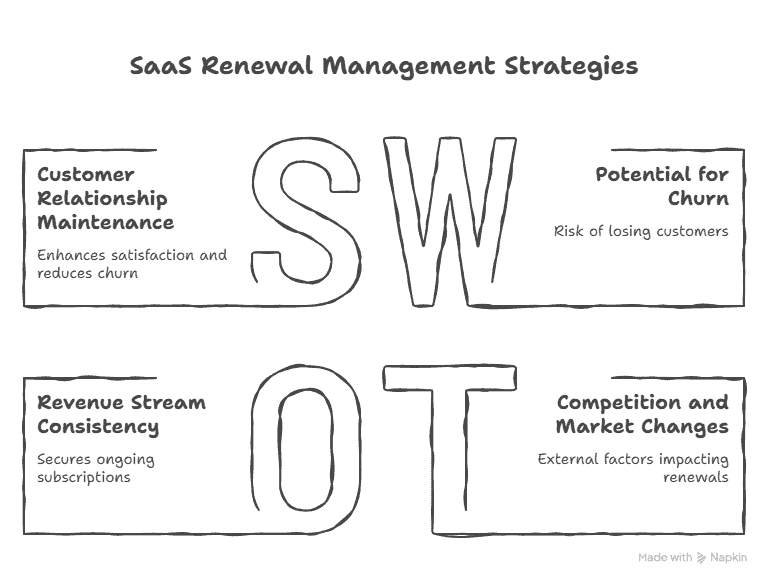
Renewal management is how you keep annual contract customers from churning when contracts end. Most SaaS companies treat renewals as automatic until customers cancel. Smart companies build 90-day renewal processes with health checks, proactive outreach, and expansion conversations. This reduces churn from 20% to under 10% at renewal events and creates upsell opportunities.
A well-defined renewal management strategy is essential for software as a service (SaaS) businesses, as it maximizes recurring revenue streams and helps create a predictable revenue stream. For any SaaS business, poor renewal management can lead to lost revenue, increased customer churn, and operational inefficiencies, making it critical to follow best practices as part of a successful customer retention strategy. Strong renewal management processes directly correlate with higher customer retention, satisfaction, and loyalty, which are essential for sustainable growth in any SaaS business. Additionally, acquiring new customers can be 4–5 times more expensive than retaining existing ones, so focusing on renewals is vital for long-term profitability.
The key is visibility: know which contracts renew when, track renewal risk months in advance, and engage before customers are already shopping alternatives. Renewal management turns contract anniversaries from churn risks into expansion opportunities.
Introduction to SaaS Renewals
In the SaaS industry, renewals are the backbone of sustainable revenue growth and long-term customer relationships. The SaaS renewal process is more than just a routine administrative task—it’s a strategic opportunity to reinforce value, deepen customer engagement, and maximize customer lifetime value. Effective SaaS renewal management involves closely monitoring customer subscriptions, analyzing usage data, and proactively reaching out to customers well before their renewal date. By doing so, companies can ensure a smooth renewal process, minimize churn, and foster a positive customer experience that drives both customer retention and business growth. In today’s competitive SaaS landscape, a well-executed renewal process is essential for maintaining predictable revenue streams and supporting the overall health of your business.
Why Renewals Need Management
Every SaaS company with annual contracts faces a truth that monthly subscription companies don’t: renewal is an explicit decision point where customers actively choose to continue or leave.
Monthly subscriptions have passive continuity. Customers stay until they actively cancel. The friction of cancellation keeps some customers subscribed even after they’ve stopped getting value.
Annual contracts are different. At month 12, the contract ends. The customer must actively decide to renew. If you haven’t contacted them, engaged them, and reminded them of value, they won’t renew by default.
We see companies lose 25-30% of revenue at annual renewals when they don’t have structured renewal management. The same companies with improved SaaS gross retention and proper renewal processes lose only 8-12%. The difference is worth millions in ARR.
Here’s what happens without renewal management:
Customer signs annual contract in January. Customer success checks in quarterly through the year. Contract expires in December. Customer gets auto-renewal notice 30 days before expiration. Customer realizes they haven’t been using the product much and cancels. Or customer asks for discount. Or customer ghosts and renewal lapses. Failing to manage SaaS renewals can result in unexpected charges due to auto renewals or automatic renewals, and missed opportunities for contract renewal or renegotiation. Financial managers play a critical role in overseeing contract renewals and ensuring budget control to avoid unnecessary spend.
With renewal management:
Customer signs in January. Success team monitors product usage monthly. In September (90 days before renewal), renewal manager initiates process. They review product usage, reach out to stakeholder, assess satisfaction, identify concerns, present renewal options, negotiate early renewal with expansion. By November, renewal is confirmed with 20% expansion. During contract negotiations, the pricing model can complicate discussions, requiring careful consideration of contract flexibility and customer needs. Rushed contract negotiations often result in missed opportunities to negotiate better terms or pricing, leading to overspending on software subscriptions. Engaging cross-functional stakeholders in the renewal process is essential to assess if the software tool still meets business needs, align software value with business goals, and reduce wasted spend.
The difference is proactive engagement versus reactive notification.
The 90-Day SaaS Renewal Process
Build a structured 90-day process for every renewal:
Tracking the upcoming renewal date is critical for maximizing customer retention and revenue opportunities. Preparation for software license renewal should begin well before the actual renewal date to allow for thorough evaluation and negotiation.
Day -90 (90 days before renewal): Renewal enters pipeline. Account manager or renewal manager assigned. Health check completed reviewing product usage, support tickets, payment history, and stakeholder engagement.
Day -75: First outreach to customer stakeholder. “Your renewal is coming up in January. I’d like to schedule time to review your results this year and discuss your plans for next year.”
Day -60: Renewal planning meeting held. Review usage data, discuss what’s working, identify expansion opportunities, understand budget cycle and approval process.
Day -45: Renewal proposal sent. Include renewal terms, pricing for current scope, expansion options if relevant, and business case for renewal showing ROI.
Day -30: Follow up on proposal. Address questions, negotiate terms if needed, identify any blockers to renewal.
Day -15: Finalize renewal terms. Get verbal commitment, process contract, handle any last-minute issues.
Day 0: Contract renews. Begin next 90-day renewal cycle.
After completing these steps, it’s essential to maintain a single source of truth for all SaaS agreements to avoid surprises and ensure a smooth software renewal process. Conducting a comprehensive audit of all existing SaaS agreements—including cataloging subscriptions, understanding terms and conditions, and identifying renewal dates—helps recognize redundancies or underutilized services. Additionally, preventing auto-renewal traps is crucial to avoid being locked into automatic price increases for software.
This timeline gives you space to identify problems, address concerns, and position renewal as a strategic decision rather than administrative task.
Companies that start renewal conversations 30 days before expiration usually lose the customer. By then, customers have often already decided not to renew or started evaluating alternatives. Starting at 90 days lets you influence the decision.
Renewal Health Scoring
Build a health score that predicts renewal risk:
Product usage (40% weight): Active users, feature adoption, login frequency. High usage = low churn risk. Declining usage = high risk. Monitoring key performance indicators (KPIs) such as Renewal Rate, License Utilization, Net Revenue Retention, and PLG-focused SaaS KPIs is essential to track the health of your SaaS portfolio. Utilize analytics tools to track SaaS usage, user engagement, and feature utilization for accurate auditing and informed renewal decisions. Data analytics provides insights into customer behavior and helps identify trends to refine renewal strategies. Predictive analytics can forecast future renewals and identify at-risk customers, enabling proactive engagement to improve retention rates. Data-driven decision-making in renewal management involves tracking renewal rates and churn rates to optimize strategies and improve financial performance. Benchmark current pricing against market data to ensure you are paying a fair price for software licenses. Analyzing actual usage data helps optimize licenses and ensures that software costs align with value delivered. Make decisions regarding software renewal based on concrete utilization metrics, not assumptions. According to a 2023 Nexthink study, on average, half of software goes unused by businesses, leading to wasted money and decreased profitability, which is especially visible in usage-based SaaS revenue modeling where underutilization directly suppresses billings. Rightsizing licenses by reviewing usage data and deprovisioning inactive users before renewal is critical for cost-effectiveness.
Engagement (25% weight): Responsiveness to emails, attendance at training, participation in user community. Engaged customers renew. Silent customers churn.
Support history (20% weight): Number and severity of support tickets, resolution time, recurring issues. One support ticket is fine. Ten tickets about the same broken feature suggests frustration.
Executive sponsorship (15% weight): Do you have an executive champion? Have you met with decision-makers? Low-level users without executive buy-in creates renewal risk.
Score each renewal on a 0-100 scale. Above 70 is healthy. 40-70 needs attention. Below 40 is at risk, and should feed into accurate SaaS churn forecasting.
Review health scores monthly for all customers renewing in next 6 months. Prioritize outreach to low-scoring customers. For high-scoring customers, focus on expansion.
We worked with a company that implemented health scoring and discovered 35% of their renewals were scoring below 40. Without the system, these would have been surprises at renewal time. With 90-day advance warning, they saved 60% of at-risk renewals through proactive intervention.
Importance of Customer Feedback
Customer feedback is a cornerstone of any successful SaaS renewal strategy. By actively seeking input through surveys, product reviews, and support interactions, companies gain valuable insights into customer satisfaction, unmet needs, and potential pain points. This feedback enables SaaS businesses to make data-driven decisions that refine their renewal management process and tailor their offerings to better serve existing customers. Incorporating customer feedback into your renewal strategy not only helps identify areas for improvement but also demonstrates a commitment to customer success, which can significantly increase customer satisfaction and boost renewal rates. Ultimately, a feedback-driven approach ensures your SaaS renewal process evolves alongside your customers’ needs, leading to higher retention and a more resilient business.
Role of Customer Success Platforms
Customer success platforms have become indispensable tools for managing SaaS renewals at scale. These platforms centralize customer data, track usage patterns, and monitor customer health, giving your team a comprehensive view of each account’s engagement and satisfaction. By leveraging customer success platforms, companies can identify early warning signs of potential churn, automate routine communications, and deliver personalized support that addresses specific customer needs. The ability to analyze customer behavior and usage data in real time empowers customer success teams to proactively manage renewals, resolve issues before they escalate, and ultimately improve renewal rates. With these platforms, SaaS businesses can ensure that every customer interaction is informed, timely, and focused on driving customer satisfaction and long-term retention.
Managing Renewal Deadlines
Staying on top of renewal deadlines is a critical component of effective SaaS renewal management. By maintaining a detailed renewal calendar and tracking upcoming renewals, companies can ensure that no contract slips through the cracks. This proactive approach allows teams to engage customers well before their renewal date, address any concerns, and present tailored renewal options that align with the customer’s evolving needs. Managing renewal deadlines also enables companies to make informed decisions about resource allocation and forecast revenue more accurately. Ultimately, a disciplined approach to renewal deadlines helps maximize customer lifetime value, reduce last-minute surprises, and create a smoother, more predictable renewal process for both the company and its customers.
Managing Renewal Windows
Effectively managing renewal windows is essential for optimizing both customer satisfaction and business growth. The renewal window—the period during which customers can review and renew their SaaS contracts—should be carefully structured to give customers ample time to evaluate their options and make informed decisions. By clearly communicating upcoming renewals and providing support throughout the renewal window, companies can reduce the risk of last-minute cancellations and foster a more positive customer experience. Proactively managing renewal windows also allows businesses to address any issues, offer personalized renewal options, and ultimately increase renewal rates. In the fast-paced SaaS industry, a well-managed renewal window not only protects recurring revenue but also strengthens customer relationships and drives long-term value for both the customer and the company.
Renewal Conversations: What to Actually Say
The renewal conversation isn’t “do you want to renew?” It’s a business review and forward planning session.
Here’s the structure:
Review the year: “You’ve been using our platform for 12 months. Let’s review what you’ve accomplished. Your team logged 2,400 hours, completed 47 projects, and reported 15% faster time-to-market on your last release.”
Quantify value: “Based on your stated goals, that represents approximately $180K in value delivered through efficiency gains and faster revenue realization R&D Tax Credit Calculator.
Discuss challenges: “What parts of the platform haven’t met your expectations? What features are you not using that we should explore? Where can we improve?”
Understand next year’s goals: “What are your priorities for next year? How can we support those goals? Are there additional use cases or teams that could benefit?”
Present renewal options: “Here are three paths forward. Option 1: Renew at current level for $50K. Option 2: Add these features for $65K and unlock these additional capabilities. Option 3: Expand to these additional teams for $75K.” Personalizing renewal offers based on customer usage patterns and preferences can significantly enhance satisfaction and increase renewal rates. Renewal pricing strategies, such as offering discounts or incentives for early renewals, can also drive higher retention.
Throughout the renewal process, proactive communication and regular customer interactions are essential for building trust and addressing concerns before they impact renewal decisions. The customer success team plays a key role in managing renewal conversations, monitoring customer interactions, and ensuring customer satisfaction. Regularly collecting customer feedback and using it to refine communication strategies further improves the renewal process and ensures customer needs are met.
The goal is positioning renewal as obvious because value delivered exceeds cost, while creating opportunities to expand.
Expansion at Renewal
Renewal is your best expansion opportunity. Customers who are renewing have confirmed they see value. They’re more receptive to expansion conversations than they would be mid-contract. Expansion at renewal not only drives growth but also contributes significantly to recurring revenue streams, making predictable income and revenue stability possible for SaaS businesses. Aligning SaaS solutions with organizational goals during renewal ensures that each contract continues to deliver value and supports long-term business objectives.
Dedicated software solutions play a crucial role in automating and optimizing the renewal process, reducing manual errors, and streamlining contract management to improve efficiency. Effective SaaS renewal management shifts from a reactive administrative task to a strategic opportunity through proactive planning and data-driven decision-making. To maximize value, a structured process is essential—this includes auditing software usage, analyzing contracts, and negotiating terms to ensure alignment with the company’s evolving needs and budget.
Three expansion motions at renewal:
Seat expansion: “You started with 15 seats. Usage data shows you have 22 active users. Let’s formalize that and add capacity for growth to 30 seats.”
Feature upsells: “You’re on our Professional tier. Based on your use of workflow automation, upgrading to Enterprise would unlock advanced integrations that could automate 40% more of your process.”
Additional products: “You’re using our core platform. Our analytics add-on would give you the reporting capabilities I heard you asking about last month.”
The key is making expansion feel natural rather than pushy. Use data to show they’re already bumping against limits or would benefit from capabilities they don’t have.
We see companies with strong renewal processes achieve 110-120% net revenue retention where 100% would be flat renewals. That extra 10-20% comes from expansion at renewal time.
Handling Renewal Objections
Common objections and how to handle them:
“The price is too high”: Reframe around value delivered and cost of alternatives. “The platform saved your team 800 hours this year. At $75/hour loaded cost, that’s $60K in value for a $50K investment. What alternative would deliver similar results for less?” When addressing price objections, emphasize the importance of contract negotiations and how the pricing model can impact renewal discussions, influencing flexibility and terms.
“We’re not using it enough”: Dig into why. “What prevented broader adoption? Is it training? Missing features? Competitive priorities?” Sometimes the answer is the product isn’t right for them (let them go). Often it’s fixable obstacles.
“Budget got cut”: Offer flexible payment terms, smaller contract with core features only, or extended payment terms. “If budget is the only issue, we can structure this as quarterly payments instead of annual.”
“We’re evaluating alternatives”: Ask when the decision timeline is. “We’d like to participate in your evaluation. Can we schedule a competitive review session?” Often customers mention competitors as negotiating tactics. Call the bluff.
“We need more time”: Set a specific follow-up date. “What needs to happen before you’re ready to commit? Let’s schedule time in two weeks after you’ve done X.”
Don’t cave on price immediately. Customers who get big discounts at renewal learn that threatening to leave gets concessions. This trains bad behavior. SaaS vendors play a key role in providing personalized experiences and promoting renewal opportunities, often leveraging automation and customer success efforts. Always thoroughly review SaaS agreements for hidden terms that could lead to unexpected costs before renewal deadlines.
When to Let Customers Churn: Considering Customer Lifetime Value
Not every customer should be saved. Some churn is healthy:
Managing the customer lifecycle is essential for optimizing SaaS renewal management. Retaining customers leads to significant cost savings by sustaining revenue, reducing acquisition costs, and increasing loyalty and advocacy. Evaluating software costs is also critical—determine if an application should be renewed by assessing whether it meets current business goals or if redundant tools exist.
Wrong fit customers: They bought before you refined your ICP. They’re too small, wrong industry, or wrong use case. Let them go and focus on better-fit prospects.
High-maintenance low-revenue customers: They generate 5% of revenue but consume 30% of support time. Losing them improves gross margin.
Customers who will never expand: They’re at maximum value and will never grow with you. Replacing them with customers who have expansion potential is smart.
Customers who got value but don’t need you anymore: They accomplished their goal and don’t need ongoing service. This is natural lifecycle, not failure.
Chronic non-payers: They pay late every time, dispute charges, require collections effort. Let them go unless the revenue is large enough to justify the hassle.
The key is being intentional. If you’re letting a customer churn, it should be a strategic decision based on customer fit and unit economics, not passive neglect.
Renewal Forecasting and Revenue Planning
Track renewals systematically for revenue forecasting:
Tracking your SaaS renewal rate and forecasting future renewals are critical for maintaining healthy recurring revenue streams. Monitoring these metrics alongside leading indicators that predict SaaS demand enables proactive management of customer retention and helps optimize revenue through data-driven insights. According to Thrive My Way, the SaaS industry grows on average 18% per year, and having excellent retention rates will enable your company to stack up revenue quickly. Additionally, a Bain & Company study indicates that 75% of software companies had a decrease in net retention rates (NRR) in the 3rd quarter of 2022, highlighting the importance of accurately modeling NRR and GRR and effective renewal pricing strategies to maintain revenue.
Maintain a renewal pipeline showing all contracts expiring in next 12 months with contract value, renewal probability, and expected renewal value.
Assign probability based on health score: – Healthy (70+ score): 95% renewal probability – Moderate (40-70 score): 75% renewal probability – At risk (below 40): 40% renewal probability
Calculate expected renewal revenue: Sum of (contract value × probability) for all renewals in the period.
Track renewal rate by cohort: What percentage of customers renew at month 12? Month 24? This reveals whether renewals get easier or harder over time and benefits from a rigorous SaaS cohort analysis framework.
Monitor expansion rate at renewal: What percentage of renewals include expansion? What’s average expansion amount? Layering cohort retention metrics and analysis on top of this view helps reveal which segments drive the strongest renewal-led growth.
Monitor key performance indicators (KPIs) such as Renewal Rate, License Utilization, and Net Revenue Retention to track the health of your SaaS portfolio and ensure sustainable recurring revenue streams.
This data feeds into your overall revenue forecasting and can be paired with a structured SaaS revenue bridge to understand how renewals, expansion, contraction, and churn are driving changes over time. If you have $5M in contracts renewing next quarter with 85% expected renewal rate and 15% expansion rate, you’re forecasting $4.89M in renewal revenue (85% × $5M × 1.15 expansion).
Renewal Management at Scale
The renewal process described here works great when you have 50-100 renewals annually. What about companies with 1,000+ annual renewals?
Segment by contract value:
High-value renewals (top 20% of ARR): Full white-glove 90-day process with dedicated renewal manager.
Mid-value renewals (next 30% of ARR): Structured process but lighter touch. Email sequences plus one renewal planning call.
Low-value renewals (bottom 50% of ARR): Automated email sequences with option to escalate to human if customer requests. Many of these auto-renew without intervention.
This tiering focuses expensive human effort on renewals that matter most while still creating systematic touchpoints for smaller customers.
Use customer success platforms (Gainsight, ChurnZero, Totango) to automate parts of the process. Health scoring, renewal pipeline tracking, and email sequences can all be automated. Software solutions designed for SaaS renewal management can further streamline these processes, reduce manual errors, and help align SaaS contracts with strategic business objectives. This lets renewal managers focus on high-risk situations and expansion opportunities, while optimizing the management of SaaS applications across the organization. Software companies play a critical role in developing and managing SaaS applications and the renewal processes that support customer retention and service continuity. Implementing a formal process for new software reviews ensures each solution integrates into your existing stack and clarifies renewal paths, helping to maximize value and control costs, and pairs well with a simple model for predicting MRR growth so you can see how renewal performance drives topline revenue.
—
Q: What renewal rate should we target?
It depends on your market and contract value. SMB annual contracts typically see 70-80% renewal rates even with good renewal management because small businesses have high natural churn. Mid-market should target 85-90% renewal rates. Enterprise should target 90-95%. More important than absolute renewal rate is net revenue retention including expansion. A company with 85% renewal rate but 110% NRR (expansion offsets churn) is healthier than one with 90% renewal and 95% NRR. Track both logo retention and revenue retention.
Q: Should we offer multi-year contracts to avoid annual renewal conversations?
Multi-year contracts can work for enterprise customers where you have very strong product-market fit, but they have downsides. If a customer’s needs change, they’re locked in and will be unhappy. If your product improves significantly, you can’t capture value through price increases until the contract ends. We generally recommend 12-month contracts with strong renewal processes over multi-year contracts, unless you’re in a market where multi-year is standard or you’re offering significant discounts for longer commitments (15-20% discount for 2-year, 25-30% for 3-year).
Q: How do we structure renewal pricing? Should we increase prices at renewal?
Most SaaS companies hold pricing flat at renewal unless they’re adding material value through new features or expanded usage. Price increases of 3-5% annually for inflation are reasonable but should be communicated early. Larger price increases (10%+) should be tied to product improvements or scope expansion. The key is no surprises. If you’re planning a price increase, mention it 6 months before renewal so it doesn’t derail the renewal conversation. Never ambush customers with 20% price increases 30 days before renewal. That creates emergency budget issues and drives churn.
Further Reading
Browse more articles in the CFO Pro+Analytics Knowledge Base for in-depth financial frameworks, models, and strategies tailored to your business.
Ready to take action? Explore our Fractional CFO Services → to see how we partner with founders and operators to build financial clarity.
Further Reading
- Integrate renewal projections into your SaaS scenario planning framework
- See how scenario modeling impacts building a SaaS Scenario Planning Framework for your business
