Clarifying the Difference between Accounting and Finance
in Accounting, Finance, Fractional CFO, Accounting and Finance, All Posts
In this post, I am clarifying the difference between accounting and finance to help business owners and entrepreneurs better navigate the development of these key functions in their emerging businesses. Understanding the distinctions between accounting and finance degrees can also help in making informed decisions about educational and career paths. The comparison of finance vs accounting is a common way to explore the differences and similarities between these two fields, especially in terms of career opportunities, education requirements, and job outlook. This article will focus on the finance vs accounting perspective to highlight what sets each discipline apart and how they overlap. Accounting and Finance are important for a business’s success, but they have subtle differences that can sometimes confuse entrepreneurs. Understanding their similarities and differences will help business owners know when they need both services and whether they are relevant to their business. Let’s dive into the topic.
Introduction to Accounting and Finance
Accounting and finance are two foundational pillars of the business world, each playing a unique yet interconnected role in the success of organizations. While both disciplines revolve around financial transactions and the management of money, they differ in their primary focus and approach. Understanding these differences is crucial for anyone considering a career in accounting and finance, or for business owners seeking to build strong financial foundations.
An accounting degree prepares individuals to handle the recording, classification, and reporting of financial information, ensuring that every financial transaction is accurately documented and compliant with regulations. In contrast, a finance degree equips students with the skills needed to manage money, assess investment opportunities, and develop strategies for financial planning and risk management. Finance professionals rely on financial statements and financial reports generated by accountants to make informed decisions about investments, capital allocation, and the long-term financial health of an organization.
Choosing between accounting and finance as a career path means considering whether you are more interested in the meticulous process of compiling data and ensuring accuracy, or in the dynamic world of financial planning, investment analysis, and strategic decision-making. Both fields offer rewarding opportunities and are essential to the effective management of any business.
Accounting: Categorization of Financial Transactions
Accounting is the maintenance and reporting of a company’s financial records through the correct categorization of financial events in the business. It involves recording, classifying, and reporting financial transactions and ensuring that financial records are accurate and compliant with the standard of accounting you seek – generally this means cash accounting or accrual accounting. Businesses are, by law, required to keep accounts and records of financial statements for taxation purposes, and cash accounting is suitable and the easiest way to go about this. Once you have investors involved in your business, it might make sense to switch to accrual accounting. According to labor statistics, accounting professionals are in high demand, with a steady growth outlook and competitive salary expectations. Accounting careers offer a wide variety of roles and opportunities, from entry-level positions to specialized fields for both CPA and non-CPA professionals. The growth expectations for accounting professionals remain strong, with positive job outlooks and expanding employment opportunities in the industry.
Accounting focuses on capturing a company’s financial information at a particular point in time. Usually monthly, quarterly, or annually. Sometimes, weekly accounting is needed to manage tight cash flow, but I don’t view this as accounting, it’s cash flow management that depends heavily on the occurrence of revenues and expenses on a weekly basis which you will find in the accounting records.
A basic principle of accounting is that Assets = Liability + Owner’s Equity. This formula looks at what a company owns (its assets), what it owes (its liabilities), and the residual that belongs to shareholders (owner’s equity).
To pursue most accounting careers, a bachelor’s degree is typically the minimum educational requirement. Having a formal education in accounting is essential for establishing credibility and demonstrating competence in the field.
What is Corporate Finance?
Finance is managing the future development of your business financially. Corporate finance, a crucial segment within the broader field of finance, involves managing monetary resources specifically for businesses. The finance field encompasses a wide range of industries and roles, requiring compliance with regulations and offering various educational pathways for professionals. Finance involves analysing financial data for strategic investment decisions, budgeting, and risk management. Finance is the strategic management and planning of money over time, focused on optimizing future financial outcomes through investment, funding, and resource allocation decisions. Financial decisions usually cover Capital Structure, Investment Criteria, Risk Management, and Value Creation.
A basic principle of finance is that Risk and Return are related. This principle states that higher potential returns require taking on more risk, and investors must be compensated for taking additional risk. To summarize, finance involves analyzing financial opportunities and risks to make decisions that maximize value creation, which drives the value of your business and makes it have value to a buyer in the future.
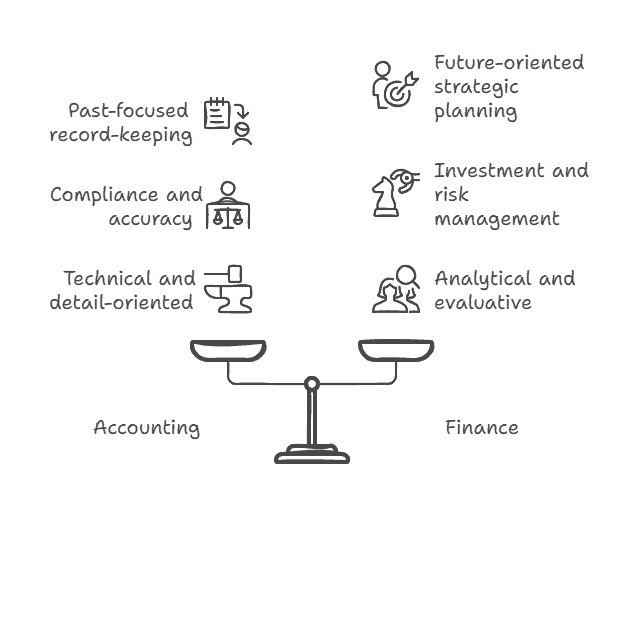
While accounting looks backward to record what happened, finance looks forward to planning what should happen. Comparing finance and accounting reveals distinct career paths and job opportunities, with finance professionals often focusing on forward-looking analysis and strategic planning, while accounting emphasizes historical record-keeping and compliance. Businesses need finance to grow and make strategic choices about using their resources – generally this means deciding between investing in growth, paying down debt, or returning capital to owners. Personal finance, on the other hand, focuses on managing money for individuals and families, covering activities like budgeting, saving, and investing. Basic financial decisions revolve around three key areas: investment (where to deploy capital), financing (how to fund operations), and dividends (what to return to shareholders).
Educational requirements for finance and accounting differ. Finance majors typically study subjects such as investment analysis, financial markets, and risk management, while accounting majors focus more on auditing, taxation, and financial reporting. Advancing in the finance field often involves pursuing graduate programs or a master’s degree to gain specialized knowledge and credentials.
Finance focuses on making decisions about a company’s financial future based on both current data and projections. Usually these decisions cover short-term (operational), medium-term (tactical) and long-term (strategic) horizons. Sometimes short-term financial decisions are confused with accounting, but I view this as treasury management which depends on understanding both accounting records and future cash flows. Within the finance field, public finance is a distinct area that deals with managing financial resources for governments, NGOs, and public sector organizations.
Key Differences Between Finance and Accounting
Similarities Between Accounting and Finance
The key similarity between accounting and finance is that both have to do with MONEY. They involve recording, analyzing, reporting, and projecting a business’s cash flow. Both accounting and finance, keep track of the assets and liabilities of a company, and are aimed at increasing the profitability and valuation of a business.
While both fields share some core business courses, finance coursework typically emphasizes analytical and evaluative skills related to financial markets and investments. There is a significant accounting overlap, as both fields require recording and assessing financial transactions, business knowledge, communication skills, and formal education, despite their differences.
Accounting and Finance require similar technical and non-technical skill sets, as well as a keen attention to detail. Essential skills for both fields include communication, adaptability, analytical abilities, and critical thinking, which is crucial for analyzing financial data, evaluating reports, and adapting to changing standards. In terms of career path, accountants and financial analysts can work in similar roles, such as commercial and investment banks, real estate finance, mortgage banks, insurance, or directly serve businesses.
Both can serve individuals, businesses, and the government. But, you should not confuse the capabilities of an accountant to handle finance work and vice versa. However, in my experience, I have found it more likely that a strong finance professional can handle accounting issues than the other way around. Not in every case, but most of the time I have found this to be true as finance inherently involves accounting but you can do lots of accounting without ever having to handle any strategic finance questions or problems.
The main difference between accounting and finance is that accounting focuses on the past, while finance focuses on the future. Accounting professionals are more focused on professional principles and processes, while finance involves creativity and innovation to think out ways a company can grow profitably.
Accounting focuses on the day-to-day flow of money in and out of a company, while finance is a broader term for managing assets and liabilities.
Accounting focuses on the day-to-day management of financial reports and records in the business world, while finance uses the same information to analyze transactions and project future growth.
When assessing performance through the lens of finance, cash is king. Unlike accounting, which relies on transactional data, finance examines how effectively an organization generates and uses cash through several measurements. They examine how much money a company has to distribute to investors or reinvest after covering all expenses.
For businesses closely managing receivables-and navigating funding or working capital decisions-our Receivables Financing Calculator can help estimate financing needs and timing with precision.
Accounting Professionals and Industry
Accounting professionals are indispensable in the business world, providing critical services that ensure organizations remain financially healthy and compliant with regulations. Their expertise spans a variety of roles, including auditing, taxation, and financial reporting, all of which are vital for maintaining accurate financial records and supporting sound business decisions.
The accounting industry is diverse, encompassing public accounting firms, corporate accounting departments, and government agencies. This variety offers accounting majors a wide range of career opportunities, from public accounting and auditing to specialized roles in taxation or financial reporting. Accounting degrees and finance degrees both require a solid grounding in quantitative analysis, financial accounting, and financial management, but accounting programs tend to emphasize the technical aspects of financial reporting, auditing, and compliance. In contrast, finance programs focus more on financial modeling, investment analysis, and developing financial strategy.
According to labor statistics, the job outlook for both accounting and finance careers is strong, with median salaries ranging from $60,000 to over $100,000 depending on the specific career path and level of experience. Accounting professionals, such as certified management accountants and certified public accountants, are in high demand across industries. Their accounting expertise is essential for organizations to maintain financial health, meet regulatory requirements, and make informed decisions that drive long-term success. Whether working in public accounting firms, corporate environments, or government agencies, accounting professionals play a pivotal role in the financial management and strategic direction of businesses.
Career Paths in Finance and Accounting
Both finance and accounting offer a wide range of career paths for professionals, each with its own set of opportunities and challenges. In finance, career paths include roles such as financial analyst, investment banker, portfolio manager, and personal financial advisor. Financial advisors play a key role in financial planning and investment management, helping clients maximize returns and achieve their financial goals. Finance professionals often engage with external entities like government agencies, banks, investment firms, and stockholders, focusing on strategic financial planning and decision-making to drive growth and profitability.
In accounting, career paths include positions such as accountant, auditor, bookkeeper, and tax consultant. A specialized role within accounting and finance is that of a financial examiner, who is responsible for examining and auditing financial data for accuracy, compliance, and fraud detection, often working with government agencies or regulatory bodies. Accounting professionals are primarily concerned with the day-to-day management of financial records and financial reporting, ensuring accuracy and compliance with regulatory standards. They play a crucial role in maintaining the financial integrity of an organization by preparing financial statements, managing budgets, and ensuring tax compliance.
Both fields require strong analytical and problem-solving skills, as well as excellent communication and interpersonal abilities. For those seeking flexibility and a broad range of opportunities, pursuing an accounting finance combined degree or career path can open doors to diverse roles across both disciplines. Whether pursuing a career in finance or accounting, professionals must be adept at interpreting financial data and providing insights that support informed decision-making.
Financial Planning and Decision-Making
Financial planning and decision-making are critical components of both finance and accounting, playing a pivotal role in the success of any organization. Financial planning involves analyzing financial data to make informed decisions about investments, funding, and risk management. Finance professionals also help clients achieve their financial goals by advising on strategies and actions that support their personal or business objectives. It is a forward-looking process that aims to optimize financial performance and ensure the long-term sustainability of a business.
Financial decision-making involves evaluating various financial options and choosing the best course of action for an organization. This process requires a deep understanding of financial data, market trends, and economic conditions. Both finance and accounting professionals contribute to financial planning and decision-making by providing accurate financial data, conducting thorough analyses, and offering strategic recommendations.
Accounting professionals ensure that financial records are accurate and up-to-date, providing a solid foundation for financial planning. They are also responsible for examining and evaluating an organization’s finances to ensure transparency, compliance, and efficiency. Finance professionals use this data to develop financial strategies, assess risks, and make investment decisions that align with the organization’s goals. Together, they play a crucial role in guiding the financial direction of a business.
Financial Statements and Transactions
Financial statements and transactions are essential components of accounting, providing a comprehensive view of an organization’s financial health. Financial statements, such as balance sheets, income statements, and cash flow statements, offer a snapshot of a company’s financial position at a specific point in time. These statements are crucial for assessing financial performance, making informed decisions, and ensuring transparency with stakeholders.
Financial transactions, including accounts payable, accounts receivable, and payroll, are recorded and reported in financial statements. Accounting professionals are responsible for preparing and analyzing these statements, ensuring that all financial transactions are accurately documented and compliant with regulatory standards. This meticulous process helps maintain the integrity of financial records and provides valuable insights into the financial health of an organization.
By accurately recording and reporting financial transactions, accounting professionals enable businesses to track their financial performance, manage cash flow, and make informed decisions. Financial statements serve as a vital tool for internal and external stakeholders, offering a clear and concise overview of an organization’s financial activities.
Which is more important?
Can you drive a car without a windshield or rearview mirror? Just as we would need vision of what’s in front of us as well as what’s behind us while driving, accounting and finance are equally helpful for a business. Financial decisions are based on accounting information and accounting using feedback from finance to monitor cash flow.
Finance degrees offer a comprehensive understanding of financial management, investment strategies, and analytical skills, which are crucial for making informed financial decisions.
In accounting, a conservatism principle is often applied, which suggests that companies should record lower projected values of their assets and higher estimates of their liabilities. In contrast, finance employs an analytical process known as valuation to determine the worth of a company, project, or asset. This is the basis for the valuation of start-ups and Venture Capital funding.
Case Study of Financial Performance in a Business
LightGreen Taxi Rental is a taxi and fleet management business that operates in a local suburb with five (5) contract employees and five (5) vehicles.
Background
Sarah started the business 5 years ago with a small loan from her family. Initially, she managed finances informally, relying on intuition. However, as the company grew, she realized the need for structured accounting. To address these challenges she hired an accountant.
Accounting Challenges
- Cash flow management: Sarah struggled to track income and expenses and manage cash flow effectively.
- Financial reporting: Lack of organized financial records hindered her ability to assess business performance.
- Tax compliance: Inaccurate financial records led to delayed tax submissions and fines.
- Budgeting: Sarah found it difficult to create realistic budgets without accurate financial data.
Key Contributions of the Accountant
- Accounting software: Adopted cloud-based accounting software (QuickBooks) for efficient financial management.
- Bookkeeping: Implemented regular bookkeeping practices to track transactions.
- Budgeting and forecasting: Created detailed budgets and forecasts.
Benefits
- Improved cash flow management: Accurate financial tracking enabled informed decisions.
- Enhanced financial reporting: Regular financial statements provided clarity on business performance.
- Tax compliance: Timely and accurate tax submissions avoided penalties.
- Informed decision-making: Data-driven insights guided expansion and investment decisions.
- Increased profitability: Better financial management resulted in a 25% profit increase within a year.
Case Study of Financial Planning by a Fractional CFO
Background
After implementing accounting practices (as seen in the previous case study), Sarah, owner of LightGreen Taxi Rental, sought strategic financial guidance. As her business grew, she faced challenges in managing growth, optimizing finances, and exploring expansion opportunities. Sarah hired a Fractional CFO for 20 hours/month, to provide strategic financial leadership.
Financial Challenges
- Strategic financial planning: Lack of long-term financial strategy hindered growth.
- Financial analysis: Limited expertise in detailed financial analysis.
- Funding exploration: Uncertainty about accessing capital for expansion.
- Risk management: No comprehensive risk assessment.
Key Contributions of the Fractional CFO
- Financial strategy: Developed a 3-year financial plan aligning with business objectives.
- Financial analysis: Conducted in-depth analysis to identify areas to drive profitability by understanding the break even points for cars and drivers.
- Risk assessment: Implemented risk management strategies by using vehicle tracking data to improve driver performance and extend the asset life..
- Budgeting and forecasting: Enhanced budgeting and forecasting processes to provide lenders with a view of how the business grows with their capital invested into vehicular assets and driver training..
- Key performance indicators (KPIs): Established finaKPIal and operational KPIs to keep ridersm drivers, routes and vehicles tracking to the overall value creation plan in the financial forecast..
Benefits
- Strategic clarity: Aligned financial strategy with business goals.
- Cost optimization: Identified areas to improve business savings.
- Risk mitigation: Implemented strategies protecting against financial risks.
- Improved decision-making: Data-driven insights inform business decisions.
- Growth acceleration: 30% annual growth within 2 years.
Education and Certifications
Both finance and accounting require specialized education and certifications to build a strong foundation in their respective fields. A finance degree or certification, such as a Certified Financial Planner (CFP) or Chartered Financial Analyst (CFA), equips individuals with the knowledge and skills needed to excel in financial analysis, investment management, and strategic financial planning.
An accounting degree or certification, such as a Certified Public Accountant (CPA) or Certified Management Accountant (CMA), provides a comprehensive understanding of accounting principles, financial reporting, and regulatory compliance. Many accounting programs also offer concentrations in managerial accounting, which is highly relevant for careers in various industries and emphasizes practical application through certifications and community service activities. These credentials are essential for pursuing careers in accounting, auditing, and tax consulting.
Many jobs in finance and accounting require a minimum of a bachelor’s degree, with advanced degrees and certifications offering opportunities for career advancement and specialization. Finance and accounting degrees often include coursework in financial analysis, financial reporting, and strategic financial management, providing a well-rounded education that prepares individuals for the demands of these fields. According to recent data, the median salary for finance and accounting professionals provides a useful benchmark for evaluating job prospects and industry standards.
Whether pursuing a career in finance or accounting, obtaining the necessary education and certifications is crucial for success. These credentials demonstrate a commitment to professional excellence and provide the knowledge and skills needed to navigate the complexities of financial management.
FAQs
Q1: Why should businesses engage a Fractional CFO in addition to an accountant?
A1: The Fractional CFO can help facilitate annual growth, optimize finances and explore expansion opportunities.
Q2: What benefits can businesses derive from the Fractional CFO engagement?
A2: Key benefits included development of a 3-year financial plan, cost optimization, securing funding for expansion, risk mitigation strategies and improved decision-making through data-driven insights.
Q3: How does a Fractional CFO arrangement support long-term sustainability?
A3: The engagement of a Fractional CFO is an affordable way for businesses to gain strategic financial leadership, without the commitment of a full-time CFO. And, this would enable the company to navigate growth challenges, optimize resources and make informed decisions, ensuring long-term sustainability and continued success.
So, Why Choose CFO Pro + Analytics for Your Fractional CFO Needs?
At CFO Pro + Analytics, we bring years of experience helping all kinds of businesses thrive. No matter your industry, size, or goals, we help you handle the most challenging demands facing your company and Organization.
Our Fractional CFO advisory services are designed to offer insights on navigating opportunities and challenges.
We would love to have a chat. Schedule a time. Click the link below.

About the Author: Salvatore Tirabassi is a seasoned Chief Financial Officer and change agent with over 24 years of success transforming finance to innovate, grow, and increase shareholder value. Based in or operating out of the New York City area, Salvatore specializes in providing Fractional CFO services to businesses, offering strategic financial guidance to drive growth and success. Connect with Salvatore on LinkedIn or CFO PRO+Analytics for more insights on financial management and strategic planning.
For more on this topic, read our CPG budgeting a month-by-month framework and how to build a rolling SKU profitability model for CPG.