Your Revenue Is Growing, Why Is Cash Still Getting Tighter? A CFO’s Guide to the Working-Capital Gap
in Fractional CFO, Cash Flow Improvement, Cash Flow Management, CFO Services, Financial Leadership, Financial Modeling, financial planning, Fractional CFO Services, All Posts
Revenue is up, new customers are signing, and the sales team is celebrating; yet the bank balance keeps falling. This is one of the most confusing situations for a growing business. The company appears to be doing well, but cash feels tighter every month.
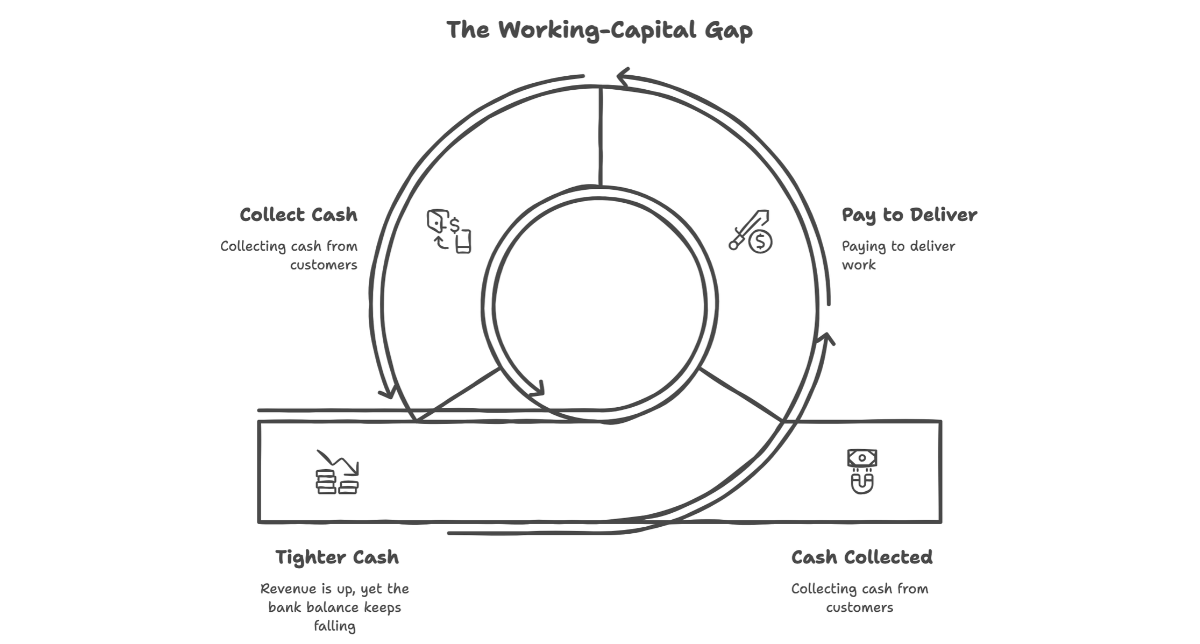
Often, the problem is not a lack of sales. It is the time and money between paying to deliver work and collecting cash from customers. That delay is the working-capital gap, and growth can widen it.
TL;DR
- Revenue growth can tighten cash when a business pays to deliver before customers pay. Profit does not guarantee liquidity.
- Track receivables, inventory, payment timing, margins, and growth costs.
- Use a rolling 13-week cash-flow forecast, test downside scenarios, and adjust terms or spending to fund growth without risking operations.
Growth can consume cash before it creates it
Consider a company that wins a large customer contract; to deliver, it needs to hire staff, purchase materials, or pay subcontractors. The customer, however, pays 60 days after the work is complete.
The company may recognize revenue as it earns it, but the cash arrives later. Payroll and supplier bills do not wait. If several projects follow the same pattern, the business must fund more work before it collects more money.
This happens across industries. A distributor may purchase inventory months before selling it. A services firm may hire ahead of a new engagement. A contractor may pay crews and suppliers before receiving milestone payments. A subscription business may collect cash upfront but still need to deliver services over the contract period.
In each case, growth creates a cash requirement before it creates available cash. I have seen this issue surface in businesses that looked healthy at first glance. The company was generating meaningful revenue, but recurring working-capital needs were making cash unpredictable.
A five-year forecast would not solve the immediate problem. The priority was to understand the next 13 weeks: which payments were coming, when customer receipts were expected, and where the timing mismatches could appear.
That kind of visibility can change the conversation. Instead of reacting to a low bank balance, management can spot cash pressure early and decide before it becomes urgent.
Profit is not cash
Profit measures whether revenue exceeds expenses over a period. Cash flow measures when money actually enters and leaves the business.
A company can report a profit while cash is tied up in unpaid invoices, inventory, work in progress, or expenses paid before customers pay. For example, a business might deliver $100,000 of work this month and record the revenue. If the customer pays in 60 days, the business still needs cash to cover labor, materials, rent, and other costs in the meantime.
The faster the company grows, the more important this timing difference becomes. If every new project requires the business to spend first and collect later, higher revenue can create a larger funding need.
A strong sales month can create a cash-flow problem, not solve it.
Understand the working-capital gap.
Working capital is the money needed to fund normal business operations. In practical terms, cash gets tied up in receivables, inventory, and work in progress, while supplier terms and other short-term obligations can offset some of that need.
The gap grows when the business takes longer to collect from customers than it takes to pay its own expenses. It can also grow when inventory sits too long, projects take longer to complete, or the company accepts contracts with high upfront costs and delayed billing.
The question is not only, “Are we growing?” It is also: How much cash does this growth require before it pays for itself?
That question belongs in the decision to accept a major contract, expand into a new market, or increase inventory. A deal may be profitable on paper but still strain liquidity if it has a long delivery cycle, slow customer payments, or high upfront costs.
Make the cash cost of growth visible.
A rolling 13-week cash-flow forecast can help answer that question. It shows expected cash inflows and outflows week by week, making it easier to identify when the business could face a shortfall.
Update the forecast as customer payment dates change, new contracts are signed, hiring plans shift, or costs differ from expectations. It is a decision-making tool, not a static spreadsheet to prepare once and forget.
As growth accelerates, keep an eye on five areas:
- Receivables: How long are customers taking to pay? Are overdue balances growing faster than sales?
- Inventory and work in progress: How much cash is committed before products sell or projects are completed?
- Payment timing: Do customer collections arrive before payroll, supplier bills, taxes, and debt payments are due?
- Margins: Does each customer or project generate enough margin to justify the cash and capacity it consumes?
- Growth spending: How much cash will hiring, marketing, equipment, or expansion require, and when?
These checks are not reasons to avoid growth. They help management understand what it will take to fund it.
Look beyond the sales forecast.
A sales forecast tells you what the business hopes to sell. A cash forecast should show when that sales activity turns into money in the bank.
That requires more than applying a collection percentage to monthly revenue, you’ll need to look at actual payment behavior by customer. Review the billing terms in contracts. Identify deposits, milestone payments, retainage, or other conditions that determine when cash arrives. If a customer has historically paid 30 days late, the forecast should reflect reality rather than the stated payment terms.
The same discipline applies to costs. Hiring plans should include start dates, salaries, benefits, and the ramp-up period before new employees contribute revenue. Inventory plans should account for purchasing, delivery, storage, and the time needed to sell through stock. Project forecasts should include the cash required to deliver the work, not just the expected margin at completion.
When those assumptions are visible, leadership can challenge them. Does the company need to hire now, or can the start date move? Can a customer pay a deposit? Is the business taking on work that uses scarce capacity without producing a sufficient return?
Model the downside before committing.
A growth plan should not depend on one expected outcome. Build a base case using current assumptions, then test a downside case. What happens if customers pay later, a project takes longer, or sales come in below plan?
If the forecast shows a possible shortfall, the business has more choices when it sees the issue early. It might adjust hiring or purchasing timelines, negotiate deposits or milestone billing, revisit supplier terms, or arrange financing before cash becomes urgent.
Waiting until the bank balance is low often means fewer options and less negotiating power. Lenders and investors also want to understand how the business manages cash, not just how fast revenue is growing. A clear forecast helps explain how much funding is required, when it will be needed, and how the business expects to repay or deploy it.
Revenue growth is valuable when the business can deliver profitably, collect cash on time, and fund the work without risking operations. Before committing to the next growth target, ask:
- How much cash must we spend to deliver it?
- When do we expect to collect the money?
- Can we fund the gap if payment is delayed?
The answers turn a sales target into an operating plan.
A business does not need to be less ambitious; it only needs to understand the cash mechanics behind its ambition.
FAQs
Can a profitable business run out of cash?
Yes. Profit is calculated over a period, while cash depends on when money is collected and paid. Slow customer payments, inventory build-up, or upfront delivery costs can leave a profitable company short of cash.
How can revenue growth create cash-flow problems?
Growth may require upfront spending on staff, inventory, materials, or delivery. If the company pays these costs before collecting from customers, new sales can increase the amount of cash tied up in operations.
How can a business monitor cash flow during rapid growth?
Use a rolling 13-week cash-flow forecast and update it regularly with current collection dates, planned payments, hiring, and major commitments. Review it alongside receivables, inventory or work in progress, and margins by customer or project.