The ROI of a Fractional CFO: What the Numbers Actually Show
in Fractional CFO, Uncategorized, CFO, CFO Services, Fractional CFO, Fractional CFO Services, Roles of a Fractional CFO, All Posts
“Is this too expensive for a company our size?”
It’s the question we hear most, and it’s the wrong question. The right question is what it costs you not to have strategic financial guidance when you’re making a pricing decision, a hiring decision, or walking into a capital raise unprepared. Once you frame it that way, the fractional CFO math tends to answer itself.
Founders evaluating a fractional CFO usually start by comparing a monthly retainer to their own instinct about what “CFO-level help” should cost. That instinct is almost always anchored to the wrong number. The real comparison isn’t retainer versus zero, it’s retainer versus the fully loaded cost of a full-time hire, weighed against the specific, dollar-denominated outcomes a strategic finance partner actually delivers. Both sides of that equation are more concrete than most founders expect.
TL;DR
- A full-time CFO costs $344K–$500K+ all-in once you include salary, benefits, bonus, equity, recruiting, and severance risk. A fractional CFO retainer runs $72K–$240K annually with none of that overhead.
- Fractional engagements ramp in under four weeks, versus a multi-month search-and-onboarding cycle for a full-time hire.
- Documented client outcomes include a $5M working capital line at a 99% advance rate, $40K in audit fees saved through faster remediation, and a 40% revenue increase following a strategic roadmap engagement.
- The internal standard for fractional CFO-built financial infrastructure is data room readiness within 48 hours of a buyer or lender request, a capability most internal teams don’t have,
- ROI shows up in two forms: hard dollars (capital raised, costs avoided) and avoided cost (the deal that didn’t get repriced, the audit that didn’t blow the timeline).
The Cost Comparison, Side by Side
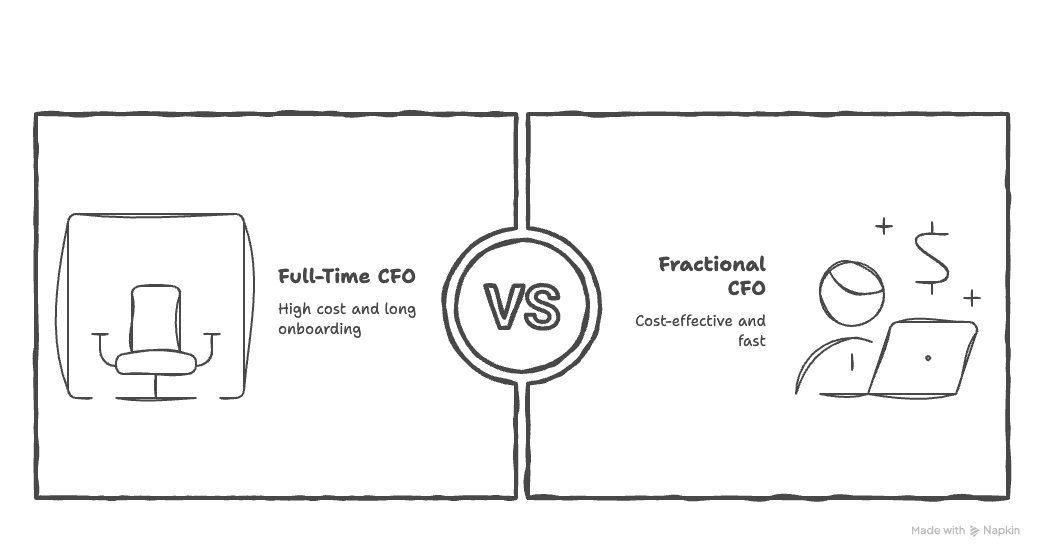
Start with the number founders actually anchor to: what does a full-time CFO cost? Base salary for an experienced CFO runs $180,000 to $250,000.
- Add benefits and payroll taxes at roughly 30%, and you’re at another $54,000 to $75,000.
- Add a realistic annual bonus of $30,000 to $75,000, and equity or long-term compensation typically worth $50,000 or more.
- Add recruiting costs; $30,000 to $50,000 is standard for an executive search at this level. And hold in reserve the severance risk if the hire doesn’t work out: three to six months of pay.
All in, a full-time CFO costs a company $344,000 to $500,000 or more per year.
A fractional CFO retainer through a firm like CFO Pro+Analytics runs $6,000 to $20,000 a month; $72,000 to $240,000 annually, with no benefits, no bonus or equity, no recruiting cost, and no severance exposure.
Ramp time is under four weeks, compared to a full-time search-and-onboarding cycle that routinely runs three to six months before a new CFO is fully productive.
That’s not a marginal difference; it’s a structural one. And it holds across the rest of the finance stack, not just the CFO seat: FP&A support runs $4,000–$8,000 a month fractional versus $12,000–$20,000 plus benefits for a full-time hire.
Controller work runs $4,000–$8,000 versus $12,000–$20,000 plus benefits. Analytics support runs $4,000–$10,000 versus $10,000–$20,000 plus benefits. The pattern repeats at every level of seniority.
What You’re Actually Buying
Cost avoidance is only half the ROI story; the other half is what a fractional CFO actually delivers, and that shows up in specific, measurable outcomes rather than vague “strategic guidance.”
Capital secured on better terms
A family-owned CPG company needed to manage cash and grow more efficiently. We built a weekly cash flow forecasting model with credit line borrowing features and a 60-month private-equity-grade forecast.
The result was a $5 million working capital line secured at a 99% advance rate, plus extended payables negotiated with key suppliers — outcomes directly attributable to walking into the lending conversation with institutional-grade financial infrastructure instead of a spreadsheet.
Costs avoided through speed
A client raising a round from a strategic investor had never been audited, and the investor required one as a condition of closing, with the company low on cash and the audit timeline threatening to sink the deal. Rapid pre-audit remediation and end-to-end audit management compressed a typical 10-week process into 6 weeks, saving $40,000 in fees and closing the financing on time with no material weaknesses identified.
Revenue growth from better decisions
For a B2B services client, we modeled three expansion scenarios and identified the highest-ROI growth path. Revenue was up 40% in the twelve months following the execution of a direct result of a strategic roadmap built on real scenario analysis rather than instinct.
Deal protection
For a PE-backed sports media company facing follow-on diligence after a close, we reorganized conflicting ERPs, rebuilt a dynamic 12-month cash flow model, and built a comprehensive sell-side data room with pre-emptive fixes to EBITDA and working capital adjustments.
The data room was delivered within 48 hours of the buyer’s request, and the deal closed on its original terms with no valuation re-trade — meaning the fix prevented a repricing that would have cost far more than the engagement itself.
The 48-Hour Standard
One number that shows up across nearly every engagement is 48 hours, our internal benchmark for how quickly a client should be able to open a full data room to a lender, investor, or buyer. That standard exists because the alternative is expensive: every week spent scrambling to produce financials after a request lands is a week the other side has to find something wrong, get nervous, or simply lose momentum on the deal.
Being able to answer “can we see your numbers” with “yes, today” is a direct, quantifiable form of ROI, even though it never shows up as a single line item.
Why the Math Favors Fractional at Growth Stage
The ROI case is strongest precisely at the stage most companies are tempted to either go without financial leadership entirely or overspend on a full-time hire they don’t yet need. Companies in the $1M–$3M range typically need accurate bookkeeping more than a CFO. Companies in the $3M–$5M range , what we call the danger zone, have outgrown a bookkeeper’s capabilities but often aren’t ready to absorb a $350K+ full-time executive. That’s exactly where a fractional engagement delivers the highest return: senior-level strategic guidance, sized to the stage of the business, without the fixed overhead of a full-time seat that may be underutilized for another year or two.
Past $5M in revenue, many companies still choose to stay fractional indefinitely, not because they can’t afford a full-time hire, but because a team-based fractional model delivers backup capacity, cross-functional expertise (FP&A, accounting, analytics, M&A), and specific deliverables that a single full-time hire, however good, can’t match alone.
How to Evaluate Whether the ROI Will Hold for Your Business
Not every fractional engagement delivers this kind of return, and the difference usually comes down to who you hire.
Look for operating experience, not just advisory background, someone who has actually built the models and defended the numbers, not just consulted on them.
Look for specific deliverable examples: models, reports, decks they can show you, not vague promises.
Look for team capacity behind the individual, since a one-person firm has no backup if something urgent comes up.
And be honest about timeline: four weeks or less to first insights is a reasonable standard.
If a firm can’t explain your business model back to you in 30 minutes, or needs 90 days before producing anything, that’s a red flag on ROI before the engagement even starts.
FAQ
Q1. How quickly does a fractional CFO engagement start showing ROI?
Most clients see initial findings and quick wins within the first four weeks — that’s our standard kickoff-to-insight timeline. Larger outcomes like a completed capital raise or a closed audit obviously take longer, but the diagnostic work that identifies where value is being left on the table happens fast.
Q2. Is a fractional CFO worth it if we’re not planning to raise capital or sell anytime soon?
Yes, and arguably it’s when the ROI compounds the most. The financial infrastructure built between capital events — growth models, scenario planning, KPI tracking — is what drives valuation up and makes every future raise or exit faster and cheaper when the time comes.
Q3 How do we compare ROI across different fractional CFO firms?
Ask for specific, dollar-denominated outcomes from past engagements, not general claims about “strategic value.” A firm that can point to a capital amount raised, fees saved, or a measurable revenue or margin improvement has a track record you can actually evaluate. Vague answers on deliverables or timelines are the clearest signal that the ROI won’t be there.

Salvatore Tirabassi is the Founder of CFOPro+Analytics, providing fractionalCFO services to growth-stage companies. Based in New York, he leverages over 24 years of experience in venture capital and strategic finance to help entrepreneurs master cash flow, unit economics, and equity value creation through data-driven financial clarity.
Assess your CFO needs in 5-minutes
For more on this topic, read our driver-based forecasting and fractional CFO due diligence preparation.