The Fractional CFO Engagement Model: What You Get and How It Works
in Fractional CFO, Fractional CFO, Fractional CFO Services, Roles of a Fractional CFO, All Posts
One of the most common hesitations founders have before starting a fractional CFO engagement isn’t cost; it’s the unknown.
- What actually happens in week one?
- Who has access to what?
- How long until there’s something tangible to show for it?
A vague answer is itself a warning sign. A well-run engagement model should be as structured and predictable as the financial infrastructure it’s meant to build. how fractional CFOs use scenario planning for strategic decisions
The engagement model is where the strategic case for a fractional CFO either becomes real or falls apart. It’s easy to make the case for why a business needs strategic financial leadership. It’s harder to explain, concretely, how an outside firm steps into your business, gets access to sensitive systems, and starts producing something useful — without a 90-day ramp-up that eats half the value of the engagement before it even starts.
TL;DR
- Engagements follow a five-step structure: scope of work, a 90-minute kickoff call, systems access, a 4–8 week initial implementation, and ongoing alignment — not a boilerplate SOW.
- There are three common engagement models: assessment plus remediation plus fractional CFO support; QofE and sell-side readiness; and interim CFO coverage during a transition.
- Pricing is retainer-based for fractional roles ($6K–$20K/month for a CFO) and hourly-against-retainer for interim and project work ($250–$600/hour depending on role and complexity).
- First insights should arrive within four weeks — a longer onboarding timeline is one of the clearest red flags when evaluating a firm.
- The engagement isn’t a solo consultant; it’s backed by a team with depth acrossFP&A, accounting, analytics, and M&A, so capacity doesn’t disappear when one person is unavailable.
The Five-Step Structure
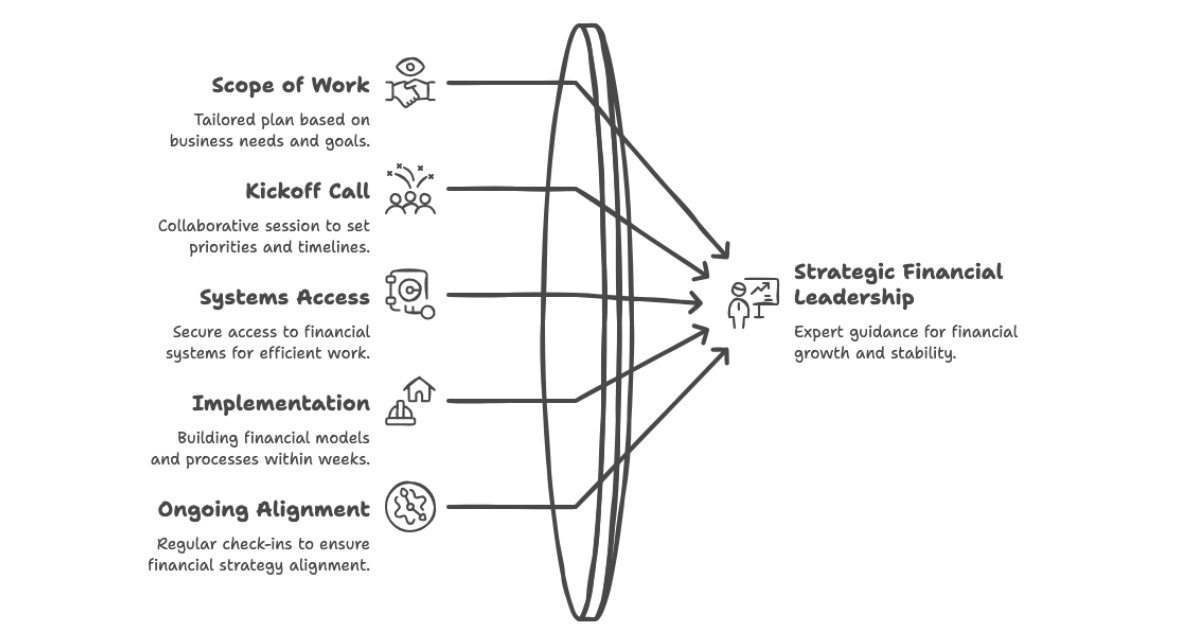
A fractional CFO engagement should feel structured and fast, not open-ended. The model we use — and the one we’d recommend evaluating any firm against — has five steps.
Scope of work
This starts with a real conversation, not a template. We meet with your team to align on what stage the business is at, what the immediate goals are, and where the financial gaps actually sit. There’s no boilerplate statement of work handed over before anyone understands the business — the scope reflects your specific situation, whether that’s a broken close process, an upcoming capital raise, or a leadership gap that needs bridging.
Kickoff call
A 90-minute session with all stakeholders in the room. This is where priorities get set, deliverables get defined concretely, and a timeline gets locked. Nobody leaves that call unclear on what happens next or when they’ll see it.
Systems access
Your team grants access to the financial systems and documentation needed to move — accounting software, banking, existing models, historical records. This step moves fast deliberately, because delays here are the single biggest cause of slow-starting engagements.
Implementation.
The initial deliverable timeline runs 4 to 8 weeks depending on scope what the first 30 days can look like with a fractional CFO, with weekly updates throughout so there’s never a black-box period where you don’t know what’s happening. This is where the actual work happens — building the model, cleaning up the books, standing up the dashboard, preparing the data room. financial modeling and forecasting
Ongoing alignment.
Once the initial deliverables are in place, the engagement shifts to a regular cadence of check-ins with founders and key stakeholders. The goal is that financial strategy stays ahead of the business as it grows, rather than the business outrunning its financial infrastructure again six months later.
Three Common Engagement Models
Not every business needs the same shape of engagement, and the right one depends on what’s driving the need.
Assessment, remediation, and fractional CFO support
This is the most common starting point: a structured assessment identifies where the financial gaps actually are and what they’re costing the ROI of a fractional CFO, followed by remediation of the specific problems found — messy books, missing models, broken close processes a rolling 13-week cash-flow forecast — with a fractional CFO providing ongoing strategic leadership once the foundation is solid.
Quality of Earnings and sell-side readiness.
For businesses heading toward a capital raise or sale, the model shifts to identifying and fixing the specific issues a buyer’s diligence team would find, then closing the transaction. This is deadline-driven work, typically compressed into weeks rather than months, aimed at a specific event on the calendar.
Interim CFO during a transition
When a CFO or controller has departed unexpectedly, or a company needs finance leadership bridging into a permanent hire, an interim CFO steps in to provide continuity — running the finance function, keeping reporting current fractional versus interim CFO leadership, and often helping recruit and onboard the permanent replacement.
Many engagements move through more than one of these phases over time — starting with an assessment, moving into remediation, and settling into ongoing fractional support as the relationship matures.
What You’re Actually Paying For
Pricing follows two different structures depending on the type of engagement. Ongoing fractional roles are retainer-based: a CFO runs $6,000–$20,000 a month, FP&A support runs $4,000–$8,000, a controller runs $4,000–$8,000, bookkeeping runs $1,000–$2,000, and analytics support runs $4,000–$10,000. All of these can be bundled with discounts, and every proposal is customized to the complexity of the business rather than pulled from a fixed rate card.
Interim and project-based work is billed differently — hourly against a monthly retainer, with the engagement scoped and quoted in advance. An interim CFO stepping in during a transition, fundraise, or turnaround runs $350–$600 an hour over a typical 3–9 month engagement. An interim controller runs $250–$350 an hour over 2–6 months. Quality of Earnings and due diligence work runs $250–$600 an hour over a compressed 4–12 week window. Audit prep and remediation runs $250–$350 an hour over 2–8 weeks. Financial modeling — investment-banking or private-equity-grade forecasts, cap tables, deal models — runs $250–$350 an hour over 1–4 weeks.
The range in every case depends on the seniority of the resource and the complexity of the engagement, which is exactly why the scope-of-work conversation happens before any number gets attached to it.
Who’s Actually Doing the Work
A structural difference between a good fractional engagement and a bad one is what happens when the primary person you’re working with is unavailable. A one-person consulting shop has no backup capacity — if that person is out, or overloaded across multiple clients, your engagement stalls. A team-based model doesn’t have that failure point. Our team includes former CFOs, venture capitalists, CPAs, and investment bankers with backgrounds spanning SaaS, CPG, industrials, and consumer credit — more than 300 combined years of finance and accounting experience, trained at institutions from Wharton to Goldman Sachs to KPMG. That depth means an engagement can flex to pull in the right specialist — an M&A advisor for a sale process, an analytics lead for a dashboard build — without renegotiating the relationship from scratch.
What to Look For — and What to Avoid
If you’re evaluating a fractional CFO engagement model, whether ours or someone else’s, a few things separate a strong fit from a weak one. Look for operating experience, not just advisory background — someone who has actually run a finance function, not only consulted on one. Look for industry and business model familiarity relevant to yours. Look for specific deliverable examples they can show you, and an honest timeline: four weeks or less to first insights is reasonable, and anything longer should raise questions.
The red flags run the other direction: a firm that’s vague about deliverables or timelines, a one-person operation with no backup capacity, an inability to explain your business model back to you within 30 minutes of a conversation, no case studies or references, or an onboarding process that stretches past 90 days before you see any output. Any one of these is worth pausing on. Several together mean the engagement model isn’t built to deliver.
FAQ
How long before we see actual deliverables after signing on?
Initial deliverables typically land within 4 to 8 weeks of systems access, with weekly updates throughout so there’s visibility the entire time. First insights — an early read on where the gaps and opportunities are — usually come within the first four weeks.
Can we start with a smaller engagement before committing to ongoing fractional CFO support?
Yes. Many relationships start with a focused assessment or a specific project — audit prep, a Quality of Earnings review, a financial model build — and expand into ongoing fractional support once there’s a track record and a clear sense of fit on both sides.
What happens if our situation changes mid-engagement — say, a capital raise gets pulled forward?
The scope-of-work and ongoing alignment structure is built for exactly this. Because the engagement isn’t a rigid, pre-packaged offering, priorities can be re-sequenced, and the team-based model means additional specialized capacity — deal support, modeling, diligence prep — can be brought in without starting a new vendor relationship from zero.