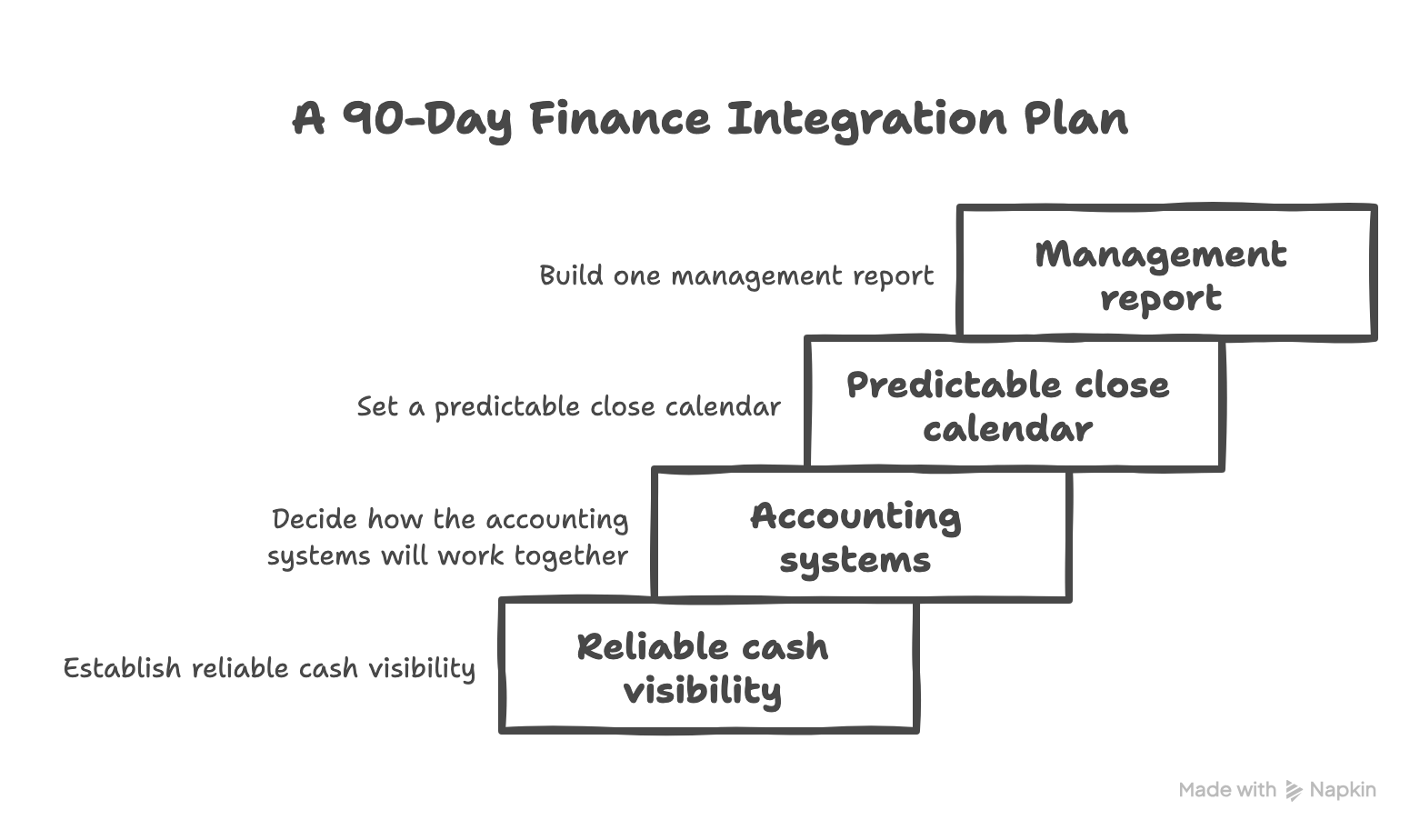
An acquisition can make strategic sense and still create financial confusion after closing. The buyer and acquired company may use different accounting systems, define revenue differently, follow different payment practices, or close their books on different schedules. Until leaders understand those differences, they may struggle to tell whether the combined business is meeting the plan.
TL;DR:
Closing the deal is not the same as integrating the business. In the first 100 days, establish reliable cash visibility, decide how the accounting systems will work together, set a predictable close calendar, and build one management report that shows how the combined company is performing. The goal is not to integrate everything at once but to give leadership trustworthy numbers and a clear way to act on them.
That is why post-deal finance integration needs an owner, a sequence, and a short list of priorities. Here is a practical way to organize the first 90 days.
Days 1–30: Establish cash visibility and protect continuity
Start with cash:
Bring bank accounts, debt payments, payroll, customer receipts, vendor obligations, taxes, and planned one-time costs into a single
short-term cash view. A rolling
13-week cash forecast is useful because it makes timing visible. It can show whether a large customer payment is expected after payroll or whether an integration expense arrives before the anticipated savings.
Do not assume that the acquired company’s cash position tells the whole story:
Review outstanding receivables, overdue payables, customer deposits, deferred revenue, inventory commitments, and debt or lease obligations. Assign an owner to each major cash input and agree how often the forecast will be updated.
At the same time, protect the processes the business needs to keep running.
Confirm who can approve payments, access bank accounts, run payroll, issue invoices, and manage collections. Make sure the right people have access to accounting and banking systems, and document any temporary workarounds. Integration should not disrupt the basic ability to bill customers, pay employees, and meet obligations.
Days 31–60: Set the accounting and close model
Next, decide how the two accounting environments will work together.
That does not always mean moving immediately to one software platform. First, establish which system is the official source for each entity, how transactions will be coded, and how management will consolidate results.
Agree on a shared chart-of-accounts structure where practical.
Map the acquired company’s existing accounts to the buyer’s reporting categories, and document any differences that affect comparisons. Pay particular attention to revenue recognition, cost classification, intercompany transactions, inventory, and customer or product categories.
Then set a close calendar.
Identify each close task, its owner, the due date, and the reviewer. Include reconciliations for cash, receivables, payables, debt, payroll, and key balance-sheet accounts. A calendar turns “we close when the numbers are ready” into a repeatable process. It also helps leadership understand when the figures are reliable enough to use.
Keep the initial process simple.
A consistent, explainable close is more useful than a complicated reporting package that arrives late or depends on one person’s memory.
Days 61–90: Connect working capital to decisions
With cash reporting and the close process underway, focus on working capital: the cash tied up in receivables, inventory, and other operating needs. Review how quickly customers pay, how much overdue receivables are building up, and whether payment terms differ between the two businesses.
Turn the review into specific actions. For example, assign owners to overdue accounts, clarify approval for customer credit exceptions, or coordinate purchasing with actual demand. Avoid treating every improvement as a finance-only task. Sales, operations, and procurement make decisions that affect cash, so they need to understand the consequences and own their part of the plan.
Give leadership one useful view
By Day 90, leaders should be able to review a common management report that connects the combined company’s results to the deal plan. Include actual performance against budget, cash and forecast changes, revenue and margin by meaningful segment, working-capital indicators, integration costs, and progress on the most important expected benefits.
Separate what is known from what is still an assumption. If the deal plan anticipated savings, show the expected timing, the responsible owner, and the costs required to achieve them. Do not present projected savings as realized results before the underlying actions have occurred.
A simple integration scorecard can track whether the reporting is becoming dependable:
- Is cash visibility current and reviewed regularly?
- Are both businesses closing on an agreed schedule?
- Can leaders compare performance using consistent definitions?
- Are working-capital issues assigned to specific owners?
- Are integration costs and expected benefits visible in the same report?
The first 90 days will not resolve every system or process difference; however, they should establish a reliable financial baseline and a management rhythm for addressing the differences that matter most.
That is how finance supports integration: not by producing more reports, but by making it easier for leaders to see what is happening, understand what is changing, and decide what to do next.
Frequently Asked Questions (FAQs)
1. What should a business prioritize during the first 90 days after an acquisition?
A business should prioritize cash visibility, financial reporting consistency, and operational continuity. This includes reviewing cash flow, receivables, payables, debt obligations, and payroll processes. It should also establish clear accounting responsibilities, align reporting structures, and create a predictable financial close calendar. The objective is to give leadership reliable financial information to guide integration decisions.
2. Should an acquired business immediately switch to the buyer’s accounting system?
Not necessarily. Moving to a single accounting platform immediately after closing can introduce unnecessary disruption. The buyer should first understand how both businesses manage transactions, recognize revenue, classify expenses, and produce financial reports. In some cases, maintaining separate systems temporarily while establishing consistent reporting and consolidation processes is more practical. Any eventual system migration should have a clear timeline, ownership, and implementation plan.
3. How can a CFO measure the success of post-acquisition financial integration?
A CFO can measure success through improvements in financial visibility, reporting accuracy, cash management, and progress toward the acquisition’s expected benefits. Key indicators include the time required to close monthly accounts, accuracy of cash-flow forecasts, overdue receivables, working-capital performance, integration costs, and realized synergies. By the end of the first 90 days, leadership should have a dependable financial reporting process and clear accountability for outstanding integration priorities
Salvatore Tirabassi is a financial operations expert specializing in the intersection of corporate finance and emerging technologies. With extensive experience advising CFOs and finance leaders on operational efficiency, he focuses on how artificial intelligence and automation can transform traditional financial workflows. Salvatore's work centers on helping finance teams leverage technology to reduce administrative burden and elevate strategic decision-making in board communications and financial reporting. Over two decads spanning venture capital (Partner, M/C Partners, ~$2.4B AUM) and operating CFO roles. $500M+ in capital raised, 12 successful exits. Brings a dual investor-operator perspective to fractional and interim CFO work for founder-led and family-owned companies ($3M–$100M revenue).