Fundraising Strategy: How to Get Your Business Investor-Ready Before You Need the Money
in Fractional CFO, Financial Leadership, Fractional CFO, Fractional CFO Services, Strategic Planning, All Posts
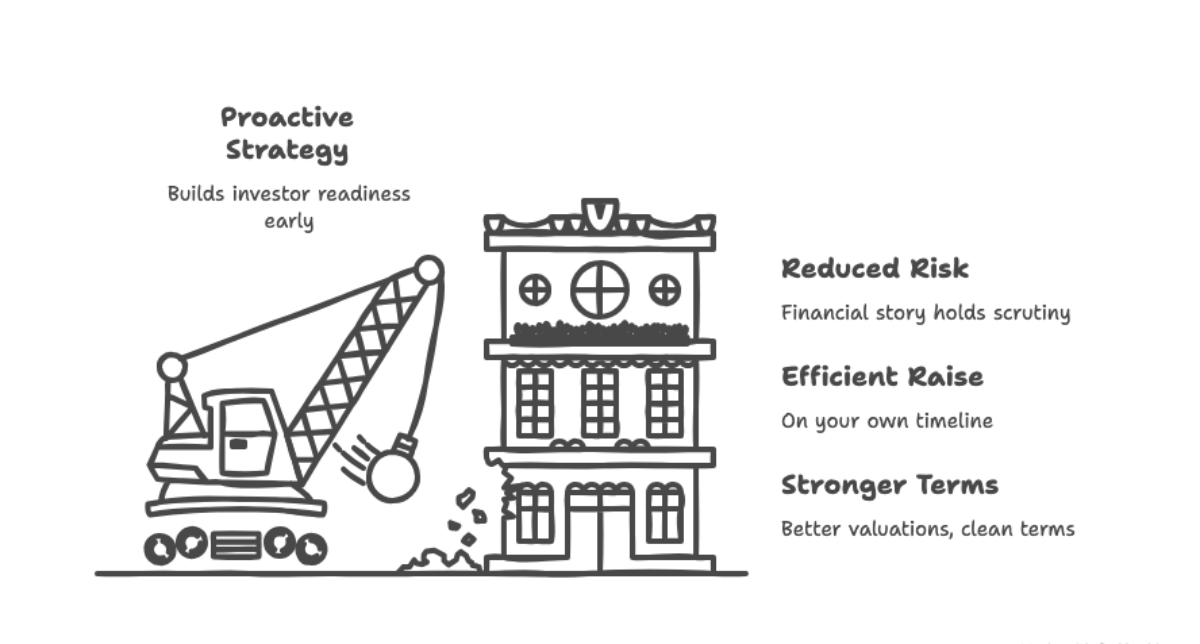
Most founders start thinking about fundraising strategy the moment they need capital. However, by then, it’s too late to build the case that gets you the best terms.
The businesses that raise efficiently, at strong valuations, with clean terms, and on their own timeline did the work months before the first investor call. They built the model, cleaned up the books, and knew their number before anyone asked for it.
I’ve spent the last several years on both sides of this table: as an operating CFO raising capital for growth-stage companies, and as a venture partner evaluating hundreds of financial packages from the other side of the desk.
The pattern is consistent.
Deals don’t fall apart because the business is bad; they fall apart, or get repriced, because the financial story collapses under scrutiny.
That’s a fixable problem, and it’s almost always a preparation problem.
TL;DR
- Fundraising readiness is built before you need the capital, not during the raise. Investors and lenders can tell the difference immediately.
- The core toolkit is a defensible financial model, a 13-week (or monthly) cash flow forecast, GAAP-compliant books, and a data room ready with under 48 hours’ notice.
- Clean financial infrastructure changes outcomes: one client secured a $5M working capital line at a 99% advance rate; another closed a strategic round with zero revenue-related adjustments in diligence because ASC 606 was already handled.
- Your fundraising story needs four parts: where you’ve been, what changed, what you assume, and where you’re going. Each one needs to be defensible under direct questioning.
- A fractional CFO builds this infrastructure faster and cheaper than hiring full-time, and the investment pays for itself as soon as terms improve.
Why Fundraising Strategy Starts With Your Books, Not Your Pitch
Founders tend to think of fundraising as a pitch problem: the deck, the narrative, and the room. It’s actually a data problem first. Every serious investor, banker, or lender runs a version of due diligence that starts with your numbers, not your story. If the numbers don’t hold up, the story never gets heard.
That means fundraising strategy isn’t a 60-day sprint before you start calling investors. It’s the ongoing discipline of running your finance function like a business that’s always ready to be evaluated. Companies that treat capital readiness as a standing operational priority, rather than a fire drill, consistently raise faster, at better terms, with less founder time burned on due diligence back-and-forth.
The inflection point tends to show up predictably by revenue stage. Businesses in the $1M to $3M range usually have a bookkeeper who can tell you your balance, but no one who can tell you where you’re headed. Between $3M and $5M is what I call the danger zone: complexity has outpaced internal capacity, there’s no model, no forecast, and no strategic financial guidance. This is exactly where companies get blindsided when investors or lenders ask for something they don’t have. Past $5M, you need a strategic financial partner who can build growth roadmaps, run scenario planning, and produce investor-grade reporting on demand.
The Financial Toolkit Every Raise Requires
Regardless of whether you’re raising equity, debt, an SBA loan, or an asset-backed facility, the underlying toolkit doesn’t change much:
A Defensible Multi-Year Model
Investors want to see 3 to 5 years of projections built on assumptions that survive the question, “How did you get to that number?” A model built in a rush, with no supporting logic, gets torn apart in the first diligence call.
Rolling Cash Flow Visibility
A 13-week cash flow forecast is table stakes for lenders and increasingly expected by equity investors, especially in businesses where working capital swings matter. It shows you understand your own liquidity, not just your P&L.
GAAP-Compliant, Audit-Ready Books
Cash-basis or tax-basis books that haven’t been reconciled to GAAP are one of the most common reasons a raise stalls. If your investor requires a prior-year audit and you’ve never been audited, the clock and cash burn start working against you at the same time.
A Data Room That’s Ready Before It’s Requested
Our internal standard is that any client should be able to open a full data room with less than 48 hours’ notice. That includes three years of GAAP financials, monthly management accounts, a working capital analysis, a Quality of Earnings bridge, KPI dashboards covering at least 24 months, customer concentration analysis, and a forward-looking model with explicit assumptions. Investors read the speed and completeness of your data room as a proxy for how well-run the rest of the business is.
What This Looks Like in Practice
Financial infrastructure isn’t theoretical. It shows up directly in the terms you get. We placed a fractional CFO with a family-owned CPG company that needed to manage cash and plan growth more efficiently.
We built a weekly cash flow forecasting model with credit line borrowing features, plus a 60-month private-equity-grade forecast, and a weekly digital ad spend model tracking CAC and ROAS. The result: the company raised a $5 million working capital line at a 99% advance rate and negotiated extended payables with key suppliers. These outcomes simply aren’t available to a business that shows up with disorganized books.
In another engagement, a client raising a round from a strategic investor had never been audited, and the investor required a prior-year audit as a condition of closing. The company was low on cash, so the audit’s timing and cost were existential. We ran a rapid pre-audit remediation, reconciling accounts, correcting historical entries, and standardizing accounting policies, and managed the audit end-to-end with our audit firm partner. The audit closed in six weeks instead of the typical ten, saved $40,000 in fees, and the financing closed on time with no material weaknesses identified.
A third client, a SaaS business with multi-element contracts booked on a cash basis, needed GAAP-compliant revenue recognition under ASC 606 before an investor would move forward. We audited every active contract to identify performance obligations, implemented a third-party tool to manage revenue recognition, and restated two prior years for comparability.
The fundraising process launched with zero revenue-related adjustments in diligence. Left unaddressed, this issue would have slowed the raise by weeks and given the investor leverage to reprice.
Telling the Story Investors Actually Buy
1. Numbers Are the Evidence
The story is what investors are actually buying. A fundraising narrative that holds up has four parts, and each one needs to survive direct questioning.
2. Where You’ve Been
Be honest and specific about what drove past performance and what the headwinds were. Sanitizing the history is a mistake. Credibility lives in the honest account, not the polished one.
3. What Changed
Identify the real inflection point that makes the future different from the past. It has to be grounded in an actual operational shift, not aspiration.
4. What You Assume
Every input in your model should be defensible on its own. If you can’t explain how you arrived at a growth rate or a margin assumption, an investor will find the gap before you do.
5. Where You’re Going
Build a specific, believable 3 to 5 year picture that bridges naturally from what came before, rather than presenting a hockey stick that appears out of nowhere.
Investors who walk away from a deal, or come back with a lower offer, are almost always responding to a story that collapsed under scrutiny, not to a single bad number. Fix the story before you fix the pitch deck.
Building This Without a Full-Time Hire
Most growth-stage companies don’t need a full-time CFO to get fundraising-ready. They need focused, senior-level capital markets expertise for a defined period.
A fractional CFO can build the model, clean up the books, and manage the data room in the weeks before a raise, then step back once the round closes.
That’s a fundamentally different cost structure than a $180K to $250K full-time hire, and it’s structured around the milestone that actually matters: closing the round on your terms.
FAQ
How Far in Advance of a Raise Should We Start Preparing?
Ideally, 3 to 6 months before you plan to be in market, and longer if your books have never been audited or your entity structure is complex. The preparation itself, including the model, the cash flow forecast, and the data room, takes time to build correctly, and rushing it is exactly what produces the gaps investors find in diligence.
We’re Not Raising Capital Right Now. Does Fundraising Strategy Still Apply to Us?
This is often when it adds the most value. The period between capital events is when you build the growth models, scenario planning, and financial infrastructure that drive valuation up and make every future raise or exit faster. Waiting until you need the money means building under pressure, which is when mistakes happen.
What’s the Difference Between Being “Ready to Raise” and Having Audited Financials?
An audit is one component, and only some investors and lenders require it. Being ready to raise means your books are GAAP-compliant and reconciled, your model is defensible, your cash flow forecast is current, and your data room can be opened with minimal notice, audited or not. Many successful raises close without a formal audit, but none close without that underlying discipline.