Case Study: Preparing a Founder-Owned Business for a $20M Exit
in Fractional CFO, Financial Leadership, Fractional CFO, Mergers and Acquisitions, All Posts
Four decades old, with real revenue and loyal customers. On paper, this looked like a straightforward exit. In practice, it was anything but that.
The company was a founder-owned industrial equipment business built around two entities operating as a single economic machine. One entity bought heavy equipment and modified it for specialized use, handling all repairs and shop operations, generating about $7.2M in revenue. The other, rented that specialty equipment to customers, deployed 40 to 50 machines at a time, and sold aged equipment at strong gains, generating roughly $4.4M.
Build, rent, sell. On the surface, a clean, integrated story. Underneath, five problems that would have stopped the deal or repriced it significantly downward before an investor ever finished their first pass through the financials.
None of it was fraud; it was all fixable. This is what it took:
TL;DR
- A founder-owned industrial equipment business with ~$11.6M combined revenue across two entities had five financial infrastructure problems invisible from the outside but fatal in diligence.
- The issues ranged from $1.6M in double-counted phantom revenue to a CPA making unauthorized year-end plugs to zero consolidated financial view across the two entities.
- The fix required six deliverables: GAAP accrual conversion, intercompany pricing, overhead allocation, a fixed asset schedule, a consolidation model, and new SOPs with a qualified controller.
- The rebuilt financial story unlocked three layers of value, operating EBITDA (~$17–20M), a fleet asset premium (~$6–7M), and a vertical integration premium, targeting $23M+ total.
- The work didn’t change the business. It changed what the business could say about itself, and what a buyer was willing to pay for it.
What Looked Fine From the Outside
Every business preparing for a sale looks fine from the outside, right up until a buyer’s diligence team starts pulling threads. This one had real revenue, decades of operating history, and loyal customers, the kind of story that makes an investment banker’s job easy on the surface. The complexity was structural: two entities, two accounting systems, one senior finance leader (an external tax CPA) who wasn’t actually equipped to run the books the way an institutional buyer would need them run.
That’s a common setup for founder-owned businesses that have grown organically for years without ever needing to present themselves to an outside party. It works fine until the day it doesn’t (the day a serious buyer or lender starts asking the kind of questions a bank statement can’t answer).
Five Problems, None Visible From the Outside
Revenue and cost of goods was being double-counted
The company’s software system was designed for a related but not identical business model. It booked equipment builds as an internal sale, and then booked the actual sale to a customer as a second, external sale, meaning for many transactions, revenue and cost of goods were booked twice. The result was roughly $1.6 million a year in phantom revenue. It had zero impact on actual profit, but a massive impact on credibility: a buyer’s diligence team runs a revenue bridge on day one, and unexplained revenue inflation is an immediate red flag, income-neutral or not.
The tax CPA was making year-end plugs into the books
In 2024, the external CPA had plugged the books with a $500,000 entry simply to make the financials match his asset depreciation schedule. Tax should never drive the books. The result was a fictitious $500,000 expense hitting the income statement, understating net income by that same amount for the year, a distortion with no operational basis at all.
Overhead was sitting in the wrong entity
All payroll and overhead expense sat 100% in the Builder entity. The Operator (the rental business) showed almost no overhead at all, which made it look unusually profitable. Bankers evaluating the deal were excited and wanted more revenue pushed into the Operator entity, not realizing the profitability was an artifact of misallocated cost, not real economics.
No fixed asset schedule existed inside the company
The business owned 40 to 50 pieces of specialty equipment worth an estimated $7–10 million at market value. On the books, much of it showed as fully depreciated, worth close to zero. The company didn’t even hold its own asset register; the external CPA held the only schedule, and the company received a single depreciation number once a year with no underlying detail.
Two entities, no consolidated view
Two separate accounting systems, no intercompany transaction tracking, and no consolidated financial statements. There was no way to hand an investor a single, coherent picture of the business as a whole, every investor’s first ask.
What We Built
Fixing five problems required rebuilding the financial architecture from the ground up, with a specific goal: tell two stories simultaneously: the consolidated enterprise and each entity as a standalone, so a buyer had full visibility into how cash was actually generated.
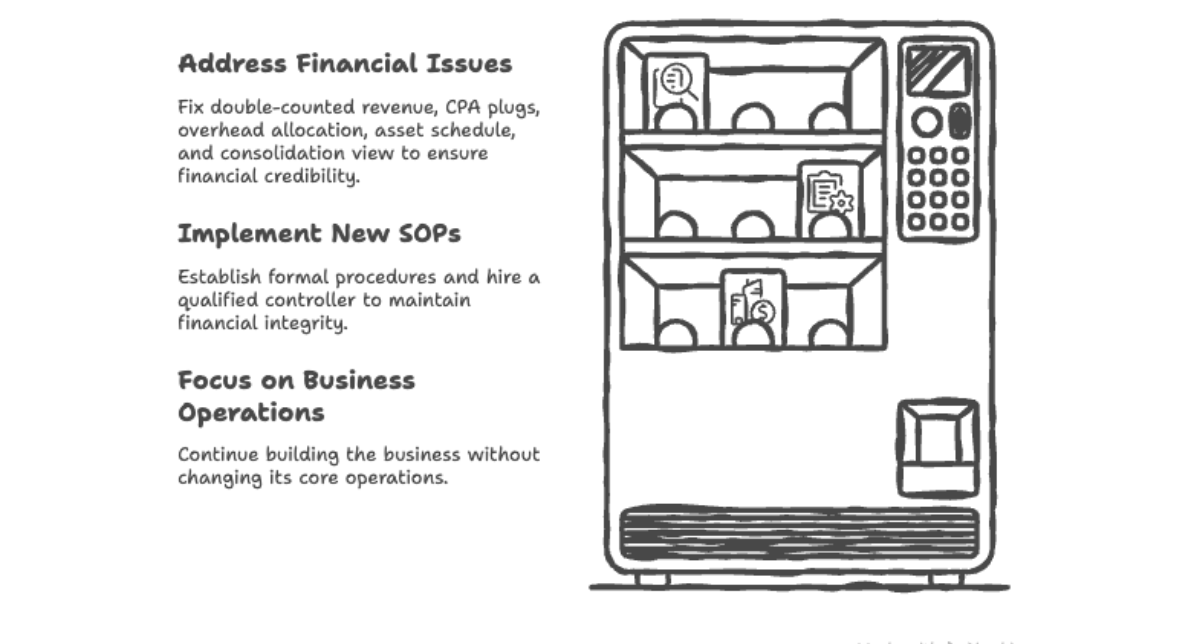
The work broke into six deliverables. We converted the books from cash and tax basis to GAAP accrual, producing financials that could actually be audited. We built an intercompany pricing structure so margin flows between the two entities were visible and defensible instead of arbitrary. We built a proper overhead allocation model, roughly 40%, based on revenue weighting, so each entity’s P&L was defensible in isolation rather than distorted by where costs happened to sit. We built a fixed asset schedule internally, capturing both the GAAP asset value and a separate valuation schedule to justify the real market value of equipment the books showed as worthless. We installed and customized Syft Analytics, at roughly $23 a month, to run a semi-automated monthly consolidation across both entities. And we brought in a qualified controller, removed the tax CPA from any operational role in the books, and documented month-end close procedures as formal SOPs so the process didn’t depend on any one person’s institutional knowledge.
None of these were exotic fixes. They were foundational finance infrastructure that most founder-owned businesses simply never had a reason to build, until the day an outside party needed to trust the numbers.
The Exit Math
Cleaning up the financial architecture didn’t just remove red flags; it revealed value that had been sitting invisible in the numbers. The most sophisticated buyers weren’t just paying for recurring rental yield; they were paying for the integrated vertical, a business that builds its own assets, deploys them for income, and exits them at a gain. That’s a fundamentally different valuation story than “profitable rental company.”
The math broke into three layers. The operating business, combined EBITDA across both entities of roughly $3.4 million, with the rental entity contributing $1.8–2.0 million at 50–60% margin and the building entity contributing $1.5–1.6 million, supported a baseline valuation of $17–20 million at a 5–6x multiple. On top of that sat an asset premium of roughly $6–7 million in estimated fleet market value: tangible equipment with a proven track record of selling fully depreciated assets at significant gains. And on top of that sat a vertical integration premium, a strategic premium paid for control of the full cycle, since a builder-and-operator combination under one roof is rare, eliminates margin leakage to third parties, and gives the buyer control over procurement, upfitting, deployment, and exit. Combined, the target was $23 million or more.
The Real Lesson
The work we did on this engagement didn’t change the underlying business. The equipment was the same equipment. The customers were the same customers. What changed was what the business could say about itself, and what a buyer was willing to pay for it.
Investors and buyers who walk away from a deal, or come back with a lower number, are almost never responding to a single bad number. They’re responding to a story that collapsed under scrutiny.
Fix the story before someone else finds the cracks in it, and the same business is worth meaningfully more.
FAQ
How common are problems like these in founder-owned businesses preparing to sell?
Very common, and this case wasn’t an outlier; it’s closer to the norm. Founder-owned businesses grow for years without needing to present their books to an outside party, so financial infrastructure gaps accumulate quietly. The good news is that, as in this case, they’re almost always fixable without any fraud involved.
How long does this kind of remediation take before a business is truly sale-ready?
Proper preparation typically takes 12 to 24 months. The business needs time to demonstrate clean, consistent performance under the new financial infrastructure, a single clean quarter isn’t enough to convince a sophisticated buyer that the fix is durable.
Could this business have found these problems on its own without outside help?
In practice, no, that’s exactly why they went unnoticed for years. The owner and internal team were focused on running the business, and the external CPA was focused on tax compliance, not on whether the books would survive institutional buyer scrutiny. It took someone who has sat on both the investor side and the operating CFO side to know what a diligence team would find and fix it before they did.

is the Founder of CFOPro+Analytics, providing fractionalCFO services to growth-stage companies. Based in New York, he leverages over 24 years of experience in venture capital and strategic finance to help entrepreneurs master cash flow, unit economics, and equity value creation through data-driven financial clarity.
Assess your CFO needs in 5-minutes