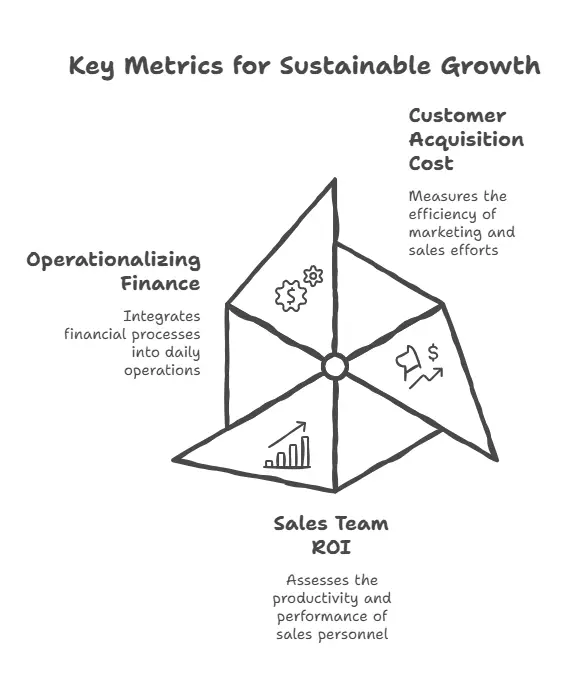
Customer Acquisition Cost, Sales Team ROI, and Operationalizing Finance
in Interviews, Cash Flow Management, CFO Pro+Analytics, Fractional CFO Services, Outsourced CFO services, All Posts
Salvatore Tirabassi, Founder and Managing Director of CFO Pro+Analytics, joins host James Kennedy on the Gross Profit Podcast to break down how founder-led businesses can turn financial data into operational decisions — from sizing customer acquisition cost to identifying which sales reps to keep, train, or let go.
Table of Contents
James Kennedy: When you say bootstrap entrepreneurs… if you’re doing 50 or 60 million bootstrapped, life is pretty good, so why would you want to get the bankers involved?
Salvatore Tirabassi: They’re usually thinking about growing faster… they wake up one day and realize, “Can I actually get this to 100 million of revenue?” And they have that epiphany moment where they’re like, “Well, what got me here isn’t going to get me there. I need more advice and talent around me to help guide the ship.” Strategic finance has to include strategic CFO services — advising the CEO and being their partner in driving the business with all the financial data connected to operations so they can make the best decisions.
James Kennedy: What did you learn [from private equity] that you still use today?
Salvatore Tirabassi: It’s really two fundamental things… due diligence readiness and a value creation plan. Due diligence readiness means you’ve got a finance operation that really understands the whole business with analytical detail… so at any given moment you can put together the materials needed to explain the story to a third party in a clean and efficient way. The value creation plan is where you’re talking to the executive leadership team about how you’re creating value in this business, why you can create value, and what the strategy is going to be.
James Kennedy: Value creation — would that instantiate to a certain profit margin or an enterprise value?
Salvatore Tirabassi: I think of it like a layered upside-down wedding cake. You’ve got the P&L from top to bottom — revenue, service delivery, operating expenses, financing costs, taxes — and to have something left at the bottom, the top has to be relatively wide. Each layer has metrics associated with it. If your lifetime revenue is four times your customer acquisition cost, you’ve got a great head start to trickle that money down to make money at the bottom… but if you’re at two-to-one, more and more components of the income statement start to matter.
James Kennedy: How do you operationalize that? Do you use a benchmark to determine what your payback period should be?
Salvatore Tirabassi: Typically what we do is look at what’s happened in the past and gather the data to figure out what the actual lifetime value of the customer is right now. Your customer acquisition historically… may range from $100 to $400. You want to triage and understand: when it was $400, why did that happen? …When you actually know what you’re targeting, you can quickly evaluate any new channel.
James Kennedy: You’ve got a story about a client where you brought insight into how their sales team was actually operating.
Salvatore Tirabassi: What we did was rank all the salespeople by conversion rate… and put them into a four-quadrant.
-
Top Right: High conversion and high talk time — those are your winners.
-
High Talk/Low Conversion: Those people you nurture with training.
-
Low Talk/High Conversion: I called those the “lottery tickets.” Ride herd on them to see if it’s pure skill or luck.
-
Bottom Quadrant: Low talk time and low conversion — there’s really no decision to be made.
James Kennedy: What’s your approach to looking at operational spend and overhead?
Salvatore Tirabassi: I focus the teams on… breaking down large IT concepts into versions of success that are much quicker. If you want to do a NetSuite upgrade… is there a way to achieve certain wins relatively quickly without delaying overall implementation for every single bell and whistle? I keep people focused on what I call quick wins.
Salvatore Tirabassi: My second rule of thumb: I’ve never really seen a business get hurt in the short to medium term by delaying OPEX. I always remind people — you’ve gotten this far without it. How soon do you really need it? Engineering is a different example — there you can feel pain right away… but many things don’t fit that mold, and the pessimist in the room can just say, “If you never did this, what would happen?”
James Kennedy: What makes you able to scale to the level you have versus someone else?
Salvatore Tirabassi: I always adopt an approach of giving people my best honest advice. From a networking standpoint… that giving of information is something people remember and attach to. So when I show up with this product… people remember me for giving them some small smart contribution.
James Kennedy: What’s the best way for listeners to reach you?
Salvatore Tirabassi: You can find me on LinkedIn — Salvatore Tirabassi… or you can go to my website, cfoproanalytics.com.

Salvatore Tirabassi is the Founder of CFOPro+Analytics, providing fractional CFO services to growth-stage companies. Based in New York, he leverages over 24 years of experience in venture capital and strategic finance to help entrepreneurs master cash flow, unit economics, and equity value creation through data-driven financial clarity.
