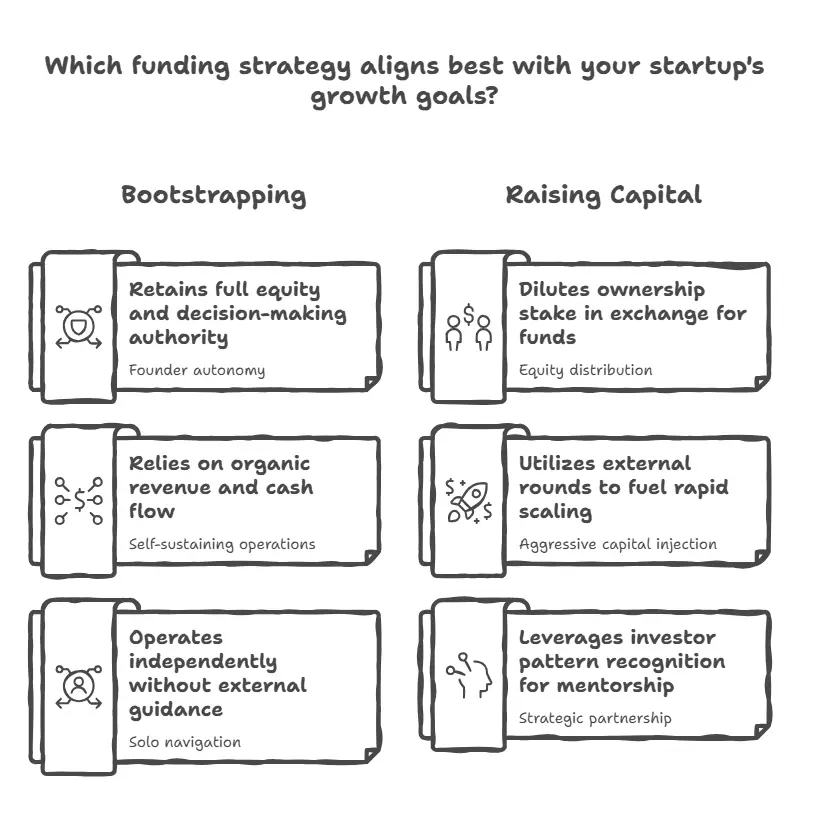
Bootstrapping vs. Raising Capital, Round Sizing, and Investor Pattern Recognition
in Strategy, CFO Services, Finance, Fractional CFO, All Posts
Salvatore Tirabassi, Founder and Managing Director of CFO Pro+Analytics, joins hosts Anthony Franco and Chris Franks on How To Founder to settle one of the messiest decisions in early-stage business: should you take outside money, and if so, how much, when, and from whom?Table of Contents
Anthony Franco: Why should I, as a founder, care? If I can raise money, I just raise it, right?
Salvatore Tirabassi: There’s a phrase in venture capital… if the capital’s available, you might as well take it, and take more if you can. Obviously, you balance that with the price and cost—dilution on the equity side or aggressive payment terms on the debt side. If someone’s putting a deal in front of you and they could be a good partner, you have to take it very seriously.
Anthony Franco: I think the list of why you should raise capital is a lot shorter than why you shouldn’t. Less than 1% of startups shostartupout and raise capital. We’ve seen really great bootstrap companies get completely ruined by capital.
Chris Franks: What are the criteria where a founder company should seek capital?
Salvatore Tirabassi: If you are on an express lane to product-market fit… you could self-finance your customer acquisition costs and bootstrap. If you’re not—either you’re far away from product-market fit, or it’s just a long sales cycle—then you need to think about how you’re going to fund it. Also, if you’re a product person, not a revenue person, you’ll need money to hire that revenue person while you learn.
Chris Franks: Speed is one. Sales cycle is another. I’ll add a third—capital-intensive businesses, like medical devices where you need to pay for prototyping.
Chris Franks: How much capital do you need to raise?
Salvatore Tirabassi: Regardless of stage, you should have a budget for how much and how long things are going to take, and then add 100%. Just double it. You don’t want to hit the market with a number that’s too low or too high; you lose credibility if an investor thinks you really need five million but you’re only asking for two.
Chris Franks: Founders never say, “I really need you to punch up my expense side.” But it’s critical to understand what you’re spending 18 to 24 months out. You can’t just guess that a VP of sales will work for $36,000 a year.
Salvatore Tirabassi: Yes. I have a calculator on my website that does forward dilution analysis for founders. You can put in valuations through Series D to see the dilution over time. It helps you level-set: is it enough money, and what will the business be worth in the next round?
Salvatore Tirabassi:
-
Pre-Seed: Have an MVP in the hands of three to five legitimate beta users who are real potential buyers.
-
Seed: Demonstrate product-market fit by selling to someone who wasn’t part of your initial trial group at near full price.
-
Series A: You’re looking for the mechanics of a P&L that’s actually working.
Anthony Franco: I’ve seen companies raise pre-revenue, then they get traction and their valuation drops because now they’re being measured on revenue instead of imagination.
Salvatore Tirabassi: It boils down to the credibility of the story. You need a large market opportunity and a viable product. Investors will look at who else got funded in the space and how far behind you are. It’s rare to be truly unique—and if you are, people might not believe it’s a real thing.
Chris Franks: Is it fair to say founders should derisk the investment to stay in the driver’s seat?
Salvatore Tirabassi: Yes, but capital raising takes time. You should run parallel paths—maintain your presence in the investment community while you do the product-market fit. If you wait until you’re running on fumes, you won’t have the luxury of time to get the message out.
Salvatore Tirabassi: Early-stage investors spread their bets looking for a few winners. If you fall out of that “top tier” of their portfolio, you’re going to get less attention because they have to focus on the deals that will pay back huge. When things go sideways, junior investors or “money people” may struggle to help you out of the hole.
Chris Franks: Where can people find out more about you?
Salvatore Tirabassi: Visit us at cfoproanalytics.com. We provide full-stack CFO services in a permanent part-time package. I also have a blog on Substack where I distill complex financial topics for general audiences.

Salvatore Tirabassi is the Founder of CFOPro+Analytics, providing fractional CFO services to growth-stage companies. Based in New York, he leverages over 24 years of experience inNew York capital and strategic finance to help entrepreneurs master cash flow, unit economics, and equity value creation through data-driven financial clarity.
Assess your CFO needs in 5-minutes
For more on this topic, read our preparing for SaaS fundraising with metrics and reporting and financial red flags in early-stage SaaS companies.