The Fundraising Moat: How to Defend Your Valuation When Anyone Can Build
in Fractional CFO, Capital Efficiency, Distribution Strategy, Financial Leadership, Fundraising, Mergers and Acquisitions, Proprietary Data, Startup Valuation, All Posts
AI has changed what it means to build a defensible company. Software features that once required years of engineering can now be replicated in weeks—or sometimes a weekend. For founders preparing to raise capital, the central question is no longer simply how quickly the team can ship. It is how difficult the business is to replace.
This is the fundraising moat: the set of structural advantages that protects a company’s valuation when competitors can reproduce its visible product features. The strongest moats increasingly come from proprietary data, distribution, customer trust, workflow integration, and disciplined use of capital.
Key takeaway: AI is making software features faster and cheaper to copy. To defend valuation, founders need durable advantages that improve with customer usage, deepen relationships, and produce better outcomes without requiring unsustainable spending. A CFO’s role is to make sure each dollar invested strengthens those advantages rather than funding features a competitor can easily replicate.
The feature moat is becoming fragile
In the previous decade, code could function as a fortress. A company with 50 engineers working for two years often had a meaningful head start that was difficult for a smaller competitor to overcome.
That advantage has narrowed. AI-assisted development has reduced the time and cost required to build polished interfaces, automate workflows, connect APIs, and reproduce common product functionality. A feature can still create short-term differentiation, but it is increasingly dangerous to treat a feature set as the primary reason an investor should assign a premium valuation.
Investors are asking a harder question: What remains valuable if another company can reproduce the product experience quickly?
| Fragile advantage | More defensible alternative | Why it matters |
|---|---|---|
| Feature set | Proprietary data loops | AI can copy a user interface, but it cannot instantly recreate unique customer-generated data and the learning built from it. |
| First-mover advantage | Distribution and trust | Being first matters less when a fast follower has a stronger relationship with the buyer or channel. |
| Technical complexity | Capital-efficient execution | Complexity can become a liability if it raises burn without producing durable customer or financial advantages. |
What is a fundraising moat?
A fundraising moat is a measurable business advantage that makes a company harder to displace and gives investors confidence that future growth will not be competed away immediately. It is not one feature, patent, or clever technical implementation. It is the combination of assets and operating capabilities that improve retention, pricing power, distribution, data quality, or capital efficiency over time.
For a startup, a credible moat should answer three questions:
- What becomes stronger as the company serves more customers?
- Why would a customer stay rather than switch to a cheaper substitute?
- How does each dollar of investment increase the company’s long-term value?
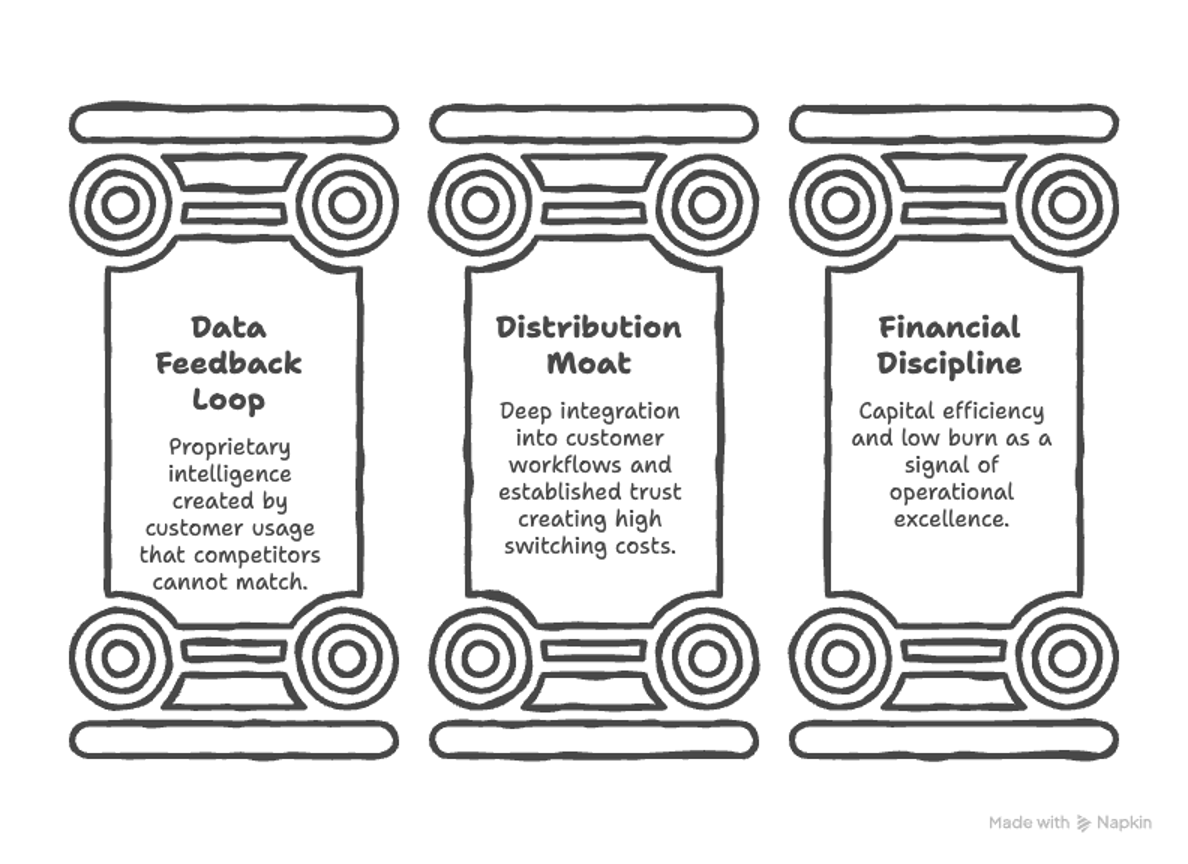
Three pillars of a defensible fundraising moat
1. Build a proprietary data feedback loop
Your software may be the container, but the data generated through customer usage can become the more valuable asset. If each interaction makes the product smarter, faster, more accurate, or more efficient—and that improvement is proprietary to your company—you are building a compounding advantage.
Investors want to see a genuine flywheel, not simply a claim that the company uses AI. A strong data loop has a clear sequence:
- Customers use the product in a meaningful workflow.
- The product captures unique, permissioned data or feedback.
- The data improves recommendations, automation, or outcomes.
- Better outcomes increase retention, usage, or willingness to pay.
- More usage creates additional data that competitors cannot immediately reproduce.
The CFO should help management measure whether this loop is actually improving retention, gross margin, time to value, conversion, or expansion revenue. Data is only a moat when it produces a business result.
2. Own distribution, trust, and workflow integration
First-rate distribution can beat a second-rate product because customers do not buy software in a vacuum. They buy from relationships, channels, communities, partners, and brands they trust.
If your company owns the relationship with a CFO, head of operations, or another critical buyer—and your product is deeply integrated into that customer’s workflow—the relationship and switching friction can be more defensible than the code itself.
Useful indicators of a distribution moat include:
- High-quality, repeatable customer acquisition channels
- Strong referral or partner contribution
- Low churn among embedded customers
- Expansion revenue from existing accounts
- Workflow integrations that make replacement disruptive
- Customer trust supported by reliable service and clear outcomes
Distribution must be measured, not merely described. Track channel-level CAC, conversion rates, sales-cycle length, retention, payback period, and the percentage of new business generated through repeatable sources.
3. Turn financial discipline into a strategic advantage
In an “Anyone Can Build” market, capital efficiency becomes part of the product strategy. A founder who uses AI to keep burn low while maintaining high output can create more enterprise value per dollar than a competitor that spends heavily to build similar functionality.
Capital efficiency does not mean starving the business of investment. It means allocating capital toward the assets that are hardest to copy: customer acquisition systems, proprietary data, trusted relationships, operational know-how, and measurable product outcomes.
Key metrics include:
- Burn multiple
- Gross margin and contribution margin
- CAC payback period
- Net revenue retention
- Revenue per employee
- Runway under base, upside, and downside scenarios
- Return on incremental product and go-to-market spend
Founders can strengthen their investor narrative by connecting product investment to these metrics. “We built more features” is a weak fundraising argument. “This investment reduced implementation time, increased retention, and improved gross margin” is a defensibility argument.
The CFO’s role in building defensibility
Defensibility is no longer only a product conversation. It is also a P&L, cash-flow, and capital-allocation conversation. A strategic CFO should challenge the team to distinguish between activity and durable enterprise value.
Before approving a major product or growth investment, ask:
- What is the expected return if a competitor can reproduce this feature in a weekend?
- Are we building a product, or are we building a proprietary data asset?
- Does this investment improve retention, pricing power, distribution, or unit economics?
- How would our economics change if a low-cost or zero-cost alternative entered the market?
- What evidence will we show investors that this advantage compounds over time?
These questions turn the CFO from a reporting function into a strategic partner in the company’s fundraising narrative. They also help prevent a common failure mode: spending heavily on visible product activity while underinvesting in the less glamorous systems that make the business durable.
How to present your moat to investors
A strong fundraising narrative should make the moat concrete. Avoid vague statements such as “our technology is difficult to replicate” unless you can explain exactly why.
Instead, show:
- The unique data or insight created by customer usage
- The measurable improvement in outcomes as usage grows
- The channels that produce efficient, repeatable growth
- The workflow or relationship costs associated with switching
- The unit-economic evidence that capital is being converted into durable value
- The roadmap for making the moat stronger over the next 12 to 24 months
This is where a rigorous fundraising and investor-readiness process can help. Investors are not only evaluating the product; they are evaluating whether the company understands how value is created, measured, and protected.
The bottom line
The “Anyone Can Build” era is not automatically a threat. It is a test of whether a company’s value exists beyond its code.
Stop selling features as if they are permanent assets. Start showing how your business compounds through proprietary data, trusted distribution, embedded customer relationships, and capital-efficient execution. The fastest builder may win attention, but the company that is hardest to replace is more likely to defend its valuation.
Your code may be a commodity. Your customer relationships, proprietary data, and financial discipline can become your fortress.
For founders preparing for a financing round, a strategic financial model should connect the moat to operating metrics, cash needs, and valuation scenarios. Companies that need broader support can also explore fractional CFO services for scalable growth.
Frequently asked questions
Are product features still a competitive advantage in the AI era?
Features can create short-term differentiation, but AI is making many features faster and cheaper to replicate. More durable advantages usually come from proprietary data, customer relationships, distribution, trust, workflow integration, and capital-efficient execution.
How can a startup build a defensible moat?
Start by creating a data feedback loop, building repeatable distribution, earning customer trust, integrating deeply into important workflows, and measuring whether each investment improves retention, pricing power, unit economics, or operating leverage.
What role does a CFO play in building a fundraising moat?
A CFO helps founders evaluate whether product and growth investments create lasting enterprise value or simply add features competitors can copy. The CFO connects defensibility to cash flow, unit economics, scenario planning, and the evidence investors need to support a valuation.
What should founders include in a moat section of a pitch deck?
Include the specific data, distribution, workflow integration, customer trust, and financial evidence that make the company difficult to replace. Quantify the improvement over time and explain why a competitor cannot reproduce the advantage quickly with the same tools.
Does capital efficiency matter to investors when AI lowers development costs?
Yes. Lower development costs make disciplined capital allocation more important, not less. Investors want to see that the company converts spending into durable customer value, efficient growth, stronger margins, and a moat that compounds.