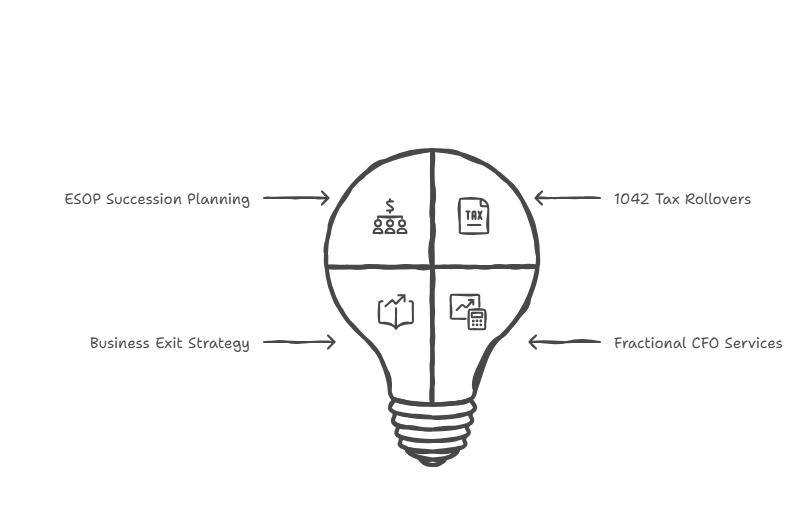
ESOP Succession Planning, 1042 Tax Rollovers, and Business Exit Strategy
in Strategy, CFO Services, Finance, Fractional CFO, All Posts
On The Agent of Wealth podcast, Salvatore Tirabassi walks through how Employee Stock Ownership Plans (ESOPs) work end-to-end — from selecting a trustee and banker to seller notes and warrants and the powerful 1042 tax exchange — and explains when an ESOP makes more sense than selling to private equity.
Table of Contents
What an ESOP is and how it works
Marc Bautis: Welcome back to The Agent of Wealth. This is your host, Marc Bautis. Today, we are diving into a topic that is often overlooked by business owners — Employee Stock Ownership Plans, or ESOPs — and how they can serve as a tax-efficient, wealth-preserving exit strategy. Joining me is Salvatore Tirabassi, a Fractional CFO with extensive experience in private equity, exit planning, and succession strategies.
Over his 24-plus years in finance, he has worked in venture capital, private equity, and as a CFO of a high-growth company. He has personally guided a $242 million business sale through both ESOP and private equity processes. Through his firm, CFO Pro+Analytics, he provides virtual and fractional CFO services. Salvatore, welcome to the show.
Salvatore Tirabassi: Thanks for having me.
Marc Bautis: Before we dive into ESOPs, share a little about your career background.
Salvatore Tirabassi: I started my career as a strategic marketing consultant working with Global 1000 companies on corporate marketing and brand strategies. Then, I went to business school and grad school for engineering. I came out the other side and became a venture capitalist during the early stages of the internet trend in 1999. I went through the internet bubble burst and did a lot of restructurings.
I then left that partnership and joined a growth equity partnership. Over that period, I developed a lot of expertise in emerging company financing, restructuring businesses, raising debt, and SaaS-typSaaSd recurring-revenue business models. After that, I became a CFO of a consumer services company focused on the finance space.
In early 2024, I started this business where I took all of my know-how from private equity and building a full CFO function in a high-growth company and packaged it in a way that can be customized to the differences across the emerging businesses I work with. No two companies are the same. We build a customized service to give them a very high-functioning, high-quality strategic finance service that can carry thearror a long period of time as they grow and evolve.
Marc Bautis: Can you give the listeners an explanation of what an ESOP actually is and how it works?
Salvatore Tirabassi: An ESOP is basically an exit transaction for the owners of a business. It can be partial or 100%. It allows the owners to sell the equity in the business to a trust that is owned by the plan participants — essentially the employees. A big question is: “Well, the employees do not have the money to buy the business.” The way this is structured is that there is external financing that creates some liquidity, or complete liquidity, for the selling shareholders. The trust builds ownership in the business over time, so they do not actually have to put money into the deal to get the transaction done.
A few important things: the structure is generally regulated by the Department of Labor. ERISA regulations also apply. The trust is basically like a single-company 401(k). When employees get their ownership, it is in the form of a retirement trust, but instead of a 401(k) where you can invest in a bunch of different stocks, in this one, you are given the shares — you do not pay for them. They are shares in the company where you work. The idea is that employees build up an ownership stake in the business over time that eventually gets monetized for retirement.
When to start planning an ESOP exit
Marc Bautis: Let us say I am a business owner and I have a five-year plan. Is that a normal time to start planning, or does this need to be planned over even longer?
Salvatore Tirabassi: As a CFO, what I always tell my clients is if you are planning to transact, you probably want to be planning about two years in advance. Things change a lot over a two-year period, so it could become a rolling two-year period if things go sideways.
For an ESOP — or if you were just going to sell to private equity — start thinking about it two years before you actually need to do it, and you are really going into overdrive on it about a year out. You want to be picking a banker to handle the transaction for you about a year in advance. In the ESOP world, there are bankers who specialize in those transactions because they help you pick the trustee who is going to be representing the employees, and they put together the debt financing that becomes the liquidity in the transaction. They are two totally different types of transactions, but either way, you need to be two years in advance with an advisor working with you.
Building the ESOP team: trustee, banker, attorney
Marc Bautis: Two years out, do I go to the employees and say, “I am exiting, would you like to participate in an ESOP?”
Salvatore Tirabassi: What ends up happening is you appoint an employee who is acting as an employee representative to actually hire the trustee. The owners of the business are not going to hire the trustee because the trustee is not representing the owners — it is representing the employees. So, an employee inside the business, or a team, can be assigned to go out into the market, interview a bunch of trustees, and pick one you like. That takes time.
You are two years out, and you also want to be selecting an ESOP banker who can help get the transaction together and find the debt financing. The banker will also help you hire a law firm that will advise you along the way. You want to pick a law firm with expertise in this type of transaction because there are many aspects related to ERISA, retirement, and Department of Labor regulations. A lawyer who has not done it before is going to need to do a lot of learning on your dime, so you are better off paying for someone who has done it a few times before.
How shares move from owner to trust to employees
Marc Bautis: What happens next? How do I get ownership into that ESOP plan?
Salvatore Tirabassi: Now the trustee is your counterparty in the transaction. They are negotiating against you to determine a value of what the business is worth so they can put a value on it for the trust. You will go through a due diligence process the same way you would with a private equity fund. They will hire a valuation firm to come in and review your projections, your financial results, and identify any risks in the business, and they will give you a term sheet with a price. You negotiate, get all your deal terms set up, and you have agreed on a transaction.
Now you sell your shares to the trust. As a seller, you are going to get seller notes that sit on the balance sheet of the company, plus warrant coverage in the business that allows you to participate in the upside but also compensates you because your seller notes are going to be at a very low interest rate. The trust now owns all the common equity. None of it is in the hands of employees at this point — it is just sitting in limbo in a holding account inside the trust. The sellers have gotten seller notes plus warrants. They are out of the equity structure. They own notes that are owed to them, and if the company ever gets sold in the future and those warrants are worth something, they will also get paid on those.
A year later, the trustee has to issue shares to employees. They bring in the valuation company again, value the business, and based on the mechanics of distributing shares over a 30-year period, a certain number of shares come out of the holding account and go directly into employee accounts. So, Jane Doe may get 10 shares and John Doe may get 8 shares.
The way their shares are determined is based on their percentage of wages as a percentage of the total wages of the business, capped at $280,000. The cap follows the same rules as 401(k) plans — this is where ERISA comes in. ERISA always has these fairness rules: anything you make above this amount does not count for your retirement benefit. The thresholds are the same for all retirement programs governed by ERISA. Once shares are in their account, those shares can have vesting terms — that is all determined at the beginning of the process. Once they are vested, they are owned by the employee and they sit there until retirement age.
Seller notes, warrants, and how owners get paid
Marc Bautis: How do the sellers actually get the proceeds? Is that where the debt financing comes in?
Salvatore Tirabassi: The trust owns this holding pen of shares, and the seller now has seller notes and warrants. There is nothing stopping the company from going to a bank and saying, “I would like to get a senior debt security in here,” or going to a private lender and bringing some debt into the business. This is where the ESOP investment banker helps you.
Let us say you sold the company to the ESOP for $100 million. You have $100 million of seller notes plus warrants. The bank comes in and says, “You are doing $25 million a year of EBITDA. I will lend you two turns of debt on that.” So, they will lend you $50 million — a reasonable risk for a bank, two turns of leverage on $25 million of EBITDA. They put $50 million in and you can pay down the seller notes within days after closing.
Marc Bautis: What are usually the terms of the seller notes — five years, 10 years?
Salvatore Tirabassi: They are 30 years. They are tied to the same schedule as the share distribution, so they are working in sync. The employee shareholders are gaining shares on a slow drip, and the seller notes’ amortization is also on a slow drip. The seller notes can also stay frozen and never amortize. The only way you amortize them is with new capital coming into the business, or if the company makes a lot of profit and uses that profit to pay down the seller notes.
Tax benefits: the 1042 exchange and tax-free corporate profits
Marc Bautis: From the employee side, what is the tax consequence of this?
Salvatore Tirabassi: From the employee side, there is no tax consequence upfront. When they take the money out, it gets taxed the way your normal distributions from your 401(k) would get taxed — as ordinary income.
The tax benefits to the company and the selling shareholders are pretty important. The selling shareholders, when they receive their proceeds, can do what is called a 1042 exchange. It is similar to how people roll over real estate gains into new investments to defer the capital gains — like a 1031 exchange — except you can only roll it over once. As long as you are investing in a U.S. C-corp, you can take your proceeds and buy.
Let us say you sold the company for $30 million. You can go to Morgan Stanley or Fidelity and say, “I want to buy $10 million of Apple stock.” That counts as a rollover for the owners. An interesting aspect: if you go to Morgan Stanley and say, “I want to buy $10 million of Apple stock,” they are actually going to give you margin on that. So, you do not have to invest the full $10 million to get the rollover protection. You can just invest the equity piece you need, and Morgan Stanley will lend you the rest. All the money left over is free to use for other stuff, and you have covered yourself for the tax deferral. Then, five years later, when you sell the Apple stock, you will pay capital gains.
On the company side, if you do a full acquisition by an employee trust — which is a nonprofit — they own all the equity. So, all the profit the company generates is state and federal tax-free because the owner is not taxable. New York City does not recognize that, by the way, so if you have a portion of your business in New York City, you will still end up paying New York City tax. But federally and in almost all states, you would end up being tax-free.
Let us say you are running a business making 10-15% margins on $100 million of revenue — making $15 million a year of profit — you were paying 21% to the federal government and 8% to New York State. Now all those taxes go away. You have $15 million you can reinvest in the business. That is not a dividend to the former owners — it is a dividend to the trust, or you can keep it in the business and use the capital to expand or pay down the seller notes.
This is one of the reasons ESOP legislation is popular with both Republicans and Democrats. For Republicans, it gives business owners the opportunity to have long-term capital gains deferral and tax efficiency in this business they are still running. For Democrats, it gives average employees the opportunity to become owners.
How owners fully exit a company after an ESOP
Marc Bautis: How does the owner fully get out of the business if that is their intention?
Salvatore Tirabassi: Fully exiting and relinquishing management control are two separate tracks. Getting fully paid involves three mechanisms: profit distributions that pay down the seller notes and pay down the warrants over time — that is a long-tail process. You can accelerate that with debt financing.
The third way is you can do the ESOP and then sell the whole thing to a private equity firm later on. In that instance, the trustee always negotiates an acceleration of shares coming out of the holding account, plus vesting acceleration if there is a transaction to buy the whole business. The trustee is not going to represent the employees and say, “We are going to create this trust and then you are going to sell it the next day and nobody gets anything.” They build in an acceleration of ownership in the event of an overall exit — sale to a private equity firm, acquisition by another company, or going public.
Relinquishing management control is up to the owner. You could theoretically have a parallel path where you are handing the management reins over to key people in the organization or hiring an outside CEO. Those two things do not have to be connected. The owner can become a board member investor by bringing in a team to run the business as part of that process.
In terms of governance, the original owners typically still drive things in the early years. The trust does not actually own a whole lot in the early stages — employees are gaining about 3% ownership over time. The rest is sitting in limbo in the holding account. Whatever is in the holding account gets redistributed upon a sale too, so the owners get some of that back. The board typically does not change very much after the transaction, and the trustee does not typically take a seat on the board, at least in my experience. The trustee is there to represent the interests of the employees, and that does not necessarily mean they have to sit on the board.
ESOP vs. private equity sale: pros and cons
Marc Bautis: From the owner’s perspective, why consider an ESOP versus selling out to private equity?
Salvatore Tirabassi: The equity rollover piece of it is a big deal. If you do a 100% employee ownership trust that owns 100% of the equity, and the owners do the math on it — and they are maybe interested in riding the value of the business over the long run — they can be in a position to make more money over time than they would in a private equity sale. But I would say the main driver is that you can use it as a way to diversify your wealth in a very tax-efficient way without having to sell the whole thing.
Which businesses are best suited for an ESOP
Marc Bautis: Are there any types of businesses this is best suited for — sector, industry, revenue, or number of employees?
Salvatore Tirabassi: It is a pretty expensive deal to do if you are not a decent-sized company. This is just my opinion — if you are doing $5 million or more of net income a year, it does not really matter what industry you are in. It is more an income-driven thing. Do you have a P&L profile that allows you to finance debt in your business? Ultimately, that is the liquidity the owner needs to be able to exercise the wealth diversification and turn what they own into the tax-deferred 1042 exchange.
You need profit to be able to do that. If you are a fast-growing but unprofitable software-as-a-service company, I am not sure what you get out of it — you are introducing a bunch of interest expense into your business when you could otherwise be investing in more customer acquisition. But when you are profitable and now you are shielding that profit because you are owned by an employee trust, then you can really make the money work for you.
Marc Bautis: What happens if an employee leaves the company?
Salvatore Tirabassi: There are some instances where you will get bought out involuntarily — that is really when you are a very small shareholder and you left very early. There is a way to keep the trust clean and focused on the longer-standing employees. Generally, you cannot monetize it until you are at one of the thresholds for retirement according to the federal government’s retirement ages.
Marc Bautis: That is all the questions I have for you today. Before we go, how can our listeners learn more about your business?
Salvatore Tirabassi: My website is cfoproanalytics.com. I also have a blog where I write about finance and analytics topics, which is my last name dot com — tirabassi.com. You can easily find me on LinkedIn. We do a lot of work doing strategic finance for emerging businesses, family-owned, and founder-owned businesses. ESOPs is one of the things we have expertise in, but we do many other things, and I would love to hear from your audience if anything I talked about is of interest.
Marc Bautis: Thanks again, Salvatore. And thank you to everyone who tuned in today.
Salvatore Tirabassi: Thanks for having me.

Salvatore Tirabassi is a fractional CFO and founder of CFO Pro+Analytics, helping founder-owned and family businesses build the financial infrastructure to grow, delegate, and exit on their terms.
Assess your CFO needs in 5-minutes
For more on this topic, read our fractional CFO framework for headcount planning and building a driver-based model with a fractional CFO.