
The CFO’s Paradox: Managing Risk
in Fractional CFO, CFO Services, financial planning, Fractional CFO, Fractional CFO Services, Outsourced CFO services, Roles of a Fractional CFO, Strategic Planning, All Posts

Fractional CFO > The CFO’s Paradox: Managing Risk
CFO Services, Financial Planning, Fractional CFO Services, Outsourced CFO Services, Roles of a Fractional CFO, Strategic Planning,
I’ve watched CEOs who built companies from nothing suddenly freeze when faced with decisions that would have been easy calls five years earlier. Success rewrites the rules of risk. When you’re bootstrapping, every decision feels like a calculated gamble. When you’re responsible for 200 employees and their families, every decision feels like it could bring the whole house down.
The pressure on finance leaders has only intensified. The CFO is now the chief architect of the company’s risk management framework, and the role extends well beyond reactive reporting into strategic financial risk management. CFOs are expected to deliver short-term financial performance while simultaneously preparing the business for long-term uncertainty through proactive risk management. That means cfo risk management now requires proactive, enterprise-wide leadership tied to the company’s long-term strategy. They are managing financial risks such as cost pressures, investor expectations, labor volatility, supply chain disruptions, rising interest rates, cybersecurity threats, and shifting customer behavior, often all at once. In many organizations, the CFO has become the executive responsible for effective risk management that preserves financial stability and resilience during market volatility or economic downturns.
But the companies that continue to grow through uncertainty are rarely the most conservative. They are the most deliberate.
They understand that risk management is not about avoiding mistakes. It is about building the confidence and visibility required to pursue opportunities that competitors are too hesitant to touch.
The Hidden Cost of Playing Defense
Many businesses unknowingly drift into defensive management as they scale.
The warning signs are subtle at first:
- Delaying strategic hires because cash flow “might tighten.”
- Passing on acquisitions because market conditions feel uncertain
- Underinvesting in systems and infrastructure to preserve margins
- Waiting too long to raise prices
- Holding excessive cash while competitors expand aggressively
Each decision appears rational in isolation. Together, they create organizational paralysis because leaders fail to evaluate risk by likelihood versus impact, and modern CFOs drive better risk management when they continuously score exposures instead of defaulting to avoidance.
Ironically, the attempt to eliminate risk often creates a larger risk: stagnation.
Markets rarely reward the companies that simply preserve what they have. Over time, defensive organizations lose speed, lose talent, and lose strategic positioning to competitors willing to make calculated moves while uncertainty is high.
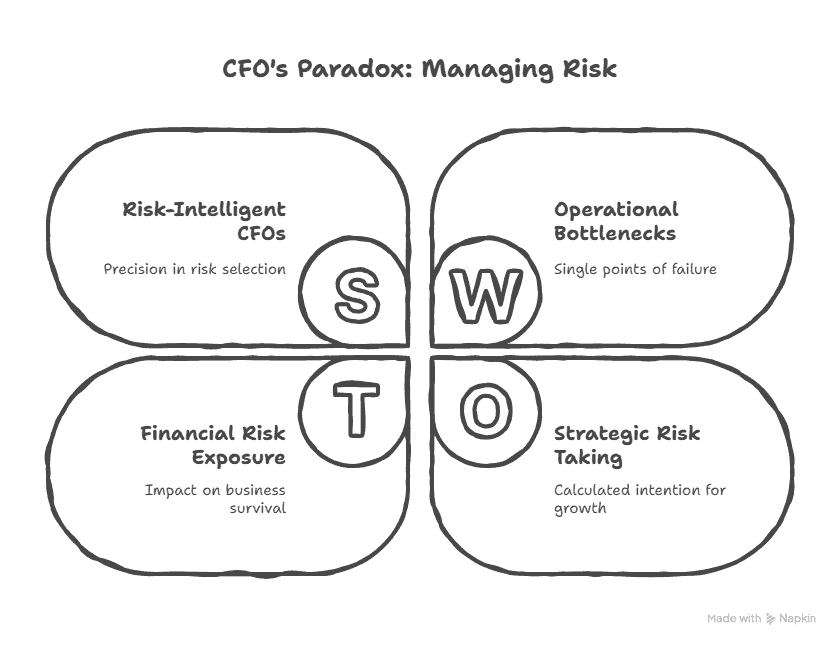
The best finance leaders recognize this dynamic early. Their goal is not to reduce all risk. Their goal is to distinguish between reckless risk and strategic risk in ways that support strategic success and align financial priorities with broader business goals through cross-functional collaboration, not finance in isolation.
That distinction changes everything. Aligning metrics and compensation structures with longer-term risk horizons encourages calculated risk-taking.
Great CFOs Build Financial Risk Management Decision-Making Systems, Not Just Controls
Modern financial risk management moves beyond older reactive oversight into a systematic framework for identifying, assessing, and mitigating risks so the business can respond quickly without creating bureaucratic paralysis. Those things matter. But mature finance organizations evolve beyond reactive oversight, with internal controls serving as a core safeguard for accuracy, fraud prevention, and disciplined execution.
The strongest CFOs create systems that improve decision quality across the business through risk identification, practical risk assessments, clear prioritization, and continuous monitoring.
That means:
- Building forecasting models that allow leadership to test multiple scenarios quickly through stress testing
- Establishing clear liquidity thresholds so the company understands liquidity risk and maintains rigorous liquidity protection as it decides how aggressively it can invest
- Identifying operational choke points before they become crises by creating early warning signals across operational, market, financial, and cybersecurity exposures
- Quantifying risks that other departments discuss emotionally
- Creating visibility that reduces fear-driven decision-making
Embedding key risk indicators and other risk indicators into the operating system helps keep risk updates tied to performance management.
This is where finance becomes strategic instead of administrative.
A CEO operating without reliable financial visibility tends to either overreact or delay decisions entirely. A CEO supported by a strong financial infrastructure can move decisively because the organization understands both the downside and the available margin for error.
The outcome is not risk elimination. It is organizational confidence.
The Best Opportunities Usually Feel Uncomfortable
Most transformative business decisions look dangerous in real time.
Entering a new market feels risky when consumer demand is shifting. Hiring ahead of revenue feels risky. Launching a new product feels risky. Investing heavily during economic uncertainty feels risky.
Yet these are often the decisions that separate market leaders from companies stuck in incremental growth cycles.
Businesses that outperform during volatile periods usually share one characteristic: they prepared before the opportunity arrived through scenario planning.
Their finance teams already understood:
- Cash flow forecasting, including dynamic forecasting for different market conditions
- Debt capacity
- Margin thresholds
- Operational scalability
- Working capital constraints
- Scenario outcomes under stress, including stress testing the balance sheet against inflation or supply chain disruptions
Because of that preparation, they could act quickly while competitors hesitated and manage market risk during market volatility.
This is one of the most misunderstood realities in business strategy: aggressive companies are often not taking more risk than everyone else. They simply understand their risk better.
Why Finance Leadership Has Changed Permanently
The modern CFO role looks fundamentally different from it did even a decade ago.
Historically, finance leaders were primarily responsible for reporting historical performance and protecting assets. In today’s digital age, that role has expanded into modern risk management, supported by FP&A software, advanced analytics, and real-time decision-making. Today, they are deeply involved in:
- Strategic planning
- Technology implementation
- Operational efficiency
- Capital allocation
- Workforce planning
- Cybersecurity oversight in coordination with IT and security teams
- Investor communication
- Enterprise risk management
In many mid-market businesses, the CFO has become the operational translator between strategy and execution.
That shift matters because modern volatility is multidimensional. Risks no longer emerge one at a time. Economic shocks, geopolitical instability, AI disruption, regulatory changes, and labor market shifts now interact simultaneously. To respond, finance teams rely on predictive analytics and continuous monitoring to detect emerging risks early and prepare for future risks before they escalate. Modern risk management also combines traditional controls with advanced technology and alternative financing options to protect the business while preserving strategic flexibility.
Industry trends and ESG issues are increasingly treated as core financial risks because they can directly affect financial performance.
Finance leaders are increasingly expected to create frameworks that allow organizations to adapt quickly without destabilizing the business.
Finance leadership now works with the CEO and board to embed financial risk management strategies into core operations.
The companies that succeed are not necessarily predicting the future more accurately. They are building systems flexible enough to survive multiple futures.
Risk Management and Risk Mitigation Should Create Optionality
The strongest balance sheets do more than protect companies during downturns. They preserve optionality through adequate financial reserves and disciplined cash flow management. They create strategic optionality.
Optionality means:
- The ability to acquire distressed competitors
- The ability to invest during downturns
- The ability to retain talent when others are cutting
- The ability to pivot quickly when markets shift
- The ability to withstand temporary mistakes without existential damage
This is the real purpose of disciplined financial management.
Optimizing receivables and payables, including faster customer payments, strengthens financial health. Liquidity risk often starts with timing gaps between inflows and outflows and should be tracked through cash flow forecasting.
Not caution for its own sake. Not endless conservatism. Not maximizing quarterly efficiency at the expense of resilience.
The purpose is to create room for intelligent action.
Companies that understand this stop viewing finance as a constraint on growth. Instead, finance becomes the mechanism that enables sustainable aggression, while technology expenses also deserve oversight because they can quietly erode liquidity and optionality. Near the end of that discipline, credit risk includes customer payment defaults or counterparties failing to meet their financial obligations, and tools such as credit insurance can reduce credit exposure.
The Companies That Win Are Usually the Ones Still Moving
Uncertainty is permanent. Volatility is permanent. Every leadership team is operating with incomplete information.
The businesses that outperform are rarely the ones that avoid uncertainty entirely. They are the ones who continue making high-quality decisions while uncertainty exists.
That requires discipline. It requires visibility. It also depends on building risk awareness across the organization. Open communication channels help teams proactively identify significant threats and emerging threats early. It requires financial infrastructure. And increasingly, it requires finance leaders capable of balancing operational realism with strategic ambition.
Crisis management should include communication protocols, resource allocation, and scenario planning for financial uncertainties, with regular review to keep risk management practices effective because this is an ongoing process. The best risk management strategies do not make companies smaller, slower, or more cautious.
They make companies confident enough to move while everyone else is waiting.
FAQ
What is strategic risk management?
Strategic risk management is the process of identifying, evaluating, and managing risks in a way that supports long-term business growth rather than simply avoiding losses. Instead of focusing only on protection and compliance, it helps companies make informed decisions about where to invest, expand, and compete.
Why are CFOs becoming more involved in business strategy?
Modern CFOs oversee far more than accounting and reporting. They now play a central role in forecasting, capital allocation, operational planning, technology investments, and enterprise risk management. As businesses face more volatility and complexity, finance leaders are increasingly responsible for helping organizations make faster, data-driven strategic decisions.
How can companies take calculated risks without overexposing the business?
The key is building strong financial visibility and operational discipline. Companies that understand their cash flow, liquidity, margins, and scenario outcomes can evaluate opportunities more confidently. Effective risk management does not eliminate uncertainty. It creates the structure needed to pursue growth opportunities while maintaining financial stability.

