How to Build a Pricing Model for Healthcare Business
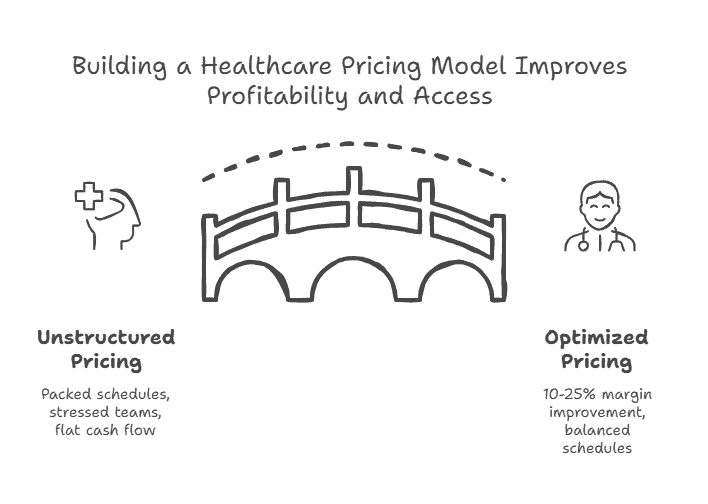
TL;DR: Most healthcare and medspa organizations still price services by “what competitors charge” or “what feels reasonable,” instead of using a structured financial model. That’s how you end up with packed schedules, stressed teams, and flat cash flow. A true pricing model starts with cost per clinical hour, capacity constraints, payer mix, and value perception, then layers in margin targets and scenario testing. Done correctly, practices typically unlock 10–25% margin improvement without adding providers or seeing more patients.
Why Healthcare & Medspa Pricing Is Usually Broken
When we come into a healthcare or medspa organization, the pricing conversation usually sounds like this:
– “We charge roughly what others in our area charge.”
– “We raised prices 5% across the board last year.”
– “We know injectables are profitable, but not exactly by how much.”
– “We can’t raise prices; patients will just go somewhere cheaper.”
Underneath that, we typically find a few structural problems:
1. No link between pricing and underlying costs. Most practices don’t know their *true* cost per treatment hour, per room hour, or per provider hour. They’re guessing.
2. No differentiation between provider types or modalities. MDs, NPs, PAs, RNs, aestheticians, and laser techs are all priced as if their time is worth the same.
3. No integration with capacity and utilization. A service that eats 90 minutes of prime-time capacity but generates less revenue than a 45-minute alternative is mispriced, even if the “margin” looks fine.
4. Payer mix and reimbursement realities are ignored. Insurance-heavy practices often anchor pricing to contracted rates instead of modeling cash-pay and hybrid structures.
5. Promotions and memberships aren’t modeled. Discounts, packages, and VIP programs get layered on top of already-weak pricing and quietly destroy margin.
A pricing model fixes this by turning intuition into a set of levers we can test, tune, and roll out deliberately.
The Five Pillars of a Healthcare Pricing Model
We build pricing models for healthcare and medspa clients around five pillars:
1. Cost Structure: What does it really cost to deliver one hour of care or one unit of treatment?
2. Capacity & Utilization: How many “sellable” hours or slots do we actually have?
3. Demand & Positioning: How does the market value what we do vs. alternatives?
4. Payer & Product Mix: Where does revenue actually come from (insurance vs cash vs membership)?
5. Margin Targets & Strategy: What profit do we need per hour, per service, and per provider?
When these five pillars lock together, pricing stops being a guess and becomes an operating system.
Step 1: Build a Cost-Per-Hour Foundation
We always start by getting brutally clear on cost per productive hour. For a given location or service line, we build:
1. Direct Clinical Labor Cost
For each provider type (MD, NP, PA, RN, aesthetician, tech), we calculate:
– Fully loaded hourly rate (salary + benefits + payroll taxes + malpractice allocation)
– Average clinical hours per week
– Nonclinical time percentage (charting, admin, meetings)
Example:
– NP compensation: $180,000 all-in
– 40 hours/week, 48 weeks/year = 1,920 hours
– 70% clinical, 30% admin
Effective clinical hours/year = 1,920 × 70% = 1,344
NP labor cost per clinical hou = $180,000 / 1,344 ≈ $134/hour
We repeat this for every provider type.
2. Facility & Overhead Cost Per Hour
We allocate:
– Rent / CAM
– Utilities
– Core admin staff (front desk, billing)
– Software (EMR, scheduling, telehealth platforms)
– Marketing
– Insurance
We divide these by total available treatment hours across all rooms.
Example:
– Overhead allocated to one site: $720,000/year
– 6 rooms × 8 hours/day × 5 days/week × 48 weeks = 11,520 room-hours
Overhead per room-hour = $720,000 / 11,520 ≈ $62/hour
3. Supply & Variable Cost Per Service
For each service, we map:
– Injectables / consumables
– Disposables & supplies
– Equipment usage (e.g., laser pulses, tip usage)
– Lab costs (if applicable)
Result: each service has a variable cost plus a time-based share of provider and overhead cost.
Step 2: Convert Cost Structure into “Cost Per Slot”
Now we combine time and cost.
For each service:
1. Service duration: e.g., 30 minutes, 45 minutes, 90 minutes
2. Provider type used: which cost per clinical hour to apply
3. Room requirement: standard vs specialized room
Example: 45-Minute Aesthetic Service
– Provider: aesthetician at $60/hour fully loaded
– Room overhead: $62/hour
– Supplies: $40 per service
– Duration: 0.75 hours
Labor cost = 0.75 × $60 = $45
Overhead cost = 0.75 × $62 = $46.50
Supplies = $40
Total cost per visit = $45 + $46.50 + $40 = $131.50
This is your floor, not your price.
Step 3: Set Margin Targets by Service Category
We rarely set a single, blanket margin target. Instead, we segment:
– Core clinical services (high trust, high value): e.g., injectables, surgeries
– Capacity fillers (shorter visits, lower intensity): e.g., follow-ups, basic skincare treatments
– Introductory / marketing services: e.g., consults, low-priced entry offers
– Premium experiences: e.g., packages, concierge, memberships
Typical target contribution margins:
– 60–70% for high-demand, branded services
– 50–60% for core bread-and-butter services
– 40–50% for filler services
– Variable for promo/intro offers, but always modeled at the cohort level
Using our earlier example:
– Cost per service = $131.50
– Target contribution margin = 60%
Required price:
$$text{Price} = frac{text{Cost}}{1 – text{Target Margin}} = frac{131.50}{1 – 0.60} approx 328.75$$
If competitors are at $249 and you’re targeting $329, that’s a strategic discussion, not an accident:
– Do we accept a lower margin?
– Do we change service design (duration, provider type, supplies)?
– Do we reposition this service as premium?
– Or do we decide this SKU doesn’t belong in the menu?
Step 4: Layer in Payer and Product Mix
For medical practices and hybrid medspas, payer mix changes everything.
We map revenue by:
Step 4: Layer in Payer and Product Mix**
For medical practices and hybrid medspas, payer mix changes everything.
We map revenue by:
– **Commercial insurance** (contracted rates, RVUs)
– **Government payers** (Medicare, Medicaid)
– **Cash-pay services**
– **Membership / subscription plans**
– **Packages and pre-paid treatments**
For each category, we track:
– **Average reimbursement per visit**
– **Denial rate & write-offs**
– **Time per visit**
– **Probability of add-on services**
Then we compare:
– Cash-pay injectables that yield $600 in 60 minutes
– vs. insurance-based visits that yield $150 in 30 minutes
One isn’t “better” by definition; we look at:
– Provider mix
– Mission & clinical goals
– Pipeline for downstream services
– Access obligations
But from a pricing perspective, we make those trade-offs consciously instead of letting payer contracts dictate the economics.
Step 5: Integrate Capacity & Provider Utilization
Even a beautiful pricing model fails if it ignores capacity.
We build:
– Provider utilization models (booked hours vs available hours)
– Prime-time vs non-prime-time slots
– Service-mix by time-of-day and day-of-week
– Bottlenecks (rooms, equipment, specific providers)
Pricing and packaging must reflect:
– What we *want* providers doing in peak hours
– What we’re willing to discount to fill valleys (slow times)
For example, we routinely:
– Increase pricing for long, low-margin services during peak hours
– Move lower-value services to mid-day or non-peak slots
– Use memberships and bundles to steer patient behavior toward underutilized capacity
Pricing becomes an instrument to shape the schedule, not just capture revenue.
Step 6: Build the Actual Pricing Workbook
The working model typically has:
Tabs / Sections
1. Assumptions
– Provider hourly costs
– Overhead per room-hour
– Target margins by service category
– Payer mix assumptions
2. Service Catalog
– Service name
– Category (core, cosmetic, intro, etc.)
– Duration
– Provider type
– Supplies cost
– Consumables per visit
3. Cost-Per-Service Engine
– Labor cost per service
– Overhead cost per service
– Supplies cost per service
– Total cost per service
4. Price & Margin Calculator
– Current price
– Modeled “should-be” price
– Current margin vs target margin
– Sensitivity table (price ±10–15%)
5. Scenario Planning
– Membership discount levels
– Promotional pricing
– New provider type mix (e.g., NP vs MD for certain procedures)
– Wage inflation or rent increases
6. Roll-Up Views
– Revenue and margin by service
– By provider
– By location
– By payer type
We want a model where you can change one assumption (e.g., labor cost +5%) and see the effect on every service.
Step 7: Test Pricing Changes Before You Roll Them Out
We rarely implement the “model price” on day one.
Instead, we:
1. Pilot by provider or room
– One NP or one room uses updated pricing
– Compare booking rates, conversion, and rebooking
2. Pilot by location
– Test in one site before rolling out to all
3. Test by service category
– Start with cosmetic or cash-pay services
– Avoid immediate changes to high-sensitivity services
4. Track KPIs tightly
– Booking conversion rate
– Average revenue per visit
– Provider revenue per hour
– Visit volume changes
– Patient satisfaction & feedback
If the model is right, we typically see:
– Slightly fewer visits for some services
– Higher revenue per visit
– Better provider revenue per hour
– More capacity to serve high-value demand
Step 8: Connect Pricing to Memberships, Packages & Promotions
Pricing doesn’t live in isolation; it sits inside your offer architecture.
We model:
– Memberships
– Monthly fee
– Included services
– Discounts on add-ons
– Expected usage and “breakage”
– Packages / Bundles
– Number of sessions
– Time-to-use period
– Discount vs a la carte
– Cash flow timing (prepaid vs pay-as-you-go)
– Promotions
– Depth and duration
– Incremental volume needed to maintain margin
– Impact on provider capacity
The rule we enforce:
No membership, package, or promo without passing through the pricing model first.
Common Pricing Mistakes We See in Healthcare & Medspas
We see the same patterns across practices:
1. Flat % price increases across the board
– Underpriced services remain underpriced
– Overpriced services become harder to sell
– The underlying structure never improves
2. Ignoring provider differences
– An MD and an RN performing the same service at the same price often yield wildly different economics.
3. Underpricing time-intensive services
– Long consults, complex procedures, or multi-step treatments that chew up prime time for low revenue.
4. Over-discounting for “VIPs” and staff friends
– Informal discounting quietly erodes margins without being tracked.
5. Letting fear block necessary price moves
– We’ve raised prices 10–20% on key services with minimal volume impact when the underlying model was solid and positioning was clear.
Strategic Outcomes of a Real Pricing Model
When healthcare and medspa practices implement a proper pricing model, we see:
– 10–25% improvement in contribution margin at the service line level
– Improved provider revenue per hour
– Better alignment between pricing and perceived value
– Clear rationale to explain pricing to patients and staff
– A roadmap for annual price updates instead of one-off reactions
– A much stronger story for lenders, investors, or potential buyers
Pricing stops being a “one-time project” and becomes a recurring financial discipline.
FAQ
1. How often should we revisit our pricing model?
At minimum, annually, with light-touch updates mid-year if:
– Provider compensation changes materially
– Rent or overhead shifts significantly
– New services or devices are introduced
– Payer contracts or reimbursement rates change
High-growth medspas and multi-site practices often revisit quarterly on a limited scope (e.g., new services, membership tweaks).
2. Will raising prices drive patients away?
Sometimes volume drops slightly on specific services — and that’s okay if:
– Revenue per hour increases
– The mix shifts toward higher-margin services
– We actively communicate value (outcomes, safety, experience)
We’ve seen many practices raise prices 10–15% with minimal volume erosion when changes are applied thoughtfully, piloted first, and supported by staff talking points.
3. Do we need different pricing at different locations?
Often, yes.
Differences in:
– Rent and overhead
– Provider mix
– Competitive landscape
– Patient demographics and income
– Payer contracts
…can justify location-based pricing bands. We usually standardize *structure* (how we price) but allow bands around list prices, especially between urban flagship sites and secondary markets.
Further Reading
Browse more articles in the CFO Pro+Analytics Knowledge Base for in-depth financial frameworks, models, and strategies tailored to your business.
Ready to take action? Explore our Financial Modeling Services → to see how we partner with founders and operators to build financial clarity.
Related Wiki Articles
- The Financial Impact of Package Sales in Medspa Business
- Pricing Psychology in Medspa Services for Conversion
- Marketing Spend ROI for Medspas and Healthcare Clinics
Further Reading
- Build a pricing model within a complete financial management structure for healthcare
- Our Team CFO framework helps align pricing with profitability in healthcare
