When Founders Should Stop Managing Their Own Finances: The $5M Revenue Inflection Point
Every founder we meet manages their own finances until the day they realize they shouldn’t. Business owners, not just founders, often face similar challenges when trying to handle company finances without the benefit of strategic financial leadership. That moment of realization usually comes in one of three forms:
- The panicked call to their accountant because they can’t explain a $200,000 variance in their cash balance
- The investor meeting where they can’t answer basic questions about unit economics
- The strategic opportunity they can’t evaluate because they don’t actually know their cost structure
By the time founders recognize they need financial expertise, they’ve already paid a steep price:
- Lost opportunities
- Inefficient capital allocation
- Cash crises that could have been prevented
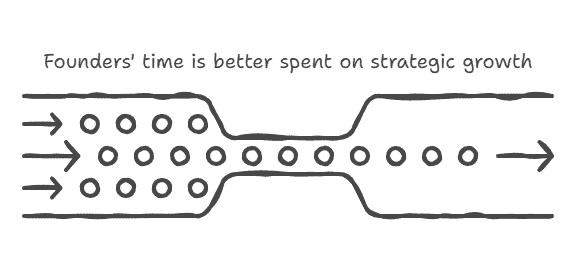
The tragedy is that these costs are invisible. You don’t see the $2M customer you couldn’t take on because you didn’t understand your capacity constraints. You don’t measure the opportunity cost of spending 15 hours weekly on financial tasks that should take a CFO 3 hours.
The question isn’t whether you need sophisticated financial management. The question is when the cost of not having it exceeds the cost of getting it. For most businesses, that inflection point arrives somewhere between $3M and $7M in annual revenue—we’ve settled on $5M as the threshold where financial complexity typically overwhelms founder capacity.
**TL;DR:** Founders should stop managing their own finances when the opportunity cost of their time exceeds the value they create in financial tasks—typically around $5M in annual revenue. At this threshold, businesses face:
- Working capital complexity
- Cash flow volatility
- Growth investment decisions
- Potential financing requirements that demand specialized finafinancial expertise>
For more on this topic, read our month-end close optimization with a fractional CFO and QuickBooks to NetSuite when to upgrade your accounting.