What are the Things to Consider Before Selling My Business?
in Finance, Fractional CFO, Financial Modeling, Fractional CFO, M&A, Mergers and Acquisitions, Roles of a Fractional CFO, Strategic Planning, All Posts

Finance > What are the Things to Consider Before Selling My Business?
FinanceStateFractional CFOM&A, Mergers and Acquisitions, Roles of a Fractional CFO, Strategic Planning. For an in-depth explanation of the roles of CFO and Controller, including their key similarities and differences, read more.
A Fractional CFO can help. Having helped numerous founders navigate successful exits while serving as both a PE partner and fractional CFO, I’ve learned that creating significant wealth through a business sale requires strategic preparation long before any buyer appears. This is where sophisticated financial leadership becomes crucial.
Many entrepreneurs, despite their expertise in running businesses, often lack experience in selling companies and may overlook key steps in the process.
Ask yourself, what are the things to consider before selling my business and who are the best advisors I can find? Obtaining a thorough business valuation and understanding the value of your assets are essential first steps. You should also prepare accurate financial statements, including profit and loss statements and balance sheets, to present to potential buyers. It is highly recommended to hire experienced professionals, such as business brokers or valuation experts, to guide you through the sale process and help ensure a successful transaction.
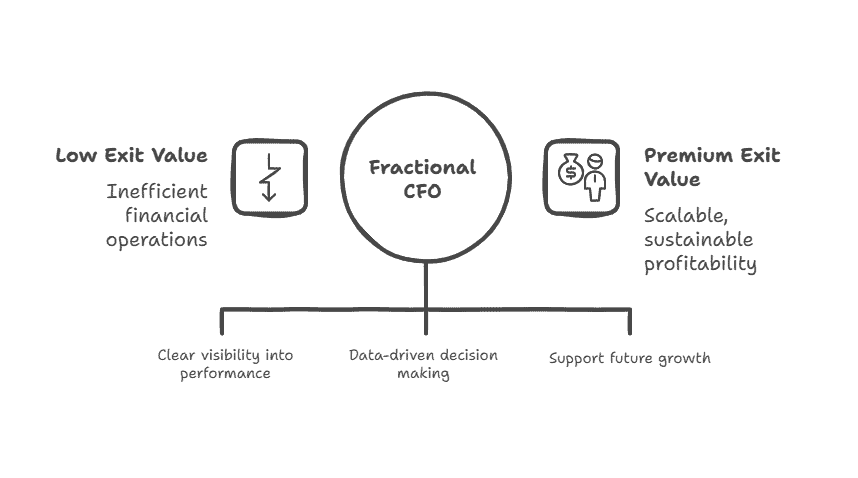
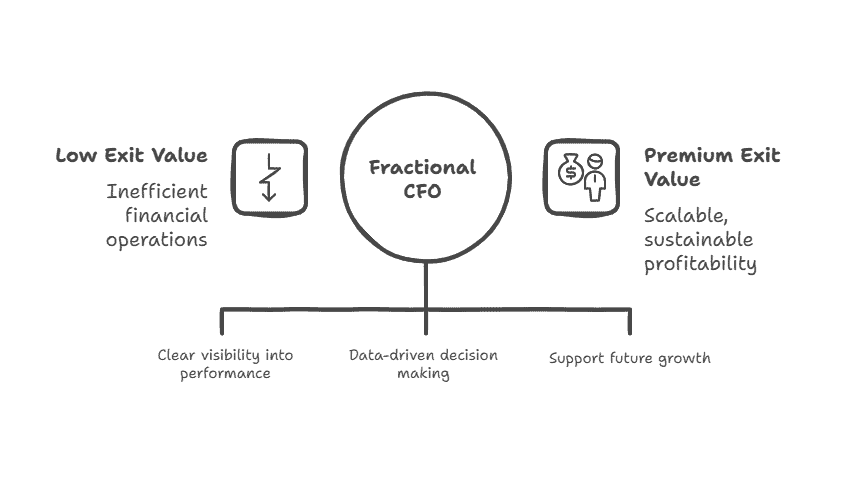
The Path to a Premium Exit
Creating substantial exit value isn’t about last-minute cleanup – it’s about building institutional-grade financial operations that demonstrate scalability and sustainable profitability. Maintaining accurate and organized financial records is essential, as these records support the business valuation process and facilitate due diligence for potential buyers. Through my work helping scale companies from $38M to $198M in revenue, I’ve seen how proper financial infrastructure directly impacts valuation multiples.
Consider a recent client: A founder-owned manufacturing business generating $15M in revenue initially struggled with basic financial visibility. The cost and risk of not having proper financial systems in place can be substantial, potentially leading to lower valuations and deal complications. By implementing sophisticated forecasting systems and operational analytics, we not only improved EBITDA by 25% but also expanded their valuation multiple from 5x to 8x EBITDA – creating millions in additional exit value. This resulted in a significant amount of money for the founder and demonstrated the benefit of thorough preparation and planning.
Building Value Through Financial Leadership
The key to maximizing exit value lies in three core areas:
First, implementing institutional-grade financial systems that provide clear visibility into business performance. Buyers pay premiums for companies they can understand and trust. Our approach to achieving 98% forecasting accuracy, for example, demonstrates the kind of predictability that commands higher multiples.
Second, optimizing operations through data-driven decision making. By managing $3M+ weekly marketing budgets using ML-driven analytics, we’ve shown how sophisticated financial leadership can dramatically improve efficiency and profitability – key drivers of valuation. It is also essential to manage inventory effectively and provide clear, up-to-date information about employees to potential buyers, ensuring transparency and smooth due diligence.
Third, building scalable infrastructure that supports future growth. Buyers pay for potential, not just current performance. Keeping all business information, financial records, and legal documentation up to date is crucial to facilitate the sale process and meet the expectations of prospective buyers. Having raised over $400M in capital across multiple ventures, I’ve learned exactly what institutional investors look for in terms of systems and processes.
Consulting with experienced professionals can help you identify the right buyer and effectively engage prospective buyers, ensuring a successful transition and maximizing value.
The Role of a Fractional CFO in Exit Strategy Planning
A strategic fractional CFO doesn’t just clean up books – they transform businesses into attractive acquisition targets. This includes:
- Implementing sophisticated financial reporting that speaks to buyers
- Building scalable systems that demonstrate growth potential
- Creating clear operational metrics that validate performance
- Developing compelling growth narratives supported by data
- Preparing comprehensive due diligence materials
- Protecting sensitive information and maintaining confidentiality, especially from competitors, by implementing robust controls and confidentiality agreements
As part of exit planning, it is crucial to develop a succession plan to ensure a smooth leadership transition and minimize disruption during ownership changes. Additionally, understanding the person behind the purchase — their motivations and fit within the business — is essential for a successful sale. During the transition, it is important to discuss expectations with key stakeholders to clarify future plans and responsibilities.
Maximizing Value Through Preparation
The difference between a good exit and a great one often comes down to preparation. A recent software company client leveraged our financial transformation methodology to:
- Improve working capital efficiency by 40%
- Implement rolling 13-week cash forecasting
- Build sophisticated unit economics tracking
- Create institutional-grade reporting packages
These steps not only improved financial performance but also helped determine the true business worth, positioning the company to achieve the highest price possible at sale.
Utilizing resources from the Small Business Administration can further support the sale process by providing guidance, tools, and advisory services tailored to small business owners.
When preparing for a sale, it is essential to negotiate the best deal, understand all fees involved (including broker commissions, legal fees, and franchise fees), ensure payment terms are clear so you get paid as agreed, and prepare for a smooth closing to finalize the transaction.
These improvements helped them secure an exit multiple two turns higher than industry average – translating to millions in additional value for the founder.
Working with a Business Broker
The reality is, most business owners approach their exit strategy the same way they approached their startup—with passion but without the systematic framework that maximizes outcomes. Consider one of my manufacturing clients who attempted a DIY sale: 18 months of market exposure, three failed negotiations, and ultimately settled for $1.2 million less than his business was worth. This is where engaging a seasoned business broker becomes transformational. In my CFO travels, I’ve witnessed brokers deliver 15-23% higher sale prices on average, while reducing time-to-close by 4-6 months through their deep market intelligence and buyer network access.
Here’s how to identify a broker who will actually move the needle on your exit: Evaluate their specific track record in your industry sector—not just total transactions, but deals within your revenue range and market vertical. The sophisticated brokers I recommend typically maintain databases of 200+ pre-qualified buyers and can demonstrate measurable results: average days on market, sale price to asking price ratios, and post-close satisfaction scores. Throughout the process, they’ll orchestrate due diligence with military precision, negotiate contract terms that protect your interests (I’ve seen brokers secure earn-out provisions worth an additional $300,000 through strategic structuring), and coordinate closing logistics that minimize operational disruption. What’s particularly fascinating is how the right broker transforms what feels like an overwhelming transaction into a systematic value-creation exercise—turning your life’s work into a strategic asset transfer that positions you for whatever comes next.
Marketing and Promotion
The reality is that most business owners approach sale marketing like they’re selling widgets instead of enterprises. In my CFO travels, I’ve seen a manufacturing client transform their $3.2 million business valuation by 47% through strategic positioning alone. Here’s what this looks like in practice: instead of generic “established business for sale” messaging, they quantified their operational excellence—23% above-industry gross margins, 89% customer retention over 36 months, and documented systems that reduced owner dependency by 60%. Their marketing materials weren’t just professional; they told a data-driven story that sophisticated buyers could validate. Consider the difference between a basic listing and a comprehensive business presentation that includes trailing twelve-month performance metrics, clearly defined growth vectors, and quantified market opportunities. The sophisticated approach creates immediate credibility with serious acquirers.
What’s particularly fascinating is how strategic networking amplifies these marketing efforts exponentially. One of my clients generated three competing offers by leveraging industry relationships rather than relying solely on broker networks. The approach: targeted outreach to 47 industry contacts resulted in 12 qualified introductions, which converted to 3 formal offers within 90 days. Result: 31% above initial asking price. This is where the real sophistication extends beyond traditional marketing channels—utilizing trade associations, peer CEO groups, and supplier relationships creates a competitive dynamic that brokers alone cannot replicate. When you combine compelling financial storytelling with strategic relationship leverage, you’re not just marketing a business for sale; you’re orchestrating a competitive acquisition process that maximizes both speed and valuation outcomes.
Negotiation and Sales Agreement
The reality is that negotiation represents the make-or-break moment in any business divestiture—I’ve watched deals worth $3.2 million collapse over a $47,000 disagreement on working capital adjustments. In my CFO travels, I’ve seen business owners enter these critical discussions woefully unprepared, lacking concrete valuation data that transforms them from price-takers into confident negotiators. Consider this: when you walk into that room armed with trailing twelve-month EBITDA of $847,000 and comparable transaction multiples ranging from 4.2x to 5.8x, you’re negotiating from a position of strategic strength rather than hopeful guesswork. The sophistication extends beyond the headline purchase price—payment terms can swing deal economics by 15-20%, and earnout provisions (properly structured with specific performance metrics) often bridge valuation gaps that would otherwise kill transactions.
Here’s how the smart money approaches the agreement phase: a comprehensive purchase and sale agreement becomes your operational blueprint for transferring $2-3 million in business value without destroying it in the process. This isn’t boilerplate documentation—I’m talking about contracts that specify everything from the $127,000 in normalized working capital to the 18-month post-closing employment agreement that ensures seamless customer transitions. What’s particularly crucial is engaging qualified legal counsel who understands business acquisitions; generic business lawyers typically lack the sophistication to structure tax-efficient asset versus stock transactions or negotiate proper indemnification baskets. Result: deals that close on schedule with both parties achieving their strategic objectives rather than drowning in post-closing disputes that can cost 10-15% of transaction value in legal fees and distraction from business operations.
Legal Considerations
The reality is that legal missteps during a business sale can cost you far more than attorney fees—I’ve seen deals collapse at the 11th hour over overlooked compliance issues that could have been resolved with proper planning. Consider this: one manufacturing client discovered environmental liability exposure worth $1.2 million just three weeks before closing, nearly derailing a $8.5 million transaction. Here’s what smart business owners understand about the legal landscape: proactive compliance isn’t just about following rules—it’s about protecting deal value and ensuring you can actually close when the time comes.
What’s particularly fascinating is how interconnected these legal considerations become during due diligence. Drafting and reviewing that sales agreement? That’s just the starting point. You’re simultaneously managing permit transfers (which can take 45-60 days in regulated industries), addressing outstanding legal obligations that buyers will demand resolution on, and navigating tax implications that directly impact your net proceeds. The sophistication extends to understanding how capital gains treatment versus ordinary income can swing your after-tax outcome by 15-20% or more. This is where early legal consultation pays compound dividends: proper structuring and documentation create a seamless ownership transfer process that actually enhances buyer confidence and, ultimately, your final sale price.
Post-Sale Planning
Consider this: In my CFO travels, I’ve witnessed business owners who pocket $3.2 million from their company sale, only to find themselves twelve months later with depleted accounts and zero strategic direction. The reality is that the transaction closing represents the beginning of a critical phase, not the end of your entrepreneurial journey. Post-sale planning becomes the differentiator between owners who multiply their success and those who watch their newfound wealth evaporate through poor allocation decisions and tax inefficiencies. Here’s what sophisticated business leaders understand: developing a comprehensive financial framework isn’t optional—it’s the foundation that transforms your business exit into sustained wealth generation, whether that involves calculated investment opportunities or launching your next venture.
What’s particularly critical is addressing the immediate operational realities while positioning for long-term advantage. Tax obligations from the sale (which can consume 20-40% of proceeds depending on your structure and timing) require proactive management, not reactive scrambling. Simultaneously, wealth management and strategic asset allocation demand the same analytical rigor you applied to your business operations. The sophistication extends to managing ongoing responsibilities—assisting the new owner during transition periods or fulfilling contractual obligations—which, when handled strategically, often create additional revenue streams or partnership opportunities. This is where engaging financial advisors, tax professionals, and specialized consultants becomes transformational: they provide the expertise to maximize your sale benefits while architecting your next chapter for sustained success, turning your business exit into a strategic advantage rather than simply a financial event.
The Time to Start is Now
Whether exit is on your immediate horizon or years away, building the financial infrastructure that commands premium valuations takes time. Having a clear exit strategy and aligning the sale with your long term goals is essential for a smooth transition and maximizing value. The sophisticated systems and processes that attract buyers must be established and proven well before any transaction discussions begin. Even small business owners can benefit from investing a little money and time to make their business more attractive to potential buyers.
For founders serious about maximizing their exit value, partnering with a fractional CFO who understands both buyer expectations and operational realities can be transformative. The right financial leadership doesn’t just prepare your business for sale – it builds the kind of sustainable value that makes buyers compete for the opportunity to acquire your company. Many past clients have shared positive experiences, highlighting the importance of referrals from satisfied clients when selling businesses.
The path to a premium exit starts with sophisticated financial leadership.
Are you building the kind of value that commands top dollar?
Realize for yourself: there are many things to consider before selling my business, and a Fractional CFO can help me figure that out.
For more insights on building exit value through strategic financial leadership, visit cfoproanalytics.com or contact our team to discuss your exit planning needs.
See Also : Maximizing Efficiency with SaaS Fractional CFO Services
See Also : Fractional CFO Services in the New York City Area
See Also : Mastering the Art of Selling Your Business

For more on this topic, read our scenario planning for retailers and CPG brand success and vendor terms how to negotiate from a financial lens.