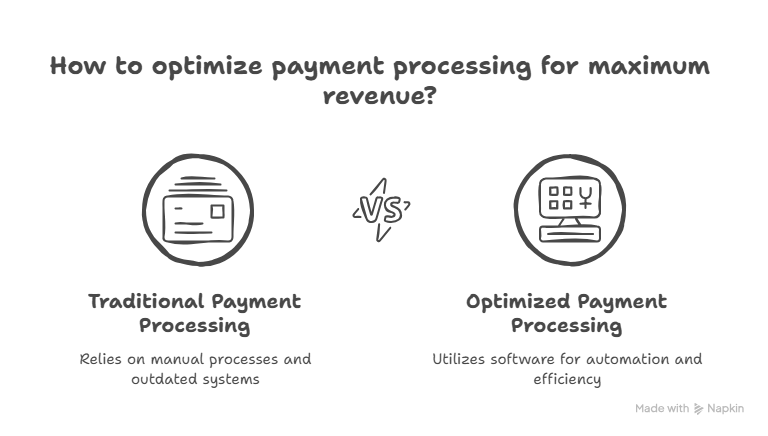
Payment Processing Optimization: How to Leverage Software to Maximize Revenue
In my years as a fractional CFO, I’ve watched promising companies hit a wall. It typically happens around the $5M ARR mark – the payment infrastructure that seemed robust at startup begins buckling under the weight of scale. For many digital businesses, these challenges are even more pronounced as they navigate the complexities of the global digital industry. Traditionally, payments have been viewed as a cost center, but it’s critical to shift perspective and recognize payments as a strategic lever for growth and operational efficiency. The symptoms are similar: finance teams drowning in reconciliation, revenue leaking through failed payments. This lost revenue from payment failures, false declines, and suboptimal processing can have a significant financial impact and hinder business growth. Customer churn climbs due to payment friction. A poor payment experience not only drives customers away but also limits international expansion and overall growth.
There are various platforms that you can use to help you. I am going to focus on a couple that I have seen in practice: sticky.io and rightrev.com.
Understanding the Breaking Point
You don’t need a CFO to tell you when your payment systems fail – your team will feel it first. In most companies I advise, the breaking point announces itself through operational chaos. Your finance team starts coming in early and leaving late just to handle basic reconciliation. Customer support tickets about failed payments pile up. Often, these failed or declined payments are due to issues such as insufficient funds or technical problems with the issuing bank. Declined transactions can be managed or recovered through automated solutions to minimize revenue loss and ensure smoother payment processing. Your churn rate creeps up, often invisibly at first, as customers quietly leave after payment friction. If you use multiple payment processors, this will happen sooner and at lower volumes of transactions, making an optimized payments setup essential to handle complexity and improve outcomes.
The most telling indicators I consistently see are:
Finance teams spend more than 15 hours weekly on payment reconciliation
Failed payment recovery rates below 65%
Monitoring payment performance helps identify trends and areas for improvement in payment success and acceptance rates.
Churn rates exceeding 5% due to payment issues (note: you should try to measure this, regardless of your reconciliation process)
Leveraging payment data can help uncover the root causes of churn and optimize payment processes.
Revenue recognition delays stretching beyond 5 days
The Financial Reality
In a typical mid-sized business processing 5,000 monthly transactions, you might see $33,000 in monthly revenue leakage from failed payments alone. That’s before we factor in the labor costs of manual processing and the lifetime value of customers lost to payment friction. Addressing these issues can result in more revenue and directly increase revenue for your business.
Here’s what transforms when you modernize your payment infrastructure. These improvements help optimize revenue by reducing payment failures and enhancing the customer experience, supporting broader revenue optimization strategies for sustainable business growth.
Immediate Impact
Your failed payment rate typically drops from 12% to 3%, while recovery rates jump from 45% to 85% by implementing retry strategies such as auto retries and auto rescue. More importantly, you free up your finance team to focus on strategic initiatives rather than payment reconciliation.
Long-term Benefits
The real value emerges in customer lifetime value. When you remove payment friction, customers stay longer, upgrade more frequently, and recommend your service more often. I’ve seen average customer lifetimes extend by 75% after implementing robust payment systems. Optimizing payments not only fosters customer loyalty but also enhances the overall customer journey, which ultimately drives sustained business growth.
A Strategic Approach to Implementation
Having worked through payment infrastructure overhauls, I’ve learned that success lies in the approach. This isn’t a technical upgrade – it’s a strategic transformation of your business operations. A well-designed payment strategy is essential to guide this process, ensuring that every step aligns with your business goals and maximizes revenue opportunities.
Start with understanding your current state. Before touching any new systems, document your baseline:
– Current payment success rates – Manual processing hours – Revenue leakage points – Customer churn related to payments
Analyzing these metrics helps optimize payments and drives ongoing payment optimization, setting the foundation for improved conversion rates and reduced costs.
Then, structure your implementation in phases. Typically, I advise clients to begin with payment automation through sticky.io, followed by analytics integration with rightrev. Sticky.io is a comprehensive recurring payments aggregation platform that automates the collection of payment processing transactions, handles failed payment retries and manages a diversity of payment processors for maximum business flexibility.
If you ever have trouble clearing transactions and wish you could automate retries based on conditions to other processors, this is the product for you. Read about our methodology for implementing these systems. Their platform is particularly strong in dunning management and provides robust APIs for integration with other systems. Beyond basic payment processing, sticky.io offers features like smart dunning logic, subscription analytics, and fraud prevention tools that can significantly reduce revenue leakage.
Rightrev.com provides the next layer of sophistication by automating revenue analytics and ASC-606 revenue accrual accounting, their platform excels at handling complex subscription and invoicing flows so that you can generate revenue transactions using clean journal entries. If you are a payments-intensive business, you will see that the ability to streamline your revenue transactions to account for accrued revenue, deferred revenue, price modifications, and revenue in transit is very hard to manage.
If you have several payment processors, this becomes even more challenging. strength lies in its ability to normalize revenue transactions across voluminous clients with potential month-to-month differences. It also handles usage-based revenue recognition if you have two-part subscriptions. This product gives finance teams a single source of truth for all revenue activities.
This phased approach allows your team to first stabilize the payment operations with sticky.io while learning the new processes, then enhance visibility and control through Rightrev’s accounting and analytics capabilities. The sequence delivers quick wins through payment automation before tackling the more complex challenge of unified payment analytics and reconciliation. By freeing up the finance team from manual tasks, you enable greater operational efficiencies and allow payment teams to focus on higher-value activities that drive business growth.
The Metrics That Drive Payment Optimization Success
As a CFO, I obsess over metrics that matter. In payment processing, focus on these key indicators: transaction approval rates, chargeback ratios, and payment processing speed. Additionally, tracking conversion rates and sales conversion is critical for understanding payment success, as these metrics reveal how effectively your checkout process turns visitors into paying customers.
Daily Monitoring
– Payment success rate – First attempt success rate – Recovery rate by retry attempt
Weekly Analysis
– Processing costs per transaction – Labor hours saved – Revenue
Reducing costs through payment optimization is essential for improving profitability and operational efficiency while maintaining a strong customer experience.
Monthly Review
– Customer lifetime value changes – Churn rate variations – Overall revenue impact
Risk Management: A Practical Approach
I’ve seen certain risks emerge, somewhat consistently. The key is not avoiding them but managing them effectively. Combating fraud and addressing payment fraud are critical components of risk management, especially as online payment threats continue to evolve.
Start with a staged rollout. I always advise processing 10% of transactions through the new system for the first week. This allows you to identify and address issues before they affect your entire customer base.
I like running systems in parallel for a manageable period of time so you can compare similar transactions in a functional A/B test. This also helps balance convenience for customers with robust security measures, while identifying root-cause problems that might emerge in your new process.
Maintain parallel processing for the first 30 days. Yes, it’s more work initially, but it provides a safety net that usually proves invaluable. Go longer if you have to, but you are doing something wrong if it lasts more than 90 days. You might say: I have 1 million transactions, and therefore, it should take much longer to do a parallel transition. That’s not necessarily true. The bigger you are, the more resources you should have and the larger the parallel volume should be. So the 30-90 days window should apply, regardless.
Building Your Business Case
When I help executives build their case for payment infrastructure upgrades, we focus on three core areas: cost reduction, risk management, and revenue growth. Aligning payment upgrades with specific business needs and customer needs is essential to drive strategic growth and ensure that payment solutions support both operational objectives and evolving market demands.
1. Direct Cost Savings
The immediate impact on your bottom line through reduced processing costs and labor savings.
**2. Revenue Recovery from Lost Revenue**
The additional revenue is captured through improved payment success rates and better retry logic.
3. Strategic Value
The long-term impact on customer lifetime value and operational scalability. Payment optimization can also drive strategic growth by leveraging payments data and innovation to expand market reach, improve customer loyalty, and enhance operational efficiency. Learn more about the value we provide.
Looking Forward
The most successful implementations I’ve overseen share one common thread: they’re viewed as strategic initiatives rather than technical upgrades. When executives understand that payment infrastructure impacts everything from customer satisfaction to operational efficiency, they approach the transformation differently. Payment optimization is an ongoing effort that requires continuous improvement to adapt to changing market conditions and consumer preferences.
Remember that your payment infrastructure isn’t just about processing transactions – it’s about building a foundation for growth. Payments innovation plays a crucial role in enhancing security, improving authentication, and optimizing the customer experience. By leveraging payments innovation, companies can stay ahead in the market, detect and prevent fraud, and adapt to evolving payment methods and regional preferences. I’ve seen companies double their growth rate simply because they could finally scale without payment friction holding them back.
Practical Next Steps
If you’re considering modernizing your payment infrastructure, start here:
Digital enterprises and global businesses must address global complexities—such as diverse payment methods, local regulations, and macroeconomic factors—when upgrading their systems to remain competitive and efficient.
1. Document your current state:
– Payment success rates – Processing costs – Manual hours spent – Revenue leakage points
2. Build your business case:
– Calculate direct savings – Project revenue recovery – Estimate strategic value – Consider growth implications
3. Plan your implementation:
– Assign a dedicated owner – Set clear milestones – Establish success metrics – Create contingency plans
Final Thoughts
As a fractional CFO, I’ve seen payment processing optimization deliver transformative results for growing businesses. The key is approaching it as a strategic initiative rather than just a technical upgrade. The combination of sticky.io and rightrev.com provides the infrastructure needed to scale efficiently while maintaining financial control.
Offering customers their preferred payment method is essential for maximizing conversion rates and reducing cart abandonment. This includes supporting local payment methods, new payment methods, and digital wallets such as Apple Pay, which are gaining popularity among consumers. Enabling customers to pay online with options like one click payments, just a few clicks, and express flow can significantly improve the secure checkout experience. Additionally, implementing network tokens and supporting debit card payments enhances both security and acceptance rates. Consumers prefer different payment methods in various regions, and insights from consumers surveyed consistently show that payment method diversity is critical for meeting customer expectations and driving growth.
When executives ask me about timing, my answer is always the same: the best time to optimize your payment infrastructure is before you need it. The second best time is now.
FAQs
Q1: What is payment processing optimization and why is it important for businesses?
Payment processing optimization is the process of streamlining and enhancing payment transactions to reduce costs, increase efficiency and improve customer satisfaction.
Q2: Why optimize payment processing?
Optimization reduces transaction fees, minimizes fraud, enhances security and improves customer experience.
Q3: What are some common challenges and pitfalls in payment processing optimization?
Technical Challenges:
Integration Complexity: Seamless integration with various payment gateways, processors and legacy systems.
Security and Compliance: Ensuring PCI-DSS, GDPR and other regulatory compliance.
Legacy System Limitations: Upgrading outdated infrastructure to support modern payment methods.
API and SDK Compatibility: Ensuring compatibility with diverse payment protocols.
Operational Challenges:
Transaction Fee Management: Optimizing interchange, assessment and processing fees.
Chargeback and Dispute Resolution: Managing disputed transactions efficiently.
Payment Method Support: Offering diverse payment options without increasing complexity.
Recurring Payment Management: Automating subscription payments and handling failures.
—
*Drawing from my experience across multiple implementations, these insights represent typical results. Your specific outcomes may vary based on your business model and implementation effectiveness.*
For more on this topic, read our month-end close optimization with a fractional CFO and QuickBooks to NetSuite when to upgrade your accounting.
Author Bio:
Salvatore Tirabassi is a fractional CFO and financial forecasting expert who helps growing businesses build sophisticated financial models that drive strategic decisions. With expertise in integrating operational data into financial planning, he specializes in creating 3-statement forecasts that serve multiple business functions from budgeting to investor relations. Connect with Salvatore on LinkedIn or learn more about his fractional CFO services at CFO Pro+Analytics.
Schedule a free intro and make smarter business decisions today.